Tuesday, December 11, 2018

Selecting detours for construction/maintenance projects


By Deb Gruver, District Five Public Affairs Manager
Flaggers and pilot cars handle most of the traffic during KDOT projects. But occasionally, a detour is necessary.
KDOT typically routes traffic to state highways when detours occur. That’s because those roads are usually the least expensive to sign and maintain.
Above shows a detour map for a project to replace the West Madison Avenue bridge over the
Arkansas River in Arkansas City.
“We know the condition of the highways and the standards they’re designed to,” said State Traffic Signing Engineer Eric Nichol.
Detour selection and design for construction projects on the state highway system is based on cost-effectiveness, maintenance considerations and impact to the traveling public.
Officially detouring traffic to local roads can be expensive, Nichol said. Local roads might not be able to withstand the additional traffic, especially truck traffic, and damage may occur. Several factors influence the selection of local road detours including, pavement condition, roadway safety features, roadway geometrics, length of detour and the number of vehicles involved.  
If a local road detour is selected, KDOT will enter an agreement with a county or city to allow traffic to detour on local roads. But most detours occur on state roads, Nichol said.
If detours are not feasible, KDOT also might build a “shoo-fly,” a temporary road adjacent to the construction site, or build the project half at a time to avoid a detour.
The state alerts the traveling public about detours and installs signage to guide drivers.


Monday, December 10, 2018

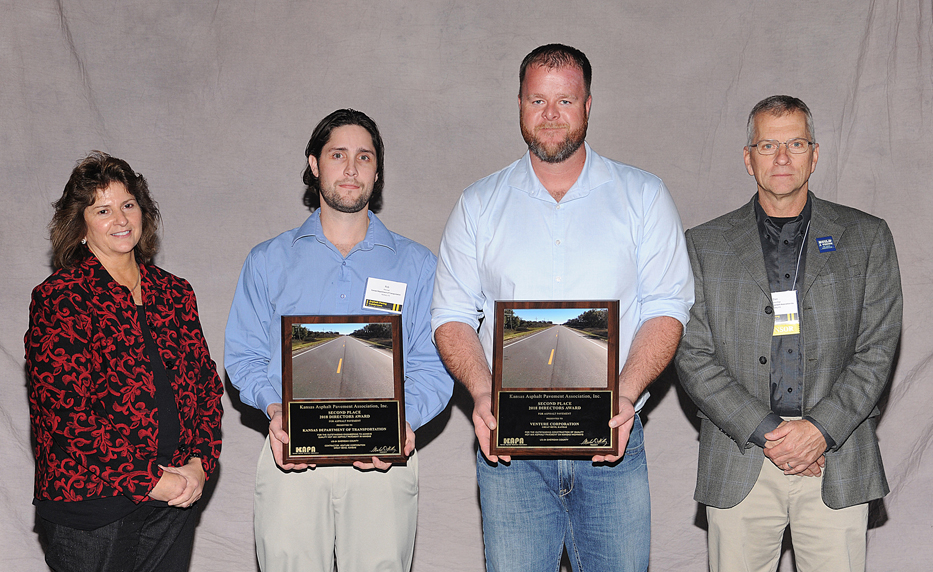
KDOT projects honored by KAPA


The 2018 Workmanship and Engineering Awards for the Kansas Asphalt Pavement Association (KAPA) took place on Dec. 6 in Lawrence. KDOT projects were honored in several categories.
State Transportation Engineer Catherine Patrick and Dan Scherschligt, KAPA Executive Director, presented the awards and are pictured with all the winners.


Overlay less than one-inch award -  

Second place was awarded to Cornejo & Sons of Wichita for U.S. 50 in Reno County. Philip Wait, Tanner Moravek and Jeremiah Booth accepted the award for Cornejo. Scott Koopman accepted the award for KDOT.

 
First Place goes to APAC Kansas Inc. Shears Division, Hays Branch in Hays, Kansas for K-96 in Wichita and Scott counties. Doug Werth accepted the award for APAC Hays Branch, and Craig Schlott accepted the award for KDOT.

Overlay one-inch or greater award - 


Tied for second place was Shilling Construction Company of Manhattan for K-63 in Pottawatomie County. Dustin Patterson accepted the award for Shilling, and Matt Mackeprang accepted the award for KDOT.


First place is awarded to Hall Brothers of Marysville for K-15 in Washington County. Greg Rietcheck accepted the award for KDOT, and Randy Laflen, Michael Teter and Andrew Grable accepted the award for Hall Brothers. 

 
Director’s Award - 

Second place is awarded to Venture Corporation of Great Bend for U.S. 24 in Sheridan County. Rob Percival accepted the award for KDOT and Matt Fitzsimmons accepted the award for Venture.

 
First place is awarded to APAC Kansas Inc. Shears Division, Hutchinson Branch of Hutchinson for U.S. 69 in Linn County. Preston Barkdoll accepted the Directors award for APAC and Troy Howard accepted the award for KDOT.


Thursday, December 6, 2018

Kansas highways win national awards

 This award winning section of  U.S. 160 extends from the U.S. 160/U.S. 54 junction in Meade County to the U.S. 160/U.S. 283 junction in Clark county


Kansas highways continue to win national recognition. APAC Shears of Hutchinson has 
received three awards from the National Asphalt Pavement Association (NAPA) for projects in Kansas.

The APAC Hays Branch was awarded the Larry H. Lemon Quality in Construction Award for a mill and overlay project on U.S. 160 that extends from the U.S. 160/U.S. 54 junction in Meade County to the U.S. 160/U.S. 283 junction in Clark county. The award recognizes asphalt pavements that use less than 50,000 tons of asphalt in the project.

The $1.4 million project was 17 miles in length and completed in June.

“We are proud of the great work our contractors do for the state of Kansas,” said Catherine Patrick, State Transportation Engineer for the Kansas Department of Transportation (KDOT).

Award-winning section of U.S. 50 in Harvey County
The APAC Heavy Highway Branch of Hutchinson received two awards - one for U.S. 50 in Harvey County in the category of projects with 50,000 tons or less asphalt, and one for U.S. 69 in Linn County in the category of projects of 50,000 tons or more asphalt.

“A Kansas asphalt contractor achieving this award is testimony of the high-quality work performed by our producer members,” said Dan Scherschligt, Executive Director of the Kansas Asphalt Pavement Association.

An in-progress photo of U.S. 69 in Linn County, which won an award from the National Asphalt Pavement Association. 

According to APAC Shears, the pavement went through a variety of tests and were compared for volumetric quality and hitting targets for air voids, density and gradation and measurements of quality pavements.    

KDOT’s Director of Operations Larry Thompson said that KDOT and the state of Kansas benefit from contractors who are able to provide quality roads.

Tuesday, December 4, 2018

Don’t ruin the holidays by being a “pedtextrian"


The hustle and bustle of the holidays are upon us and visiting shopping centers, attending parties, discussing holiday gifts with loved ones and even online shopping are a huge part of the season. During this festive time of year, we need to remember one thing – stay alert while traveling.

Whether you text or drive, or text and walk at the same time, both activities are dangerous. The National Safety Council said that distracted walking incidents are on the rise and everyone with a cell phone is at risk of serious injury if they don’t pay attention while walking.

In 2016, 5,987 pedestrians were killed in the United States.  A contributing factor for this rise in fatalities is not paying attention to our surroundings. This is putting our safety, and the safety of others, at risk.

The solution is simple: Stop using phones while walking, even if you aren’t at a crosswalk or intersection. Distracted walking incidents can happen virtually anywhere, even in our own homes or familiar places.

An added hazard to texting while walking is sidewalks that are covered in ice.
Both the NSC and the National Highway Traffic Safety Administration have some great tips to help walk safer and smarter:
  • Don’t use your phone or smart device while walking.  If you aren’t paying attention, you may as well be walking blindfolded.
  • Pay attention to vehicles: look left, then right, and then left again. Vehicles can travel large distances in a short timeframe. Never assume that you can beat a moving automobile.
  • Be bright. Wear light colored clothing.
  • Don’t wear headphones while walking. Like texting and walking, when we wear headphones we are sacrificing a crucial sense: our hearing.  The ability to hear an approaching vehicle can be an important warning sign that traffic is coming toward you.
  • Never rely on a driver to stop, make sure they can see you. A great way to do this is to make eye contact with them. If you aren’t sure they have spotted you, don’t cross until it is safe.
  • If your vision is blocked by another car or object, move to a safer location before crossing.
  • Use crosswalks.
  • Walk in groups.
  • Never allow children younger than 10 to cross the street alone.

The holidays can be a wonderful time of year for many, and although our minds may be filled with presents, holiday treats, family and candy canes; if we use these tips the holidays could be jollier for everyone.

Monday, December 3, 2018

Shedding some light on driving in the dark


By Priscilla Petersen, Public Affairs Manager for Southeast Kansas

It happens every winter: mornings have less sunlight and darkness comes on much more quickly in the late afternoon. Going home from work or school on a weekday, drivers can view the low-hanging sun slipping below the horizon. The winter solstice will occur Dec. 21, ushering in the shortest day of the year — and the longest night.

Darkness can affect a driver’s depth perception, color perception and peripheral vision. On top of those problems, staring into oncoming headlights can even cause temporary blindness. According to the National Safety Council (NSC), the risk of fatal crashes triples at night. The NSC recommends that drivers take the following steps to better cope with driving in the dark:

  • Properly align your vehicle’s headlights and check to make sure they are clean.
  • Dim your dashboard lights
  • Look away from oncoming lights
  • Make sure you are wearing anti-reflective glasses.
  • Check to make sure that your windshield is clean and free of streaks.
  • Slow down! Your visibility is limited to approximately 500 feet with high-beam headlights and 250 feet with normal beams.


Always run your headlights in the early morning and early evening, even if there is some light in the sky. Your vehicle is equipped with headlights not only to help you see the roadway, but to help other drivers see you.

Don’t trail others too closely; increase your distance whenever its dark out. Make sure your bright beams aren’t on when you are following traffic or encountering oncoming vehicles — turn them to low beams. If you are in an urban area watch out for pedestrians, especially around school zones, as darkness reduces their visibility. As always, put away your phones and avoid other distractions.

Finally, during this holiday season do not drink and drive. Please remain vigilant and keep an eye out for others who might be driving impaired. Use extra caution to help yourself and fellow drivers get home safely to snuggle in during the man remaining deep, dark winter evenings.

Thursday, November 29, 2018

Car seat installation class could help save lives


By Lisa Knoll, Public Affairs Manager for southwest Kansas

Child passenger safety technician students use
their training to properly install car seats.  
According to Safe Kids Worldwide, more than 2,600 children under the age of 13 are involved in a car crash daily.  That’s one child every 33 seconds.  While most families put kids in car seats, the latest research from the National Highway Traffic Safety Administration (NHTSA) shows 59 percent of car seats are not installed correctly.  As the District Six Public Affairs Manager for KDOT, I am all too familiar with the statistics.  In addition, I live in a county with a child safety belt usage rate of 81 percent, which is well below the state’s average of 90 percent. 

Remembering the confusion and frustration I felt installing and adjusting my daughter’s car seat, I enrolled in a three-day CPS technician certification class to make a difference in the lives of children and families in southwest Kansas.

My class included professionals from health care, EMS, police departments, KDOT and private individuals.  Our instructors were career law enforcement officers with more than 30 years of experience installing car seats and certifying technicians.  We all had one thing in common — a desire to make our communities safer for the children and families we serve.     
The first two-and-a-half days were intense — we discussed injury prevention, crash dynamics and seat belt systems. We also learned about car seats and studied car seat and vehicle manuals.  Our class completed several practice scenarios given a child’s age, height, weight and special needs.  We picked out the correct car seat and installed it in a vehicle multiple times. The class was also given five different car seat installations, we identified what was incorrect about each installation. 

Child passenger safety technician students use 
their training to properly install car seats.  
By lunch on the third day, we were ready for the final test. We hosted a car seat check lane at the Kansas Highway Patrol parking lot in Garden City.  Our instructors warned us that car seat installation was a bit of puzzle, and you never knew what to expect.  They were right.  Three cars, three seats and three children were part of the challenge, and each of them had unique scenarios.   

The first installation was basic and straight forward.  A mother-to-be arrived with an infant seat still in the box.  She was going to be induced that night, so the check lane came at the perfect time for her.  Two of my classmates showed her how to correctly install the seat and check the installation for future reference.

The second car’s occupants were an older gentleman and a preschool-age child who was in a forward-facing booster seat.  Three of our classmates greeted them and noticed right away that the seat was not correctly installed.  My classmates attached and tightened the top rear tether of the car seat, which reduces the risk of head injury in a crash.  They explained this to the caregiver so that he could correctly install the seat in the future.   
Inside the third car was a mom and an infant.  The rear-facing seat was already installed in the mother’s car, she just wanted us to check it.  My classmates noticed the level on the seat’s reading was off, which meant the seat was not positioned correctly.  They removed the seat and tried to install it again, but the seat belt didn’t lock in place like it was supposed to. 

Child passenger technician student reads
a car's manual to better understand how to
properly install a car seat for that vehicle. 
On closer inspection, they found that both seat belts in the back seat were faulty and would not lock the seat in place, which could put the infant in danger if there was a crash.  The only option was to install the seat using the vehicle’s LATCH system in the center back seat.  With the seat installed in the correct position according to the seat’s level, they realized the seat was in an almost upright position which was not safe for the infant.  When it was determined the level must not be working, the instructors were called over. After it was decided that the level was indeed faulty, another seat was provided and my classmates helped the mother correctly install.

It was a dizzying three days filled with information, demonstrations and practice.  In the end, thanks to our instructors, we have 10 newly certified Child Passenger Safety Technicians in southwest Kansas ready to assist parents.

If you are interested in learning more about child passenger safety or becoming a certified technician, visit https://www.ktsro.org/child-passenger-safety.

Wednesday, November 28, 2018

Just another day at the office: KDOT crews save lives

KDOT Highway Maintenance Supervisor, Clyde Thrush helped save the day for one critically ill patient during the weekend snow storm. 

A major storm hit most of Kansas on Nov. 25, and the hard work of numerous KDOT employees across the state to clear the highways did not go unnoticed. Two examples of these efforts include employees from north central Kansas.

For Clyde Thrush, Highway Maintenance Supervisor in Minneapolis, snow removal and treating the roads for ice is just part of the job. But that day, it meant helping to get a critically ill patient the urgent medical care they needed. 

Jim Frye, KDOT Field Maintenance Manager, was contacted by Concordia Hospital and was told they had an emergency patient who needed to get to Salina Regional Hospital as quickly as possible. They asked for a snow plow to lead the way down U.S. 81. Frye contacted Thrush who happened to be at the junction of U.S. 81 and U.S. 24 at the time and was more than happy to assist. 

“We do what we can here at KDOT to help the public,” said Thrush.
According to a thank you note written by Brandon Bennett of Concordia Fire Department, he said the employee driving the snow plow (Clyde Thrush) went above and beyond the call of duty that day. 

“While en route, we got a call from dispatch that there was a snow plow truck trying to catch up to us to lay salt in our path,” Bennett said. “Mind you, Highway 81 this evening was a sheet of ice, and we were barely able to maintain 25 mph without our ambulance starting to slide. 

 “So eventually the snow plow caught up to us about 15 miles south of Concordia and we fell in behind him as he layed salt. This plow driver stayed in front of us all the way to Salina. Not only that, but he even got off the freeway and ensured our path was clear on the side streets up until we pulled into the hospital with our patient.”


Cody Deneault, Equipment Operator from Belleville, also helped people who were stuck in a snow drift. 

For Cody Deneault, Equipment Operator in Belleville, helping the public meant getting out to help a person whose vehicle was stuck in a snow drift. According to an email sent to KDOT, Deneault pulled over to assist the motorist dig underneath the car and then helped to push the car out of the snow drift. 


A special thanks to all the KDOT employees working around the clock to clear the highways during this blizzard.