Chilly weather is setting in and the thought of waking up to drive in a frigid vehicle before work can leave many feeling cold.
Before you turn that key, be aware of your surroundings. If you are in an enclosed place with no air circulation you could be putting yourself at risk from carbon monoxide gas exposure.
Also known as “the silent killer” carbon monoxide (or CO) is a colorless, odorless gas that can be dangerous if precautions are not taken to avoid poisoning. According to the Centers for Disease Control and Prevention (CDC), an average of 400 Americans die from unintentional CO poisoning a year. In that same time frame, more than 20,000 visit emergency rooms and 4,000 are hospitalized.
Symptoms from CO poisoning can be easily confused with the flu. The most common symptoms include: headache, dizziness, weakness, upset stomach, chest pain, confusion and vomiting.
Here are some ways you can prevent CO exposure while you are operating or inside a vehicle:
Most drivers understand that starting your car in an enclosed garage is not a good idea. But starting a car with a garage attached to your home could put you in danger as well.
Similarly, once you start your car back out immediately and close the garage door.
Be sure to have your exhaust system checked by a mechanic every year. A small leak in the system could cause CO to build up in your car.
Clear the tailpipe of any ice or snow during inclement weather. If the exhaust pipe is blocked, CO could build up in your car as well.
Keyless ignition vehicles are growing in popularity. They should always be checked to make sure they are turned off. The car could still be running, even if the keys are not inside.
Keep the doors locked, and keep children away from the keys. Never leave a child unattended where they could have access to the car and never leave them inside a car alone.
It is a busy time of year, and mistakes do happen. It is a good idea to purchase a carbon monoxide detector for you home just in case. Most injuries and deaths occur while the victims are sleeping.
For more information on how to prevent CO poisoning in your home or work check out the CDC’s safety guidelines here.
Part of a Kansas Highway Patrol trooper’s job
is notifying next of kin when a person dies in a car crash. One trooper
remembers a mother collapse in a doorway. Another caught a mother crumpling to
the floor. This is the final story in the four-part series involving KHP death notifications.
Watch Trooper Wright's video and read the story below.
‘They
know why you’re there’
Technical Trooper Nick Wright
Technical
Trooper Nick Wright recalls a crash where a 17-year-old had been killed because a
16-year-old crossed into his lane and struck him head-on just before he was to
exit. She was allegedly speeding and texting.
It
was Wright’s first death notification in which he was the lead investigator.
What Wright remembers most is the follow-up investigation a day or two later at
a home where some of the 17-year-old’s family had gathered. Maybe 15 people
joined around a dining room table – all of their eyes on him. He remembers the
father saying he couldn’t sleep. The father was obsessed about how the girl
came to be where she was when she lost control. Wright recalls them being a
loving, forgiving family.
Now,
every time Wright drives past the cross put up near where the two cars collided
– it’s a neatly weeded roadside memorial, “I think about it,” he said.
In
another crash, a young man had become intoxicated and was found in his wrecked
SUV at the bottom of a steep embankment. After he died, Wright and his patrol
partner pulled up outside the mother’s home. She was standing at the screen
door. When she saw the troopers, she collapsed to her knees. “They know why
you’re there,” he said of those moments.
He
introduces himself the same way every time: “Hey, I’m Trooper Wright. Can I
come inside?”
With
the grieving mother, he remembers getting her tissue from the kitchen and maybe
a glass of water. Still, years later, he can see her home. “I could almost draw
the inside of her house.”
He
was relieved when a chaplain showed up to help comfort her. He explains that
when giving death notifications, he and another trooper go in as a pair. “We
kind of pick who’s saying the words before we go there.” He’s been with the KHP
for 16 years now. So he feels like he should offer to say “the words” to the
loved ones if he’s with a less experienced trooper. It’s part of his
personality, he said. He’s a greeter at church. “I’m kind of a people person.”
About
“the words”: “You cut straight to the chase,” he said. If he’s notifying a
young woman that her father has died in a crash, for example, he’ll say it as
clearly and clinically as possible: “I’m really sorry to tell you, but your
dad’s been killed in a crash.”
The
reactions vary. Some loved ones pass out, some fall, some sob, some deny it,
some get angry. Anything can happen.
“You learn to talk to people,” he said. “You
are greatly affecting these people’s lives.”
He
remembers hugging a family before he left. Most people in law enforcement, he
noted, don’t hug on the job. Still, he said, “You can’t be robotic. You just
have to be a person to them. You are delivering the worst news to this person.
There’s no good way you can do it. … I remember choking back tears.”
Five
years ago, I wrote an article about my personal experience with roadway safety
after others heard my story about surviving a car-bicycle crash I was involved
in. That story detailed what had occurred on a late evening ride in May
2014 when my wife and I were struck from behind by an inattentive
motorist. Fortunately, we both survived that incident, although there were
lingering effects from our injuries for some time after that unfortunate event
(read 2016 story here).
Now
I’m sharing an update to my current status as an avid cyclist, what experiences
I have had and what changes I may have made since this accident.
I
suppose as a natural progression of my cycling activities, I have become
involved with other types of events, as well as becoming more involved with
group rides. Many may be aware that the gravel riding scene has grown
rapidly, and I too have become more active in these types of rides. Of
course, there is typically much less traffic on gravel roads than on paved
roadways, so naturally less chance for conflicts with motorized
traffic. The lower speeds vehicles travel on unpaved roads also gives more
time for both drivers and cyclists to react to each other’s presence.
I
have also discovered a great group of fellow cyclists to ride with on shorter
evening rides and longer weekend events. Travelling in a larger group
makes all of us more visible than we would be on solo rides, and vehicular
traffic seems to be more conscious of passing our larger groups more
cautiously.
There
are also more options these days for locations to ride that are not on major
roadways. The City of Wichita and the surrounding areas have a pretty decent
network of both paved and unpaved riding trails that cyclists can utilize where
we do not have to be as cognizant of other road users.
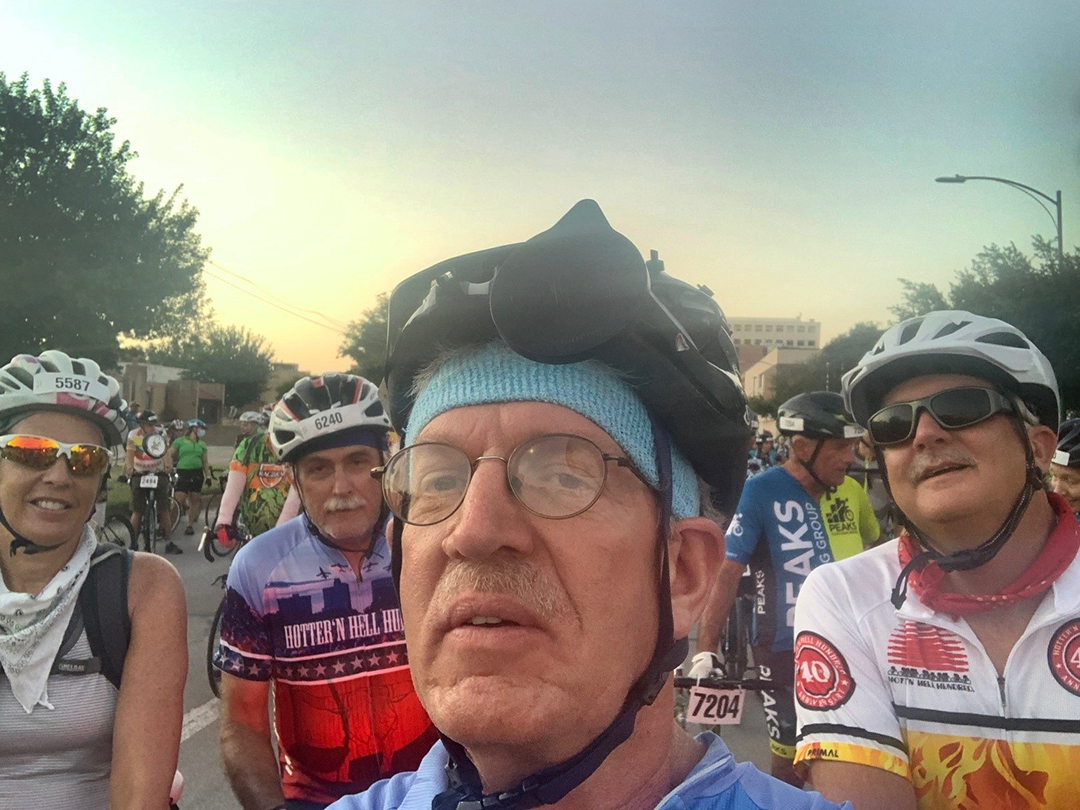
I
still do some paved road cycling where I am riding in the same type of environment
where I had my accident seven years ago, but I make every effort to be aware of
vehicles on the same roads I am on. I have used a rear-view mirror that is
attached to my helmet for many years so I can see what is approaching from
behind. I also choose not to have any audio devices playing while I ride so I
am more aware of the sounds of others on the roadway.
So,
in conclusion, I did not let the accident I was involved with take away what
has become my favorite pastime, and of course I was very blessed that my
injuries did not create permanent debilitating physical issues. Cycling
will always be part of my lifestyle as long as I am physically able to ride,
and the lessons I have learned while riding have made me more safety conscious
so I can continue these activities.
Motorists
and cyclists both have to share the same roadways to get to our destinations,
and we all need to be aware of others on our journeys and show the same level
of respect we want for ourselves.
In July 2017, my husband, Marvin, was taking our three-year-old
grandson, Macen, to daycare for the afternoon. It was a rainy day, around noon,
on a Topeka city street when a ¾-ton pickup truck lost control on a curve and
slammed into my husband’s car.
Our grandson was in his car seat on the opposite side of
the car where the majority of the impact occurred. Even though my husband had
severe injuries, our grandson remained safely in the car seat with minor cuts
from the seat belt and from glass.
They transported him in the ambulance with my husband.
Emergency personnel took our grandson in the fully intact car seat in the
ambulance to the local hospital.He was
checked out and released that same day.
I firmly believe the car seat saved Macen from more severe
injuries. My husband was also able to focus on talking to Macen in the car
until others were there to help get them out.
Properly installed and used car seats for children save
lives. I truly believe this. Macen is proof of that and thriving as a seven-year-old
boy now.
Casey Simoneau (third from right), with his family
It was an unexpected call when asked to do a follow-up to
the blog that I wrote nine years ago. Many lives have been changed since that
time, including my own. I no longer work for the Kansas Highway Patrol, but I am
running my own business and serving as Mayor of Baldwin City. However, past
experiences always stay and impact your future decisions, and my work for the
Kansas Highway Patrol is no exception to the rule.
As my life may have taken on a new direction, the memories
from my time in law enforcement still impact me even more now than before. When
I wrote the previous story, I had one child. But now I have three children and one
on the way. I still find myself driving the same highways I once patrolled and
continue to be reminded of the fatalities I had worked in those specific areas.
I use those moments to explain to my children the importance of good
decisions.
Each person has decisions to make, and sometime those
decisions have a positive or negative impact on another person in our
communities. Unfortunately, often times the decision to drive while impaired,
with alcohol or drugs, have a more immediate impact on families, friends and
communities. Those decisions lead to memories and pain that is never
forgotten.
I still drive K-10 and see the cable barriers that were
installed after a traffic accident that I worked involving young children. I
often tell the story of a sibling of the deceased child. I remember her sitting
on my lap on the days following the accident and giving her a Trooper Bear.
Those memories do not leave me.
A community came together and mourned the loss of the child
and rallied around the family to create change so that it did not happen to
another family. Cable barriers were installed shortly after to help lessen the
opportunity of that type of event occurring again.TOGETHER this community helped to save lives.
This is the most profound memory of all the fatalities that
I worked. I often find myself thinking about what could have been. The sister
would be nearing her teenage years now and all she has is a distant memory of
her brother. She will never have the same experiences as others. She will not
remember fighting with her brother, celebrating with her brother or snuggling
her brother. A community lost the opportunity to see a child grow. All these
lives changed over a person’s bad decision. Often poor decisions can be made
right, but this one can never be undone.
Please think before you drive as you do not know the
negative impacts of your decision to your family, friends and community. It may
be a decision that cannot be made right and can leave many lives changed
forever.
On May 5, 2019, Randall left the house early to go to work
and he never made it home. Randall was a husband, stay-at-home dad, runner,
builder, and friend to all. When he kissed me, said goodbye, and walked out of
the house that morning, he was in the prime of his life. At 33 years old, he
had a beautiful two-year-old daughter who adored him and a spunky almost one-year-old
son who had barely had a chance to do the fun father/son activities that every
dad looks forward to. Randall and I were excitedly preparing to find out the
gender of our third and final baby, renovating our home, and accomplishing the
goals we had been dreaming of during our nine years of marriage.
Randall worked that morning at the Tri-Zou triathlon event
in Columbia, Missouri. He had set up the racecourse, worked on the race staff
throughout the event, and was picking up cones after it was finished. He worked
for the race company, UltraMax, for a few years and their team always worked
with care to make their racecourses safe for both the runners and the staff.
They were professionals in their field. But no amount of safety precautions can
protect you from the reckless choices of others.
In an intersection marked with race cones, an unlicensed,
uninsured driver was going 10 miles per hour over the speed limit while on a
video call, before she looked up to see the police escort that was blocking
traffic behind Randall and his team. To avoid crashing into the police car, she
swerved around it, never even noticing the cones or the workers who were in
front of it.
When she hit Randall, throwing him 100 feet through the
air, he broke his pelvis and ribs, and suffered a severe trauma to his head.
Randall spent the next seven months in multiple hospitals, ICU’s, and rehab
facilities and passed away on November 18, just two weeks after his 34th
birthday. He missed his son’s first birthday, the birth of his third daughter,
and countless other events he had been looking forward to.
The news articles all call it a tragic accident, but this
was no accident. Accidents happen regardless of careful planning and attention.
The unnecessary and senseless wreck that took his life was the direct result of
choice. The woman who hit him chose to break multiple laws that day. She chose
to get behind the wheel of a car despite knowing it was not lawful to do so.
She chose to be reckless in her haste to get where she was going. She chose to
prioritize her phone conversation over the safety of herself and others.
Those choices were intentional and not by accident, making
Randall’s death a choice someone made as well. The choices made behind the
wheel of a car may seem insignificant at the time, but every moment and every
choice have the potential to change lives forever. Randall, our children,
myself and even the driver who will spend her next five years in prison, all
suffered life altering consequences that day because of distracted and
irresponsible driving.
CLICK HERE for a video narrated by Adrienne and Sgt. Andrew Perkins about the crash.