Working in the field for KDOT can be a rewarding but dangerous career. KDOT
workers face oncoming traffic, impatient and unsafe drivers, extreme weather
conditions and many other hazards while maintaining our roads and
infrastructure so communities can thrive.
It is time to recognize those hardworking individuals who risk their lives to
keep Kansas moving.
This semi-regular illustration project, titled #IAMKDOT, is intended to
highlight and bring awareness to the incredible work that KDOT employees do for
our state.
These #IAMKDOT illustrations will be posted to our blog and other social media
to remind everyone that these hardworking men and women aren’t robots. They
aren’t slowing down traffic to irritate or inconvenience. They are working hard
to ensure that our way of life is maintained and improved upon. It is our hope
that #IAMKDOT illustrations will encourage the public to slow down, and treat KDOT
employees with more respect and patience.
Featured today is Cole Peterson. He has worked with the District 3 Bridge Crew for four years. Peterson, 24 years old, said that he enjoys watching the Kansas City Chiefs and the Kansas City Royals. He also enjoys working on vehicles.
In this illustration, Peterson is getting ready to take the giant snowplow, Big Bertha out to clean up snow and ice from the February snowstorm that impacted much of the state earlier this year.
It can be the most frustrating part of owning and driving a
car: Rush Hour Traffic. So much of our lives are wasted moving at a snail’s
pace. Wouldn’t it be great if something positive could come from all that time
and energy wasted?
For citizens in California, that time and energy will be put
to good use. Drivers are about to make a huge difference in the way energy will
be created and stored and they don’t even have to leave their cars.
According to an article on Care2.com, The California Energy Commissions (CEC)
has paved the way for a pilot program to use piezoelectric crystals embedded into sensors to be
installed on freeways.
What is a piezoelectric sensor? Well it has nothing to do with that cherry pie
you might be craving. A piezoelectric sensor is a material about the size of a
watch battery. When pressure or vibrations are applied to it creates an
electrical current that can be harnessed and fed onto the energy grid.
Multiply the power of piezoelectric sensors by the tens of thousands of
cars and hundreds of sq. miles of sensors embedded into the freeway, and power could be provided to entire cities.
This type of technology isn’t exactly new. Many countries are already
harnessing this technology. Care2.com says that the East Japan Railway Company
Tokyo Station has been using the power of pedestrians as they walk over floors
made up of piezoelectric sensors since 2009. Israel is also using this
technology on some of their highways and Italy is not far behind.
Maybe at some point we will all be doing the
“Piezoelectric
Slide” on our roads.
Tell us what you think! Would you like to see this technology installed on our
state roads someday?
Check out this animation for a simplified example of how this process works:
The future may be delivered quicker than we thought.
According to an article on governing.com,
Starship Technologies, a British company will be testing a robotic delivery
system in select residential neighborhoods in Washington D.C. this fall.
Starship Technologies’ website says that robotic delivery started its testing
phase late last fall. And it began hitting the sidewalks in London earlier this
spring. The 6-wheeled intelligent robots may look like a glorified water cooler,
but they have the power to make deliveries, faster and on time, the company
claims.
Relying on computer vision, these robots could deliver groceries, takeout or
packages straight to your door without the help of humans. (Unless it gets
stuck, then an operator can come to its aide remotely.) It can then be opened
with a code sent directly to the person receiving the goods.
“The delivery
robots each have six wheels, weigh about 40 pounds and have nine cameras to
help them navigate city neighborhoods. They are designed to travel mostly on
sidewalks, although they can negotiate small curbs.” Governing.com says.
Although it may be a little while before robots make deliveries in every city.
This poses an interesting question:
How will robots affect the future of
delivery services?
Tell us what you think! Would you like to have your pizza
delivered by robot?
To see more of these cool robots in action, check out the
video below.
Joseph
Francis “Buster” Keaton was born in Piqua in 1895 when his family was
performing in the area with magician Harry Houdini and his mother happened to
go into labor. In 1917 in New York City, Buster met Roscoe “Fatty” Arbuckle, a
famous comic actor at the time and Buster showed him the ropes for the movie
industry. He moved to Hollywood and became an actor, writer and director.
In
1992, the nearby community of Iola started an annual event devoted to Keaton,
and people started donating memorabilia; thus was the beginning of the Buster
Keaton Museum. The Piqua Rural Water District #1 office in Piqua houses the
collection with many donations from Keaton’s widow, Eleanor. The collection includes movie posters, articles
and many photographs. The museum also has a small collection of his movies that
can be played.
The
annual Buster Keaton Celebration in Iola is scheduled this fall on Sept. 23-24.
For
more information on the Iola celebration, click here.
For
more information on the museum in Piqua, click here.
What a difference five months can make: The first photo fades into the second photo, contrasting what areas in South-Central Kansas looked like just days after the Anderson Creek Fire and what the landscape looks like today.
It could be described as a nightmare. On March 23 and 24,
Kansans living in the south-central part of the state watched as the largest
wildfire in Kansas history overtook homes, structures and livestock. Over
400,000 acres burned.
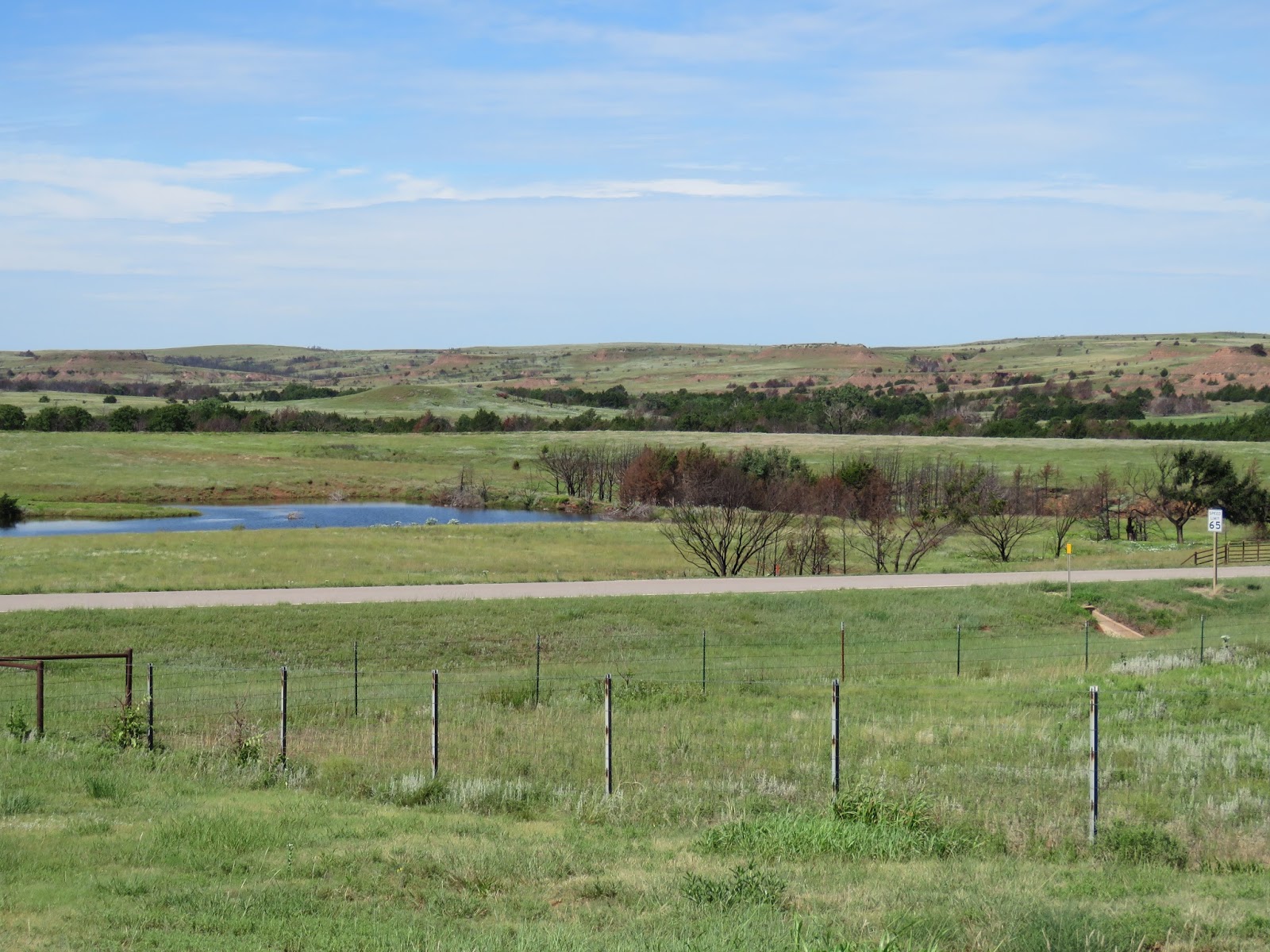
Just days after the wild fire burned over 400,000 acres of land the, the landscape is charred and lifeless.
“The area looked like a desert wasteland,” Jerry Baker, a Kansas
Department of Transportation sub area supervisor from Medicine Lodge described what
was left in the blaze’s wake. “The aftermath view of the area was depressing.”
During the fire, KDOT crews were essential to containing the
fire. They assisted emergency officials by directing traffic, closing roads
when needed and they even provided water for the fire department using their
2,000 gallon brine tanks.
“Several times we were pretty close to the fire due to its erratic behavior
while we were providing water and where we were placed for traffic control.”
Baker said. “We set up traffic control where the fire chief wanted us at Aetna
Road then he had us move back to Lake City Road [and] when that got too close I
pulled us back to the U.S 281/U.S. 160 Junction to better control traffic and
safety reasons.”
Baker said that he felt a wide range of emotions as he watched the prairie burn.
“Feelings about the fire ranged from awe to fear at times,
sadness thinking about all of the losses to property, livestock and wildlife
then by the time it was over, exhaustion [there
weren’t] that many of us and we had to pull some long shifts.”
After the fire, infrastructure needed some serious repairs.
KDOT employees worked quickly, and within 10 days 331
guard fence posts and five signs were removed and replaced.
KDOT also assisted with the recovery efforts in the area by
repairing important infrastructure and cleaning up debris.
“Besides replacing and repairing our signs and
guardrails, we worked with several landowners removing dead, burnt trees;
cleaning ditches and repairing washes, which helped them with their fence
removal and repairs.” Baker said.
Over the course of five months, the weather has brought
regrowth to the fire-stricken land. Where there was once a large, black scar
there is now fresh, green prairie.
KDOT U.S. 160 Guard Post Project Team from the Coldwater and Medicine Lodge Subarea offices and the Pratt
Area were selected as the Example of Excellence on August 9th.
Earlier this month, the U.S. 160 Guard Post Project Team
from District Five was selected as the Example of Excellence for the second
quarter of 2016 because of their efforts during the fire. They replaced 331
guard fence posts and five signs that were destroyed.
“All in all I’m very proud of my crew and all of the other crews that helped us during the fire and with all of the repairs afterwards. They are a good group of hard working people,” Baker said. “Another thing that was amazing to witness was all of the fire departments from all over that came to help.”
South-Central Kansas five months after the Anderson Creek Wildfires.
South-Central Kansas five months after the Anderson Creek Wildfires.
South-Central Kansas five months after the Anderson Creek Wildfires.
To see drone footage of the wildfire check out this video from Kiowa County Media:
As a driver you might think of the rumble strips noisy feature of the highway, but to KDOT they are are
an effective countermeasure for reducing roadway departure crashes. The noise
and vibration produced by rumble strips alert drivers when they leave the highway. Rumble stripes is the term used for rumble strips painted with a
retroreflective coating to increase the visibility of the pavement edge at
night and during inclement weather conditions.
Research from the Federal Highway Administration shows that installing rumble strips can reduce severe crashes.
KDOT uses all types of shoulder rumble
strips, depending on the need and the material. The groove pattern can be
installed intermittently or continuously. The groove pattern, depth, width,
shape, and spacing may also change with the road agency. Milled rumble strips are made by a
machine with a rotary cutting head, which creates a smooth, uniform, and
consistent groove into the pavement.
Different dimensions of milled rumble strips provide different amounts of sound and vibration in a passenger car. The wider and deeper the rumble strip, the more sound and vibration. Cars and trucks make different sounds while driving over the strip. It's important for KDOT to inspect the quality and construction of the rumble strips in order to create right amount of vibration and noise to do what they are intended to do, alert drivers to the fact they are no longer on the roadway.
The Pawnee Indian Museum State Historic Site
is an archaeological site and museum located near the city of Republic. At the
site are the remains of a village once occupied in the late 1700s and early
1800s by the Kitkehahki, or Republican, band of the Pawnee tribe.
To protect the site, the land was purchased
in 1875 and then donated in 1901 to the state of Kansas for historic
preservation. Research at that time showed that Zebulon Pike led an expedition
to this site in 1806, seeking allies after the Louisiana Purchase in 1803. Pike
supposedly persuaded the Indians to take down a Spanish flag and replace it
with a U.S. flag.
A granite monument commemorating the flag
incident was dedicated in 1901. Years later it was discovered that Pike
actually visited a Kitkehahki village in south central Nebraska. The effort was
a fortunate one though; this site was preserved whereas the Nebraska site was
not.