Thursday, July 29, 2021

Hot job summer: The asphalt pavement process


By Tim Potter, 
District Five Public Affairs Manager 

Imagine this: You’re under a blinding sun along U.S. 50 near the town of Walton, and the combined heat and humidity makes it feel like around 106 degrees. It’s suffocatingly hot, the kind of conditions that trigger a heat advisory.

Not just that: You’re laying down asphalt cooking at around 250 degrees when you first apply it. The stiff south wind feels like more of a blast furnace than a cooling breeze. You’ve worked through lunch because overlaying a side road at a highway is one of those jobs where it’s not real practical to take a normal 30-minute break. The equipment has been strategically positioned, and the different tasks involved must click right along. The asphalt -- and the process for applying, shaping and finishing it -- is demanding, unforgiving.

That is what it was like for a combined team of crew members – from the Newton Subarea, District Special Crew and El Dorado Area and El Dorado Subarea -- the afternoon of July 28. If you had to visit one of the hottest KDOT jobs on an extra sweltering day, this was it. They had been overlaying side roads for almost two weeks.

Sweat beads covered the reddened face of Bobby Jones that afternoon as he matter-of-factly explained the work being done and the reality of enduring merciless weather.

“The hotter it is, the nicer it lays,” Jones said of the asphalt. “You have to work it while the asphalt’s hot.” The Newton Subarea Supervisor watched a massive roller compact the new surface. Even though they had paving machines, some of the finishing and clean-up tasks must be done by hand, by bending over a shovel and pushing and lifting.

Through it all, “You have to drink lots of fluids; otherwise, you’ll be laid out on top of the asphalt,” Jones said. “If you don’t keep hydrating, this heat will take it right out of you in a heartbeat.”

Everyone had a different role in the overlay job, and part of it was paying attention to their co-workers – operators making sure they didn’t drive over someone, everyone staying aware of the semis barreling past only feet away, everyone making sure that the next person wasn’t overcome by the heat.

“This is a team effort,” Jones said. “We all have to watch out for each other.”


Tuesday, July 27, 2021

Did you ever wonder? How do KDOT crews stay cool?

Four KDOT crew members spread black asphalt on a road with equipment
On June 15, workers from Wellington and Hutchinson crews repaired a spot on U.S. 81 between South Haven and Caldwell. The job included a milling and overlay

For days in advance, the National Weather Service sent alerts warning people to prepare for a dangerous combination of heat and humidity on Thursday, June 10. And, of course, there have been and will be other days like that during the rest of the summer.So on a dangerously hot day, how do KDOT employees who have to work in the elements deal with the heat hazards? A common theme was - prevention is crucial. Here is what they shared about coping with the heat and humidity on June 10: 

Dennis Senters, Beloit Subarea Supervisor, District Two: “I made sure they (his crew) had their water with them” – meaning extra water. “You could tell it was the first big heat of the year,” Senters said. “And it was hard on ‘em. When they came in, their tongues were hanging out. I tell them: When you need a break, you take a break.” He also reminds his crew that some people can endure heat better than others, and not to assume that because you feel OK, your co-worker does as well. “We got a great crew in Beloit. We keep a close eye on each other.” 

Daryl Dougherty, Engineering Technician, Phillipsburg Construction Office, District Three: His June 10 work schedule centered around inspecting a grading project north of Osborne on U.S. 24/281. Even with a breeze, at 2:24 p.m. the temperature where he was working was 94 degrees. But the “real feel,” factoring in the humidity, was 103 degrees, Dougherty noted. He had been in the heat for about six hours at that point, but he was making sure he stayed hydrated. “Every time I go back to the pickup, I make sure I drink a glass of water.”

Burke Koehn, Scott City Subarea Supervisor, District Six:
Koehn tried to steer his crew to jobs where they could avoid the heat and sun that day. He noted that his area of southwestern Kansas had been unusually humid after weeks of regular rainfall. “The humidity is definitely something that makes it harder to cope with,” Koehn said.

Mike Lorett, Facilities Specialist, part of the District Five HVAC crew:
“My biggest trick is a spray bottle of water.” He works outside in sweltering conditions so others can stay cool inside. So he sprays his face, head and neck -- sometimes every five minutes. “I spray my beard, and I call that my portable air-conditioning,” he said, laughing. “I’ve got a big ol’ hat, big ol’ brim on it. I don’t care what I look like -- I keep cool. You got to keep cool, and you got to keep hydrated.”

Dan Acridge, Wichita Area Crew Supervisor:
Because of the extreme heat on June 10, Acridge had his crew finish painting stop bars by 2 p.m. “That’s enough -- they’ve been out in the heat all day,” he said. While they worked, he had them take breaks in an air-conditioned truck. “It was really humid this morning, and the humidity burned off a little.” Working directly over pavement intensifies the heat, Acridge noted. “Then, of course, we’re always working in teams so we can keep an eye on each other.”

Remember to slow down and pay attention in work zones and help our crews get their work done so they can make it home to their families. 

Friday, April 30, 2021

Work zone safety takes a team

 
KDOT and contractors are keenly aware of the value of safety on our highway projects. As we have read in previous posts here, there are countless firsthand accounts of accidents and near misses in our work zones across the state. I believe we could greatly reduce these numbers if everyone is committed to being on the same team – KDOT, contractors and the traveling public.

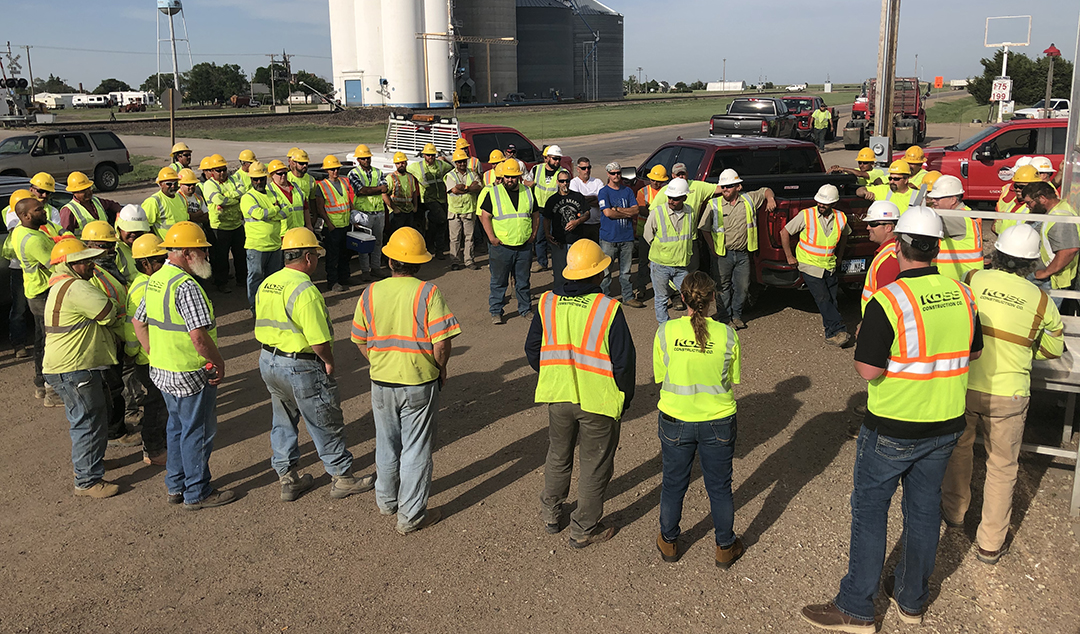
Tim Garhardt and co-workers.
As I was finishing my degree at Kansas State University, I was fortunate to get connected to a summer position with KDOT at the Junction City office. The assignment there was an interstate reconstruction project on I-70 that included almost 10 miles of removal and replacement of the pavement on both lanes in one construction season.  The traffic was detoured head-to-head on one lane, while the other side was reconstructed. A big project with a challenging schedule! It was early on here that I saw firsthand the value of teamwork and the challenges that come with different perspectives and focus.

Often times a contractor finds their primary focus being the project schedule and trying to get ahead, to maintain the plan or sometimes to catch back up to the plan. This is inherent to the nature of a low bid process where the estimated production rates and durations yield the costs that are incorporated in the unit prices and the overall bid strategy. This focus can, and often does, clash with the priorities of the owner’s engineers and inspectors responsible for these projects. This big challenging project on I-70 was one of those that had a clash of priorities. 

When classes started again in the fall, I was again fortunate in having the opportunity to go to work for the contractor on this same project as they moved their project engineer out to oversee the paving operation and I backfilled some of his responsibilities. A view from both sides on the same project.

As I reflect today, this unique opportunity to see a project from both an owner’s view as well as the contractor’s side, was foundational for me in recognizing the value of working together and truly partnering toward a common goal.  At the end of every project is some form of recognition of accomplishment. For many projects we point to the quality, the good ride or the timely completion. I believe the projects that we can be most proud of are the ones that were completed safely. We may have had our disagreements along the way, but in the end, we built the project and we delivered it SAFELY. 

We need another teammate for success on our roadways and reduce the number of accidents and near misses – the traveling public. It is unlikely that we will have the chance to bring this teammate to a project meeting, talk with them face to face or celebrate the project’s success with them. So how do we get them on board? How do we get them to focus on this priority as we do? 

This is where we partner with our efforts to provide a safe work zone every day. KDOT and contractors work together to provide adequate oversight and implementation of the traffic control plan with qualified personnel and quality signs and devices. We work together to make sure that these work zones have adequate reflectivity at night and correct all types of deficiencies in a timely manner.  We work together to provide schedule information, phase changes and traffic impacts to the appropriate partners to get the word out to this third teammate. Through news briefs, social media and other methods, we let the public know what to expect so they can plan accordingly. Then their part is to pay attention in our work zone, put away the distractions and focus on safety as we do. 

Building our projects as a team allows all of us to deliver a project safely.

Tim Gerhardt is President of Koss Construction Co. in Topeka


Thursday, April 29, 2021

The sound that makes highway workers immediately react

Paul Thomas
Hello, my name is Paul Thomas and I have been a state employee now for over 13 years. I started as an Equipment Operator, and I have been the KDOT Safety Specialist in south central Kansas for about two years.   

Work zone safety wasn’t something that I thought much about before working here, but now I know it’s importance. Unfortunately, I had several close calls while working on the highways and I am going tell you about an incident that happened when I first started with KDOT.

That day’s plan was to repair the driving lane that was breaking up on the interstate at an overpass where the concrete and the asphalt met. A crew went out and set up traffic control around the construction location with the crew working in the driving lane. For the most part, traffic was going along nicely, minus a few drivers ignoring the fact that the speed limit had been reduced, which is not uncommon.

On a work zone set-up like we were in, there are not flaggers, so you don’t have those other individuals watching your back. You must rely on your senses and everyone else in the work zone to keep an eye out for each other. There is nothing more eerie than having your back to the traffic in a work zone and feeling the wind off the larger vehicles that come passing through as you are trying to complete your task.

On this particular day, everyone was working and all was going well when we all heard the “sound” – the sound of a traffic cone getting hit by a vehicle. Anyone who has worked in a work zone for any length of time would know that sound as soon as they heard it. So when this sound was heard, it triggered a highway worker to immediately yell for everyone to get out of the way and take cover.

As I was running to safety, I turned to look, only to see a driver had failed to slow down for whatever reason, and due to other traffic was forced to crash through the cones headed for the work zone we were working in. Luckily, no one was hurt because the driver did finally make it back into the directed lane.

But had it not been for that “sound” and the watchful eyes of other employees, things could have had a totally different outcome. This was just one of many close calls that happen out there every day. Most of the time, no one hears about these incidents because fortunately, no one is hurt. But there are times when something serious has happened either to a highway worker, the driver or both.

Hopefully, National Work Zone Awareness Week helps bring to light the kinds of things that can happen in work zones so that everyone is aware of the possible dangers out there on the roads. It is my hope that after stories are shared this week, there is an appreciation for work zone safety, and it becomes important to everyone. In the end, it’s all about saving lives.

Wednesday, April 28, 2021

Scan the area every 3 to 5 seconds


Hi, I am Tim Micek, the Subarea Supervisor at the KDOT Goodland office, and I have worked for KDOT for 21 years now. I have seen several crashes and incidents on the highway. There is one incident that I will never forget.

We were fixing guardrail on I-70. It was the end of the day and we had just finished up and were picking up traffic control.  We were getting close to the end of the taper picking up our cones.  We were using the 36-inch cones with the 6-pound weight at that time. 

The arrow board was still on with its message, directing traffic into the passing lane. I was at the last cone near the arrow board and reached down and picked it up. On my way up, it slipped out of my hand and proceeded to roll out in the driving lane. I bent down quick in hopes to grab it and WHOOSH!! I felt something bump the top of my hat and knock it off my head. 

I looked up and a motorhome WHOOSHED by, running over the cone. It was still in the driving lane and the driver failed to move over. Boy! That day was an eye opener for me and how dangerous it was working on the highway.

Ever since that day, I decided that whenever I am on the highway that I would scan the area every three to five seconds to look for hazards. Had I have scanned the driving lane to see if traffic were there, I would not have had this close call. I had only been working for KDOT for probably less than five years - it sure made me respect the highway.

Since I made the choice to implement the scan method in my everyday life, I have been able to be more proactive and see potential crashes or incidents before they happen and get out of the way of them. I even find myself doing this in parking lots when I’m off of work, and let me tell you, it has saved me several times.

Highway workers, whether KDOT or private contractors, are in a whole new and different environment compared to the average person. I have seen a lot of people (including myself) who get upset at people who do not move over. This may be a legitimate reason to get mad, but I try not to. Think about it for a second. We all know what it feels like to have someone fly by us at 90 mph, but the traveling public has no idea at all. They do not know that when they went by, that they about knocked you off your feet. They are oblivious to it.  We cannot control them. All we can do is control how we react. And if you choose to get upset and mad, that only makes your day more difficult.

If we could put every person traveling the highway at centerline just one day and they could see what we go through, then things may change.  We all know this is impossible to do, so highway workers need to implement ways and follow guidelines of being safe in work zones.

Thank you


Tuesday, April 27, 2021

Phones Down. Eyes on the Road.


Troy Dunnaway
By Troy Dunnaway

I’ve been with the Kansas Turnpike for almost 28 years doing roadway maintenance. I’ve seen my fair share of distracted drivers and had some close calls on the road.

Last summer, I was with my crew picking up cones after a lane closure near mile marker 208 in Lawrence. There wasn’t a lot of traffic at the time, but a good flow of cars passing by. One of my guys was at the back of the truck picking cones up while I kept watch.

A white truck approached us and veered closer to the white line. I slowed down and prepared to honk to get the driver’s attention while my co-worker turned his body away from the road. Suddenly, the driver of the white truck struck my side mirror and completely destroyed it. It all happened in a matter of seconds. If our truck had been any closer to the white line or the white truck crossed the white line by another 6 inches, he would have actually hit the vehicle and could have seriously injured myself or my co-worker.

I couldn’t see the driver’s face, but I could tell he was looking down at something. I’m guessing he was on his phone and not paying attention. What made the situation worse is the driver of the white truck didn’t even stop after the accident. He kept going down the Turnpike and most likely exited a few miles down the road.

We do a lot to prepare drivers to enter a work zone — lots of signage, lights, cones, barrier trucks. It’s frustrating to see people still coming through work zones and reading something on their phone. It takes a quarter of a second to go off the road or cross the white line.

The bottom line is, get off your phone completely when going through a work zone. Pause your call, put your phone down. Any distraction can potentially cause someone injuries. My biggest fear is having to contact an employee’s loved one because there’s been an accident.


Troy Dunnaway is the Structures Foreman for the Kansas Turnpike Authority in Lawrence.


Monday, April 26, 2021

My mistake in a dire situation

Hello, I am Doug Vogel, the District Superintendent in District Four, which covers the
southeast portion of Kansas. I have been the District Superintendent since 1999. Overall, I have had the opportunity to work within District Four for 34 years.

Doug Vogel
While working for KDOT in multiple positions, I have experienced a lot of good and a lot of not-so-good occurrences. In 1997, I was a new Subarea Supervisor in Area Three, which covers Elk, Wilson, Chautauqua and Montgomery counties. That Subarea office sits right off U.S. 75. I remember that particular day was mid-summer, around 5:30 p.m. The crew had already left for the day, and I stayed behind finishing up some paperwork.

As I was getting ready to leave, I heard a loud ‘BOOM,’ to the south of the office. My curiosity led me to hopping into a state pickup to try and find the cause of the noise. About a mile or so into my drive, I start seeing smoke. As I drove closer towards the smoke, I noticed a chair sitting in the southbound lane. Someone was sitting in the seat, still buckled in. 

I drove closer and stopped the truck about 20 yards from the person. I angled the pickup to cover him from traffic view. Nearby, I noticed there was a conversion van, or what was left of it, 50 yards to the west along the fence line. I shifted my eyesight south. There was a semi angled in the ditch. The rest of it was on the shoulder.

As I exited the pickup, I looked up the hill. I saw a car coming towards me from the north. When the car got closer to me, it stopped around 50 yards from my parked pickup. I approached him, and I asked if he could block traffic further down the highway, call 911 and not let anyone through. As he drove off, a second vehicle approached. I asked that vehicle to stop traffic coming from the north. He backed up, and he started blocking traffic as well.

I started walking towards the man in the captain’s chair, sitting in the highway. Unfortunately, he was deceased. I knew I needed more KDOT assistance to secure this site before going to the van. I went around the front of pickup, which was pointing to the centerline of the highway, to get my cell phone from the front seat. I remember looking forward only. A car that was not supposed to be there raced by and the mirror of his car hit my vest as it went by me. My vest slapped my side and left a nice welt, which later turn into a bruise.

I do not think the car ever saw me. If they did see me, they chose to just continue speeding down the highway. I never saw the brake lights lit. If I had taken one more step, my career would have ended a lot sooner.

I always considered myself to be a safe person - one who knows better to look twice when working on the highway. That late afternoon, I made a mistake that could have cost me my life. I let the stress of the situation distract me from being more aware of my surroundings.

No matter how safe you may think you are in a situation, you need to always be alert to your surroundings, no matter how dire a situation might be.