Showing posts with label Flooding. Show all posts

Wednesday, June 12, 2019

Flood patrol: How KDOT crews assist with roads affected by high waters


During heavy rainfall events, with even the slightest chance of flooding, KDOT crews are on the lookout to help keep everyone safe by monitoring the roads in Kansas.

Crews keep a close eye on flood-prone roads and areas of concern and they watch for high water that may come onto the roadway.

“Due to the wet winter and wet spring, this year we put many workers on standby during several storms to monitor the flooding situation at numerous locations,” said James Roudybush, Maintenance Engineer in north central Kansas.

When water is only partially over the roadway and it is safe to drive on another part of the road, KDOT crews flag vehicles around the high water so traffic can continue to flow.  If the water becomes too high for traffic to safely go around or the high water around the road has caused unsafe conditions, the roadway will be closed until it is safe to reopen.

“We set up traffic control and try to ensure traffic doesn’t go past the barricades to keep everyone safe,” said Billy Wilson, Highway Maintenance Supervisor in Strong City.
If you come across an area with water over the roadway that is not being controlled, you should call 9-1-1.  Crews will then determine if the road should be closed until water goes down or if part of the road is safe to drive on.

In order to safely reopen the highway, all debris must be removed that may have floated onto it and the roadway surface and any bridges must be inspected for damage.

“After recent flooding we have had to cut up trees with a chainsaw and remove them from bridges or roadways to prevent damage,” Wilson said.

If there is damage to the roadway or bridge, it may have to be repaired before it can be reopened.

Crews work hard to reopen roads after flooding has occurred. Please remember to give the crews room to work and never drive around a barricade.  Remember: if you come across high water, turn around, don’t drown! More rain is in the forecast this weekend. 

Tuesday, June 4, 2019

Heavy rains, flooding impacts KDOT construction

May was one of the wettest months Kansas has seen in recent years. Some parts of the state saw more than 20 inches of rain — more than four times the average amount for some areas. 

Greg Schieber, KDOT Bureau Chief of Construction and Materials said that KDOT is currently working through the impact of severe weather on the 2019 construction season.

"Not only has the severe weather impacted the physical work that can be completed on a project, it is also impacting materials supply for projects including aggregate supply and binder supply," Shieber said.   "We are working with contractors now on prioritizing the projects that can be completed this construction season. KDOT also has initiated discussions on the potential of changing late start dates and delaying some projects until the 2020 construction season."


Estimated rainfall for the month of May. Source: NOAA 

Shieber said in some situations, the floodwaters are still too high to assess damages, putting construction projects farther behind. As reported last week, the Lewis and Clark Viaduct is one of those projects. 

Location at Kaw Point, where the Kansas River meets the Missouri River near the Lewis and Clark Viaduct. The Kansas river has pushed the flow of the Missouri river to the north.  

All this additional rainfall only exasperated several rivers that were already full because of heavy snow melt from states farther north. Highways in parts of the state have closed at times due to water covering the surface and that’s not the only problem. This much water has led to delays in maintenance repairs and construction projects across the state.

Joe Palic, KDOT Area Engineer in Marion, is dealing with delays on some construction projects. 

High waters caused K-177 to close between Strong City and Cottonwood Falls last month

“The flooding hasn’t been the issue, it’s been the heavy rains that have saturated the job sites and made it tough to work,” Palic said. 


Ashley Tammen, Public Affairs Manager for north central Kansas, also said that for each day of heavy rain means another day lost in highway work as crews work to clean up debris from flooding.

KDOT crews help clear water on K-140 in Saline County last month.


Ron Hall, District Engineer for southwest Kansas, said that weather can have an impact on construction season. “Some projects may take longer to complete, the planned start date for some projects may be delayed,” Hall said. “Schedules and tasks change due the impact of weather events.” 

Delays can also happen because KDOT crews and contractors must spend more time and resources cleaning up debris and tacked on mud on the roadways. 

After the flood waters recede debris can be left behind and KDOT crews work to clear the roads. 

“Pavement can sustain damage from floodwater,” Tom Hein, Public Affairs Manager for south central Kansas said. “Before a highway is reopened, it is checked for damage.” 

Hein also said that while there have been delays on smaller projects, for larger projects it is less of a problem. “It slows down work, but they’ll eventually catch up.”

Damage to K-7 in northeast Kansas from flooding earlier this spring. 


The heavy rains and flooding have also had an impact on normal maintenance activities across the state, like mowing the right of ways. 

Jeff Romine, Area Superintendent for Wamego, said that there are a couple of reasons why crews can’t mow when the ground is saturated.

Heavy rains help grass grow quickly, unfortunately, all the water received has caused the ground to become saturated, which can make mowing efforts difficult. 

“It is harder on the equipment when it is wet due to the equipment falling through muddy area,” Romine said.  “It also causes the mower to pull harder with the mower getting mud stuck between tires and frame of the machine. Mowing when wet leaves large ruts in the ground and then the grass dies, creating more work because we need to haul dirt in and do some landscaping.” 

Romine also added that if KDOT mowing equipment is damaged, it puts crews even farther behind.

Kansas is expected to receive even more rain this week. Please be patient as KDOT crews work when it is safe to do so. Please be aware of flooding risks and check Kandrive.org regularly for road conditions. Remember if you come across a flooded roadway — turn around, don’t drown. 


Thursday, May 30, 2019

Weather delays I-70 Lewis and Clark Viaduct Project

A look at high waters near the Lewis and Clark Viaduct construction area last week. 
By Michael Quizon.
Public Affairs Manager, Kansas City Metro 

Even though parts of Kansas will see a brief break in the rain for a few days, the completion of the Lewis and Clark Viaduct I-70 westbound bridge reconstruction, which was due to be completed in December 2019, will be delayed. High water has prevented crews from accessing pier sites in the Kansas River. While the sites remain inaccessible, work on the piers, which are upright supports for the superstructure, cannot continue. 

The Lewis and Clark Viaduct crosses the Kansas River 1,500 feet from the confluence of the Missouri River, making it susceptible to high water conditions from both rivers.  


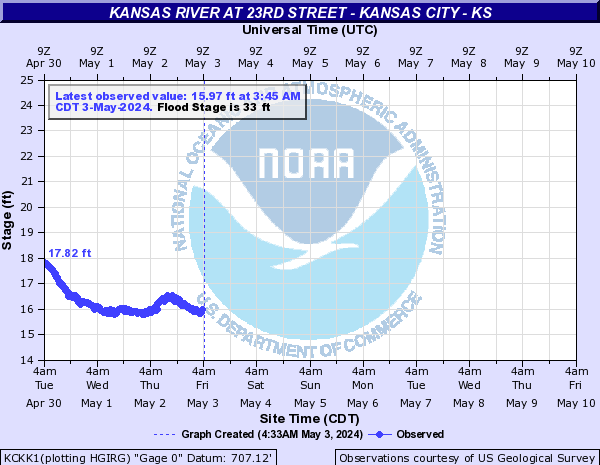
Hydrograph from May 24


Kansas River at 23rd Street - Kansas City - KS
Current Hydrograph with predictions of the flood stage into early next week.


“We need the water level to come down to safely continue the work,” said Jason Van Nice, KDOT Metro Engineer for Wyandotte County. According to the National Weather Service, the Kansas River at 23
rd St. exceeded 36 feet on May 22, 2019, twice the daily average.
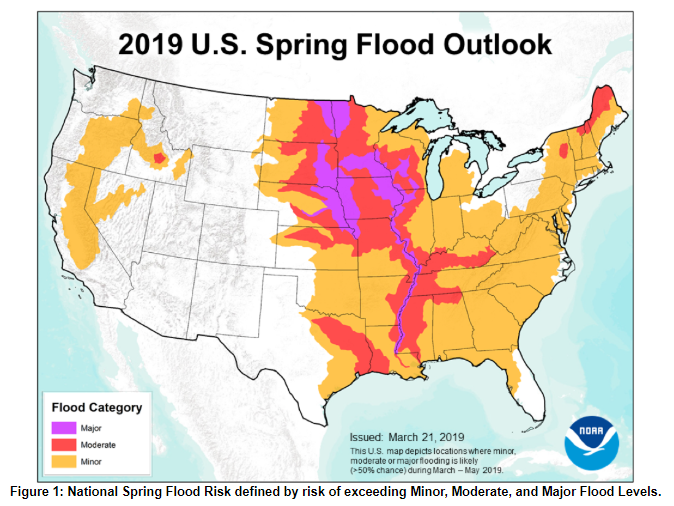
Above-average spring rain and late season snow contributed to elevated flood risk for 25 states facing major or moderate flooding from March through May, including Kansas and Missouri, according to the National Oceanic and Atmospheric Administration’s (NOAA) Spring Outlook. “Significant, record breaking flooding is already underway across the Lower Missouri River Basin. To keep track of this area's flood stages, click here.


 A storm system in the middle of March brought two-four inches of rain across the already saturated area. The combined effects of these rains and snowmelt also produced enhanced runoff. The northern Plains have an above normal snowpack, and the flood risk is expected to stay relatively high for the region throughout the spring,” according to NOAA.

Between March 13 and May 21, crews lost 58 of 70 possible workdays due to the high water. Recent weather in the Kansas City metro has already produced two to four inches of rain and more rain is expected next week. KDOT won’t have an updated completion date estimate until crews can access the work sites and make an assessment. Current detour and traffic control measures will remain in place until the completion of the project.


Rainfall in inches, over the past 30 days. Source: NOAA  


Wednesday, May 8, 2019

Rain, rain go away: Highways in Kansas impacted by flooding


“Rain, rain go away, come again another day,” may be the tune that Kansans hum to themselves as they look at the weather forecast this week.  Parts of the Sunflower State haven’t seen the sun for what seems like days.
Flood waters cover K-4 in Saline County.

With all that rain comes the added risk of flooded roads and highways, and many have experienced this reality already. Today several highways in Kansas, including I-35 south of Wichita are closed.

Driving across flooded roads can be dangerous and there are many reasons for that. Check out this photo from last year when flooded waters washed parts of U.S. 24 away leaving a giant hole. Driving over that could have resulted in tragedy.

Last year flood waters damaged U.S. 24 in Graham County.

Just six inches of water can cause damage to your vehicle? According to SmartDriving.co.uk, water at this level can be sucked into your exhaust system and cause  serious issues for your vehicle.

Trees branches rest on K-98 in Meade County after powerful rushing waters carried them into the roadway. 

Six inches of water can cause your vehicle to lose traction, and 12 inches of water is enough to turn your vehicle in a boat, which it was never designed to be. Water can damage your engine and leave you with an expensive repair bill, or force you to buy a new vehicle.

The best way to stay safe during flood events is to be prepared. Watch the forecast ahead of time to make sure you won’t be encountering severe weather or torrential rainfall. Of course, flash floods can happen without warning. If you encounter a covered roadway, turn around, don’t drown. Never try to drive through it, it could result in the loss of your vehicle or even your life.

Earlier this year, flood waters caused flooding in northeast Kansas near White Cloud. 

For updated road conditions, check the construction tab on www.kandrive.org and pay attention to the weather forecast! More rain is expected today. 

Thursday, October 18, 2018

Wet and wild weather affects roads across the state

Last week the state of Kansas experienced two extremes — flooding and snow in October. Highways in several counties were closed for various periods of times, and KDOT crews were there to assist with traffic control. Here are a few areas affected by floodwaters.

Crews from KDOT-Fort Scott use a snowplow to swab cornstalks and other debris away
 from the flooded roadway on K-31 west of Fulton.


South east Kansas
Heavy rainfall led to flooded and closed highways at several locations in southeast Kansas during the week of Oct. 8. K-31 west of Fulton and K-65 in Bourbon County were barricaded, and the permanent floodgates were closed at the flooded section of K-152 in Linn County.


The sun sets on a flooded section of K-65 in Bourbon County.

Early last week, the U.S. 169 exit ramp from U.S. 54 was closed because of water standing at its base. In addition, KDOT crews flagged traffic through shallow flood waters on U.S. 54 at the U.S. 169/U.S. 54 junction. The town of Erie experienced significant flooding, although U.S. 59 remained open. KDOT crews from Erie and Chanute assisted Neosho County and the City of Erie in flagging and making repairs at the Neosho River levee at Erie.


Flooding at the base of the U.S. 169 on-ramp from
U.S. 54 resulted in a brief closure to traffic.


North east Kansas

The flooding of the Cottonwood river south of Emporia prompted the closure of K-99 last week. 

Several closures occurred as a result of floodwaters in north east Kansas. 


One of the areas affected was near Emporia. Last week's rain lasted approximately three days and resulted in flash flooding in the Dow Creek/Neosho River flood plain just north of the city. This caused KDOT crews to close K-99 between I-35 and 240 Rd. The highway was closed for nearly 24 hours last Tuesday and Wednesday. 

During the same weather period, the Cottonwood River began to rise past flood stage. Last Wednesday, just after opening K-99 north of Emporia, KDOT had to close K-99 south of the. This flood event was slow to recede and the highway was closed approximately two days. 

During the flooding closure, KDOT, Lyon County and KTA officials worked together on a local detour that allowed locals who lived south of town to get to their jobs and home again. This was achieved through signed detours on county roads and over to a temporary gate on the KTA.  The KTA didn't charge users for this temporary detour. KDOT crews manned the closure point on K-99 and gave instructions to vehicles passing in the area. 

Other areas affected by floodwater on the highways:
K-9 and K-87 near Vliets - This area is prone to flooding, as the Black Vermillion and North Fork Black Vermillion rivers converge there.

K-5 closed in Leavenworth County where Sevenmile Creek crosses the highway.  That area also is prone to flooding after heavy (or prolonged) rainfall


K-7 was closed in Doniphan county, north of White Cloud, as the Missouri River rose high enough to cover the surface of the highway.


North central Kansas
A highway outside of Minneapolis is covered in water.
High waters and flooding occurred in parts of north central Kansas on Oct. 9. K-14 in Ellsworth County was closed for eight miles during the day and one mile overnight as water covered the road in several areas. Ellsworth County also experienced flooded roadways on K-111 and traffic was flagged for two hours until roads were drivable. Saline County had a lane closure for a few hours on K-140 due to water over the road at the bridge by mile marker 22.

South central Kansas
Drone Footage of U.S. 81 north of the K-55 Junction in south central Kansas. Photo by KDOT employee, AJ Wilson
Flooding closed several highways in south central Kansas. KDOT crews on the evening of Oct. 8 began flagging U.S. 281 in Barton County from the bridge over Blood Creek to south of the Hoisington city limit. KDOT later closed the road to traffic. U.S. 281 was opened to traffic on Oct. 10.

Crews flagged K-2 from about two miles east of the U.S. 281 junction to just west of Kiowa as well.
Crews began flagging K-14 north and south of the city of Lyons on Tuesday and later closed the highway south of Lyons. K-14 reopened Friday.

In Sumner County, flooding closed U.S. 81 for about a six-mile stretch from the K-55 intersection to the Sumner/Sedgwick county line. Crews also closed K-55 for a 2.5-mile stretch from U.S. 81 to the Belle Plaine city limit. Those roads reopened Friday.


Flood waters over K-55 west of Belle Plaine.

Wednesday, May 30, 2018

Storms affect roads in northwest Kansas


Damage to U.S. 24 in Graham County, after severe storms and torrential swept across northwest Kansas on Memorial day. 

In case you didn't need another reason to turn around when the roads are flooded. Severe storms and torrential rainfall swept across parts of northwest Kansas on Memorial Day. That part of the state had several areas affected by flooding with areas of Graham and Trego Counties seeing the most impact. In fact, WaKeeney had 5.5 inches of rain that afternoon and evening.

Damage to U.S. 24 in Graham County, after severe storms and torrential swept across northwest Kansas on Memorial day. 

A portion of U.S. 24 between Hill City and Nicodemus sustained significant damage from flooding. The roadway has been closed from the K-18 junction near Bogue to Stockton and will remain closed until repairs can be made.

U.S. 283 was closed from WaKeeney to Hill City most of the evening because of water covering the roadway. High winds also caused several semis to overturn on I-70 west of WaKeeney, and damaged the roof of the salt and sand shed at the WaKeeney Subarea.