Showing posts with label Speed limits. Show all posts

Wednesday, September 18, 2019

Cruise control: Setting the speed limits in Kansas


By Ashley Tammen
Public Affairs Manager
Northcentral Kansas

When it comes to setting the speed limits in Kansas, “Increase the speed” is often a statement we hear the most. As you may already know, safety is a top priority for KDOT, and we look at many factors to determine a safe speed for a road or highway. KDOT determines the speed limit of a roadway through a speed study which may be conducted multiple times in a given year.

What is a speed study?

A speed study is done using a radar gun to collect speed data.  Normally, this data is collected during off-peak hours from about 50 random vehicles on a given roadway in each direction at free flow speeds. The vehicles are selected at random to avoid bias in the study results and the 85th percentile speed is the speed at which 85% of the drivers are traveling at or below. The 85th percentile speed reflects the safe speed as determined by a large majority of drivers.

All factors considered!

Many factors are considered in speed studies including crash history, roadway geometry, activity within the driving environment, and politics or state law. According to Brian Gower, Bureau Chief of KDOT’s Bureau of Transportation Safety and Technology, one of the most important factors considered in a speed study is engineering judgement from a traffic engineer. The engineering judgment of a traffic engineer may determine, if any, of the factors in a speed study warrant a downward adjustment of the 85th percentile speeds.

Establishing realistic speed limits

Often, speed studies may not result in a speed change as this may not be the best decision for everyone such as the speed study conducted in February 2016 of K-9 from Beloit to Clifton. Other times, only sections of a roadway may result in a speed zone change like the speed study conducted in May, 2015 of U.S. 81 and K-9 in Cloud County where it was recommended only to raise the speed limit at State Street. Once all variables are considered, a safe and reasonable speed limit is established for a given road section.

Now that you’ve learned all this you may be wondering how we determine when a speed study will be conducted or who initiates the request for a speed study. Anybody can initiate a traffic study or check when the last one was completed, simply contact your local KDOT office.

Wednesday, December 20, 2017

#Back2Basics: Debunking common misconceptions about driving in Kansas

The driver’s license: It’s a rite of passage for new drivers. For many of them it’s a ticket to freedom. Obtaining a license potentially means that of depending on guardians, an older sibling or friend to provide transportation to a destination are a thing of the past.   

Before that license can be obtained, new drivers must go through training and testing to understand the rules of the road. 

Unfortunately, upon completion of those requirements, some drivers do not go back and reread the Kansas Driver’s Handbook. Important information and rules of the road may have been forgotten, which can have an impact on traffic behaviors.

For the next several weeks we will take a quick look at some of the misconceptions about driving. Feel free to read this blog as a reminder to yourself and share it with your loved ones.

Today’s #Back2Basics blog is about the speed limit in Kansas.


Common Misconception #1: “I can go 5-10 miles over the speed limit and I won’t get pulled over.”

Fact: According to both the Kansas Driver’s Handbook and the Kansas Highway Patrol, there is no buffer speed limit. Drivers should not exceed the posted speed limit. However, there are times when going below the speed limit may be necessary, especially during inclement weather.

 “Kansas’ basic speed law requires that you never drive a vehicle at a speed greater than is reasonable and prudent under the conditions then existing,” The Kansas Driving Handbook says, “Consider road, weather and your vehicle condition, as well as your own physical condition. What might be a reasonable speed at one time may not be reasonable at another time because of differing conditions. Adjust your driving to road, traffic and weather conditions.”

Speed Limits can vary depending on where you are.

Have you ever found yourself traveling in an unfamiliar part of the state, and you just aren’t sure what the speed limit is? Where no special hazards exist, the law sets maximum speeds for normal driving conditions. Unless otherwise posted the maximum speeds are:

  • In Towns or Cities: Thirty (30) miles per hour in any urban district
  • On Roads and Highways Outside of Towns: Seventy-five (75) miles per hour on any separated, multi-lane highway as designated and posted by the Secretary of Transportation
  • Sixty-five (65) miles per hour on any State or Federal Highway
  • Fifty-five (55) miles per hour on any County or Township road
  • Unless otherwise posted – Maximum speed limits 20 mph -School Zone (when properly marked) -Business District (when properly marked)


Common Misconception #2: I can go as slow as I want as long as I don’t exceed the speed limit.

Fact:  Slower drivers must go the speed limit too and there is such a thing as going too slow. According to the handbook, minimum speed limits also exist on some roadways. Going too slow can impede traffic and it can lead to traffic incidents. Where these minimum speed limits are posted, any speed below that is considered unlawful under normal weather, road and traffic conditions.

“Even when a minimum speed is not posted, it is unlawful to drive a vehicle so slowly as to impede or block the normal movement of traffic,” the Kansas Driver’s Handbook says. “The exception is when it is necessary for safe operation in compliance with the basic speed law.”

So, the next time you are behind the wheel, remember unless conditions call for slower driving, the posted speed limit is the speed you should be going. Remember to slow down in Work Zones and give highway workers plenty of room.

Check back next week when we discuss passing misconceptions in Kansas.
For more information, you can read the Kansas Driver’s Handbook here:


https://www.ksrevenue.org/pdf/dlhb.pdf

Thursday, July 20, 2017

Reminder: Speed Limit Enforcement Blitz this weekend


TOPEKA, Kan. – The Kansas Department of Transportation has partnered with law enforcement agencies across the state to launch a tough new speed enforcement blitz statewide. The intensified enforcement effort against speeding drivers underscores the severity of the problem in cities and towns across Kansas.
“Speeding greatly reduces a driver’s reaction time,” said Chris Bortz, KDOT Traffic Safety Program Manager. “A speeding driver puts everyone on the road at a greater risk of a crash.”
On average in Kansas, 25 percent of fatal crashes are speed-related. Nationwide, speeding was a contributing factor in 27 percent of all fatal crashes, leading to more than 9,500 deaths, according to the latest data from the National Highway Traffic Safety Administration (NHTSA).
During campaign from July 21-23, officers will intensify enforcement of posted speed limits on Kansas roads, highways and interstates, targeting and ticketing speeding drivers.
“We’ll stop and cite anyone caught speeding—especially in construction zones and on interstates—where most of our speed-related crashes occur,” said Lt. Adam Winters with the Kansas Highway Patrol.
As speed increases, the severity of crashes increases, leading to a rise in fatalities and/or serious injuries. According to NHTSA, a crash on a road with a posted speed limit of 65 miles per hour or greater is more than twice as likely to result in a fatality than a crash on a road with a speed limit of 45 or 50 miles per hour, and nearly five times as likely to result in a fatality than a crash on a road with a speed limit of 40 miles per hour or below.

“On the drive to zero fatalities, you are in the driver’s seat,” Bortz said.

Tuesday, February 18, 2014

Technical Tuesday: The need for speed...limits

Today's blog will answer a question we received via social media recently about speed limits.
To answer this question, it’s best to start by looking at what the actual speed limits in Kansas are.  Check out the map below.
All four-lane highways or dual-carriageways in Kansas are 70 mph and above.  Our interstate routes (shown in red on the map) are 75 mph and above.  These routes have no cross traffic, which is why they are at the higher speed.

The majority of the two-lane highways in the state have 65 mph speed limits (shown in dark blue on map).  As you can see, there are some highways that have speed limits of 60 mph or below.  The reason for these lower speed limits can be attributed to a number factor such as a heavy traffic, roadway geometrics or high crash rates.

This wasn’t always the case.  In 1973 Congress enacted the National Speed Limit in an effort to conserve gasoline and it was set at 55 mph. In the 1980s it was increased to 65 mph on some roads, then in 1995 the law was repealed and each state was then allowed to choose their own speed limit.


Until 2011, the speed limit on all major freeways was 70 mph in Kansas.  When the Kansas Legislature passed the new maximum speed limit of for separated, multi-lane highways, KDOT then made the choice of which highways would be increased to 75 mph. All of the routes that were chosen for the increased speed limits are freeways and have controlled access to and interchanges. Other factors that were considered for choosing those particular highways were whether the road was in a rural or urban area, the amount of traffic and the speed limit in the surrounding states. (Our neighbor to the west Colorado’s speed limit on I-70 is 75 mph, while our eastern neighbor Missouri is 70 mph.) Basically, at least in Kansas, the more populated the area, the lower the speed limit.

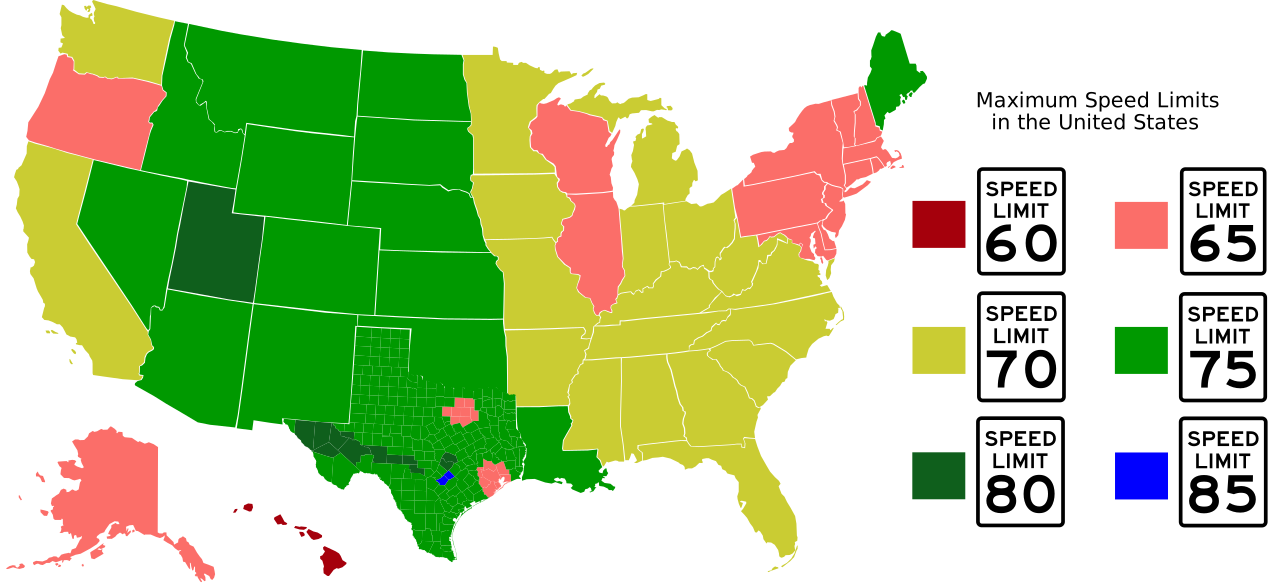
Below is map of the current maximum speed limit in each U.S. state.  As you can see a good portion of the country is at the same limit or higher than the United Kingdom, it just depends on where you are at while traveling in the U.S.

If you have any more questions about speed limits or another transportation-related issue, feel free to pose it in the comment box below or ask us on twitter @KDOTHQ.