Showing posts with label Wichita. Show all posts

Monday, December 2, 2019

Innovative possible solution to icy problem

KDOT Mechanic Curtis Watts with the brine bar he crafted as part of a pilot project.


You could call it a salty solution to a big challenge: A pilot project to possibly modify KDOT plow trucks – at low cost – to efficiently treat Sedgwick County roads with brine so traffic can move safely in snow and ice.

The request came from David Lechner, Maintenance Superintendent for the Wichita Metro.
The innovative potential solution came from a veteran KDOT mechanic, Curtis Watts. He built it, with among other things, about $30 worth of PVC pipe and less than $8 in auto-parts-store exhaust clamps.

Lechner, one of Watts’ supervisors, put it this way: “To be able to pre-treat the whole town (Wichita metro) in a few hours is the whole goal. … Curtis put all this together.”
Ask Watts how he designed it, he says, “Just in my head.” The Equipment Mechanic Senior can draw on his 35 years of KDOT know-how.

The nozzles attach/detach with simple clamps.

KDOT gave him room to create. “We felt like we had the freedom to do whatever (was needed), and I just passed it on to Curtis,” Lechner said.

The idea was to build something workable at a lower cost than a manufacturer’s price.

As far as spreading brine, “Why not use PVC?” the thought went. It’s inexpensive, easy to work with, easy to repair.

In a day, Watts crafted a brine spreader bar out of inch-and-a-half PVC, in a straight line that bends out at both capped ends to fully distribute the liquid. He drilled holes spaced for 12 nozzles. They spray down in a cone shape and angled out to the side, on the back of a truck. It treats two lanes in one pass. For nozzles, he used stainless steel ones used in agriculture and available online. The nozzles attach/detach with simple clamps. He picked standard auto exhaust pipe clamps to attach the bar.

Watts and his team also found a bigger pump to bring brine from 400-gallon saddle tanks on either side of the truck.

A button in the cab activates it all. Equipment Operator Senior Tim Kyle demonstrated the cold-weather system as others on the brine-bar team, including Shop Supervisor Shane Stubbs, watched at the Wichita area office.

The brine-bar set-up worked fine last winter, Watts noted. The brine bar has been installed on four trucks; three of the trucks are being equipped with other components to complete the system. And all four trucks will be rolling this winter, Lechner said.

As far as cost, the whole new brine-bar system comes to about $1,500 per vehicle, with the biggest portion going to the pump and electric valve. Watts gave an itemized breakdown in perfectly neat handwriting: $1,389.35 plus PVC, fittings and hoses, for the total of around $1,500, which seemed to be a relatively low-cost addition to a $170,000 truck.

The new brine system can be used with salting and plowing and allows KDOT to treat more in less time, which is crucial for Wichita metro traffic flow, Lechner said.

KDOT’s Bureau of Maintenance has reviewed the brine bar pilot project, and with revisions it could be part of an improved system for treating roadways.

“This is just something we did to help our work situation” – and to protect motorists, Lechner said. “That’s our job.”

Tuesday, November 12, 2019

Highway Safety 101: Don’t get lulled over


Technical Trooper Chad Crittenden pulls over to watch traffic near I-235 and Zoo Boulevard in Wichita.


By Tim Potter
Southcentral Kansas 
Public Affairs Manager

I’m belted comfortably into the passenger seat of a gleaming, heavily equipped Kansas Highway Patrol SUV. It’s one of those sun-drenched fall days when a driver can see for miles. It’s a perfect time for traveling, on highways engineered for ease and safety.

The person driving me around the Wichita area in a 2018 Ford Interceptor Utility is an expert driver -- Technical Trooper Chad Crittenden. He’s been patrolling state highways as a trooper for more than 16 years. He teaches defensive driving.

Yet, even on days like these, people still die or get maimed on Kansas highways.
Why?

“Complacency,” Crittenden says without hesitating. Complacency is a dominating factor in car crashes that he responds to in the Wichita metro area.

By complacency, he means the situation where a driver gets lulled into a false sense of security. They’ve never been in a bad accident. They assume the driver on the side road will not suddenly pull out in front of them. To compound the risks, they might not wear a seat belt. They might drive while on their cell phone, chatting, texting or fidgeting with the radio or comfort controls. So far, the multitasking has led to nothing tragic. So they keep doing it, eyes and brain diverted as they cruise at 60, 70, 75 … 

“We’re not as focused as we possibly should be,” Crittenden says. “You have to be looking here and there,” he says, his eyes scanning back and forth as he motors west on K-254 past a side road. It’s the same spot where two vehicles collided with fatal consequences a few months back.

According to Kansas traffic statistics, the by-far biggest single factor in crashes during 2017 was inattention.

That same year, most accidents occurred during daylight hours, 63 percent; in good weather conditions, 88 percent; with dry pavement, 87 percent; and where the road was straight and level, 77 percent.

To Crittenden, winning the game of safe driving starts with a mindset, a discipline – to always be prepared to survive when the unexpected happens. It includes practicing the most basic death-defying thing that people keep ignoring – wearing a seat belt.
How does he enforce safe habits?

From his driver seat near I-235 and Central, he zeros in on a small, white Nissan sedan because he can see that the woman driving it is not wearing her seat belt. She quickly pulls over after he activates his flashing lights, and he will issue a ticket for not wearing a seat belt but only warn her for not signaling a lane change.

When he tells her why he stopped her, she says about the seat belt, “I just left class. I think I forgot. … I remembered it when I saw your lights, though.”

He suggests that she stick a note on her dash to remind herself to buckle up. “Yeah, I guess,” she good-naturedly replies. “Please wear your seat belt,” he responds. “OK,” she says. “Thank you.”

Not all drivers react so politely. “Don’t you have anything better to do?” the rude ones say. Some still contend it’s their “right” not to wear a seat belt.

Technical Trooper Chad Crittenden stops a driver along I-135 for an expired license tag. For his safety with passing traffic, he stands to the passenger side of the vehicle while talking to the driver. 

In teaching safety, Crittenden urges his defensive-driving students to avoid the situation that often causes aggressive driving: leaving late and giving in to the urge to drive too fast and on edge. So he reminds his students to leave early and avoid the aggression and stress.

It comes down to this, he says: Patience saves lives. It translates to not speeding around every car, maybe waiting a second or two longer and passing safely, under control.
When he exits onto a ramp, for example, he checks his mirror to make sure someone isn’t closing in on him too quickly. He’s alert to the potential danger of impatient drivers.
And then it happens: Minutes after he talks about the importance of staying patient, while driving east on K-96 approaching Rock Road, he notices a car right behind his marked patrol unit.

The driver “is in a hurry,” he says. “She’s going to tailgate a trooper,” he exclaims, before she veers off onto the exit ramp to Rock, seemingly oblivious to or unfazed by the traffic safety enforcer in front of her.

She was lucky this time.

Another thing that should be part of the mindset, part of preparation for driving: Getting enough sleep. Crittenden views a drowsy driver as being just as dangerous as a drunken driver. The only difference is the legality.

So while teaching his defensive-driving classes, he asks his students how many of them got eight hours of sleep the night before.
Only a few raise their hands.

Tuesday, September 17, 2019

Summer recap: Large jaws make quick work of old bridge

By Tom Hein 
Wichita Public Affairs Manager
Have you ever wondered what goes into demolishing a bridge?

Using machinery that resembles Jurassic Period predators, a deconstruction crew removed a 1960s era bridge over I-235 in north Wichita earlier this summer, which required a weekend shut down of a 3-mile section. 

The removal of the bridge makes way for continuous auxiliary lanes between North Meridian Avenue and Broadway. 

The section of I-235 under construction is also part of K-96


A 1960s era bridge was demolished over I-235 in north Wichita earlier this summer. 
To protect I-235 from the heavy equipment used for the demolition, a dirt cushion was placed over the concrete lanes. After the bridge was down, removing the debris took several hours as concrete and steel were separated and hauled away.

To protect the road surface from the heavy equipment a dirt cushion was placed over the concrete lanes.

Dirt was also removed from the bridge abutments and will be used to construct the new ramps at the I-235 and Broadway interchange.

In order to construct new ramps at the I-235 and Broadway interchange, dirt had to be removed. 
The average daily traffic for this area is between 45,000 and 52,000 vehicles per day.

The Green Project is the first phase of the Wichita North Junction reconstruction.

To find out more about the project, see the Green Project fact sheet here  .

 A fact sheet for the North Junction phases can be found here 


Monday, August 26, 2019

Second week of KDOT Local Consult Meetings begins


KDOT officials traveled 491 miles and visited four different communities during the first week of the Local Consult Meetings. More than 500 Kansans and stakeholders attended the first round of meetings and provided input for how Kansas can move forward.

Together, attendees and KDOT staff were able to discuss what a modern transportation system requires and how to make sure jobs and opportunities will be available. Other topics, like safety, healthcare, technological needs and changes, investing in multi-modal transportation and the partnership required for both urban and rural communities.

As we turn our focus to the next half of the local consult meetings, there will be even more important conversations. As we look forward to the future of Kansas, we know that collaboration will continue to make our state strong.

Here is the schedule for this week’s Local Consult Meetings, we hope to see you there!

Northeast Region
Monday, Aug. 26, 2019
1:30 - 4:30 p.m.
Capital Plaza Hotel
1717 SW Topeka Blvd.
Topeka, Kansas

Wichita Metro Region
Tuesday, Aug. 27, 2019
9 a.m. - noon
Eugene Hughes Metroplex
5015 East 29th Street N
Wichita, Kansas

Southwest Region
Wednesday, Aug. 28, 2019
9 a.m. - noon
Dodge House Convention Center
2409 West Wyatt Earp Blvd.
Dodge City, Kansas

Northwest Region
Thursday, Aug. 29, 2019
9 a.m. - noon
Fort Hays State University
Memorial Union
700 College Drive
Hays, Kansas

You can catch up on all of the blogs from last week at the following links.

Kansas City Metro Region

Monday, August 19, 2019

Local Consult meetings begin


We need your voice! Plan to attend a series of Local Consult meetings hosted by the Kansas Department of Transportation. KDOT will provide Kansas an opportunity to help set the vision for transportation for the Sunflower State.  

The discussion begins this afternoon in Salina followed by meetings in Hutchinson, Independence, Overland Park, Topeka, Wichita, Dodge City and Hays.

“This is a transformational time in transportation,” said Secretary of Transportation Julie Lorenz. “We need your help to chart our success into the future.”

At each meeting attendees will review facts and trends and explore alternative future possibilities through scenario planning. There will also be time to present information about transportation projects that were not discussed during last fall’s Joint Legislative Transportation Vision Task Force meetings.

Check back here each day for updates and summaries of the Local Consult meeting discussions in each region. Look for a recap on the northcentral Kansas Local Consult Meetings in Tuesday’s blog. 

For more information check out our webpage: http://www.ksdot.org/LocalConsult/LocalConsult.asp

Tuesday, August 13, 2019

Stakeholders can discuss future transportation priorities at Local Consult meetings


A series of Local Consult meetings hosted by the Kansas Department of Transportation will give citizens a chance to discuss regional transportation priorities and participate in scenario planning for the future.

“These meetings are an important opportunity for stakeholders to help set the vision for transportation in Kansas,” said Secretary of Transportation Julie Lorenz.  “This is a transformational time in transportation, and we need you to help chart our success into the future.”

At the meetings, stakeholders will review facts and trends and explore alternative future possibilities through scenario planning. Stakeholders will also have the opportunity to present information about transportation projects not discussed during last fall’s Joint Legislative Transportation Vision Task Force meetings.

“I strongly encourage you to attend KDOT’s upcoming local consult meetings, so we hear your thoughts and create a transportation system that works for all Kansans, regardless of where they live,” said Gov. Laura Kelly.

The Local Consult meetings are scheduled to take place in August in Salina, Hutchinson, Independence, Overland Park, Topeka, Wichita, Dodge City and Hays. A list of the dates, times, locations and a map are below.

To view an invitation to the meetings from Gov. Kelly and Secretary Lorenz, click https://vimeo.com/351478294/033c1e70dc

If possible, please contact Mike Moriarty, KDOT Chief of Transportation Planning, at 785-296-8864 or Michael.Moriarty@ks.gov to let us know which meeting you plan to attend.


Meeting schedule -
uSalina - Monday, Aug. 19
1:30 p.m. - 4:30 p.m., Kansas Highway Patrol Academy, 2025 East Iron
 
uHutchinson - Tuesday, Aug. 20
9 a.m. – Noon, Atrium Hotel & Conference Center, 1400 North Lorraine St.

uIndependence - Wednesday, Aug. 21
9 a.m. – Noon, Independence Civic Center, 410 N. Penn Ave.

uOverland Park - Thursday, Aug. 22
9 a.m. – Noon, Matt Ross Community Center, 8101 Marty Street

uTopeka - Monday, Aug. 26
1:30 p.m. – 4:30 p.m., Capital Plaza, 1717 SW Topeka Blvd

uWichita - Tuesday, Aug. 27
9 a.m. – Noon, Eugene Metroplex, 5015 East 29th Street N

uDodge City - Wednesday, Aug. 28
9 a.m. – Noon, Dodge House Convention Center, 2409 W. Wyatt Earp Blvd.

uHays - Thursday, Aug. 29
9 a.m. – Noon; Fort Hays State Union, 700 College Drive

Monday, March 18, 2019

Interchange project uses smart work zone to help drivers

It’s not often that a multi-year highway project finishes a full six months before its deadline. But that’s what drivers in Wichita have experienced with the first phase of the I-235/U.S. 54 Interchange improvements in west Wichita.

The I-235/U.S. 54 Interchange Project opened to traffic a full six months ahead of schedule. 

While the three-year project still has some work that is waiting for spring weather, drivers have been enjoying the benefits of the lane and ramps improvements since December. The remaining work items should not affect traffic and the project will wrap up before the planned date in June.

The project eliminated dangerous merge points and added dedicated directional ramps to make the interchange easier to travel. 
The project eliminated dicey merge points. Dedicated directional ramps make the busy interchange much easier to maneuver. 

A traffic camera helps monitor the construction area.

During the three years of construction, a Smart Work Zone was used to alert drivers of traffic incidents and other problems leading to congestion in the work zone. From K-42 to Central Avenue on I-235 and from Maize Road to downtown Wichita on U.S. 54, multiple monitoring devices positioned throughout the project area communicated real-time travel conditions then automatically posted travel times to common destinations in the city. 

Portable message signs were placed to help direct traffic and give drivers more information about their route.

Fifteen portable message signs placed on arterial streets were used to complement the large roadside WICHway message boards. Messages with estimated drive times through the construction zone allowed drivers to make informed decisions about their route. 

According to data collected during construction, as much as 50 percent of the traffic was diverted once delays of seven minutes or more were reported on the message signs.

“The design of the Smart Work Zone kept traffic moving safely, both through the construction site and along the alternative routes,” said Garry Olson, KDOT Smart Work Zone Coordinator. “We are encouraged by the results and look forward to maximizing this technology in future projects.”


And future projects keep coming. In the last week, a new three-year project on I-235 in north Wichita began that will replace six bridges, upgrade and expand travel lanes and reconfigure the I-235 and North Broadway interchange. 


Thursday, January 31, 2019

The Green Project – The First Step in Fixing Wichita’s North Junction, one of several projects approved


The North Junction in Wichita is a burden for some commuters, commercial delivery services, truckers and other Sedgwick County drivers. It is a pinch point that some avoid and some just suffer through, especially in the morning and late afternoon drive-times.
Four highways come together: I-135, I-235, K-96 and K-254 – and for some travelers, depending on the time of day, it is an annoyance that most would rather do without.


The first step to fixing the North Junction bottlenecks will soon begin. Earlier this month, three bids were opened for the I-235 Green Project in Wichita. Bergkamp King, A Joint Venture, LLC was the low bidder at $51,337.971.52 and the planned date for that start is March 11.

The I-235 Green Project is just the first phase of the Wichita North Junction fix. It will replace aging pavement, the structurally deficient bridges over the Little Arkansas River and the functionally obsolete bridges over Arkansas Avenue and Broadway. It also adds auxiliary lanes to I-235 and improves ramp geometry at the Broadway interchange.


Awarding the Green Project to a contractor is a big step in the life of the interchange reconstruction project. With the near-completion of the I-235 and U.S. 54 interchange project, the North Junction rebuild has advanced to a priority highway concern for the Wichita/Sedgwick County community. To further the rebuilding process and encourage the continuation of projects that will address the North Junction bottlenecks, Sedgwick County and the City of Wichita have teamed up to help finance right-of-way acquisitions for the next phase. They produced a video to share their support for this multi-phase project.
See the video at Wichita North Junction Video.

Find out more about the I-235 Green Project at Green Project Fact Sheet.
See all the phases of the North Junction reconstruction at North Junction Fact Sheet.

This is one of several projects approved in the January Letting. For the rest of the project list click here:

Wednesday, October 24, 2018

Joint Legislative Transportation Vision Task Force – Wichita Meeting


Evolving Technologies and Transportation – At the meeting last Thursday in Wichita, the Task Force turned its focus to technology and its impact on transportation. To begin the meeting, we heard from the Mayor of Wichita on the importance of transportation as an economic driver to draw businesses to Kansas. KDOT presented an overview of existing and emerging transportation technologies, including Intelligent Transportation Systems as well as the movement toward electric vehicles and eventually autonomous and connected vehicles. Discussion also included the partnerships and infrastructure that will be needed as technology advances and changes how people move across the state. Presentations from the meeting can be found here.

Local Testimony Highlights Importance of Addressing Congestion and Improving Safety – During the public testimony, we heard from a variety of stakeholders on the importance of improving existing transportation infrastructure to meet the increased demands of today. As both freight and personal vehicle traffic has increased, congestion has increased in areas such as the Wichita North Junction and K-254 highway.  Like other meetings, safety continued to be emphasized. 

Considerations for Future Task Force Discussions – The Task Force reviewed the variety of information sources that will be available to help inform recommendations later this year including fact-books, which summarize information from presentations; the online funding/expenditure/performance calculator; the list of projects shared by stakeholders and local input testimony from each meeting. Task Force members also indicated they like to learn more about cost-effective safety improvement options, opportunities for partnerships as new transportation technologies evolve and a variety of funding options.     

The next task force meeting Is taking place today at Fort  Hays State University in Hays, Kan. At this meeting, topics will focus on alternative delivery methods and the county transportation system in Kansas. More information about future meeting locations and directions on how to provide testimony can be found here.

Local Programs and Rural Mobility Discussion in Hays. Before the task force meeting in Hays, we will hold a stakeholder meeting to discuss local programs and rural mobility from 8:00 – 9:30 a.m. An urban mobility focused stakeholder meeting will be held before the meeting in Olathe on Nov. 8.

Tuesday, July 10, 2018

Artful walk: Wichita State University's sculpture collection provides healthy activity


By Tom Hein,
Wichita Metro Public Affairs Manager

Tres Mujeres Caminando (Three Women Walking)  by Francisco Zuniga 
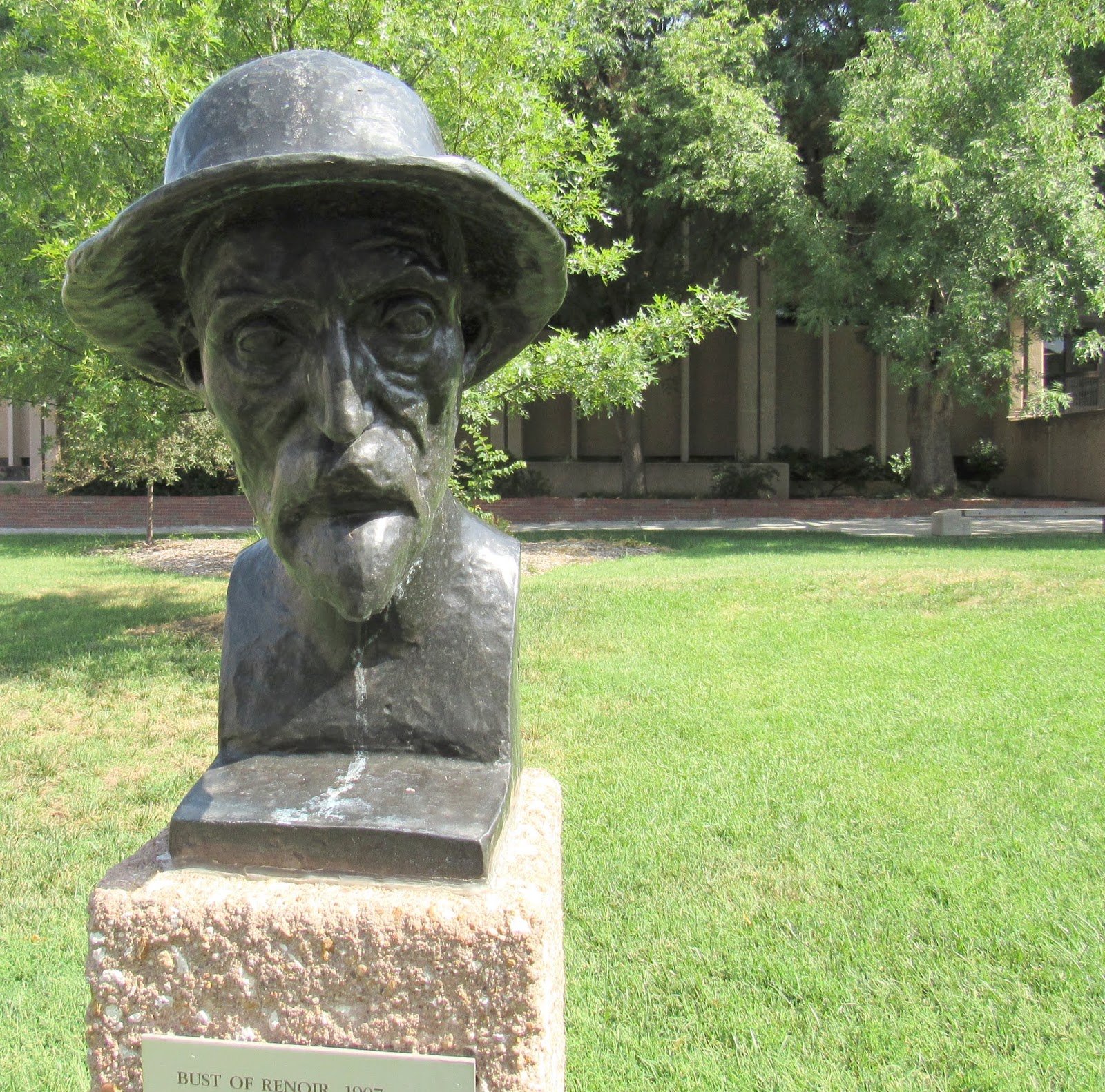
Combining outdoor walking and art appreciation is a healthy way to enrich the body and the mind. On the campus of Wichita State University, 76 sculptures are spread across the 330-acre campus, inviting walkers to discover a diverse collection – and improve their health.

Millipede by Tom Otterness.

There are works by famous artists – Auguste Rodin, Joan Miro, Henry Moore and others – but who created them is less important than how you experience the pieces as you walk around them.

Bust of Renoir by Aristide Maillol

Summer, albeit rather warm, is a great time to visit the campus and tour the Martin H. Bush Outdoor Sculpture Collection. With only summer school in session, there are plenty of free parking spots. Stop by the university’s Ulrich Museum of Art for a map of the collection or check it out online at http://webs.wichita.edu/?u=ulrichmuseum&p=/art/outdoorsculpturecollection/.


Man with Cane by Fernando Botero

Visiting all 76 pieces of art will be good for your heart – in more ways than one!

Thursday, June 7, 2018

Was that a UFO? KDOT helps route F-35A on its journey to Wichita


No, it wasn’t a UFO — unless by UFO you mean “UN-FLYING-OBJECT.”

An F-35A is hauled through the U.S. 77 and U.S. 169 roundabout in Cowley County while on its way to the National Institute for Aviation Research at Wichita State University. 

Several residents of south central Kansas joked that an F-35A “durability ground test article” that the Kansas Department of Transportation helped route on its journey from Houston to Wichita was a UFO. The oversize load definitely was not something you see every day on the highway.

The aircraft is the second of three expected to be tested at the National Institute for Aviation Research at Wichita State University.

Engineering Technician Specialist Barry Santee at KDOT’s South Central Kansas District reviewed the route the jet took to ensure it would safely get to Wichita, taking into consideration the height of signs, the width between bridges and the width of roads.

The trucking company that transported the jet applied for a permit for the oversize load through the Kansas Truck Routing and Intelligent Permitting System.

“I have to override restrictions to make it work,” Santee said.

Doing so “takes a lot of communication” between various agencies.

“We’ve got to let all the locals and law enforcement know. Our subareas are involved too,” he said.

In Kansas, the jet came up U.S. 77 to K-15 and then up I-135 to NIAR’s facility at the old Kansas Coliseum.

Oversize routes must follow the approved route. Permits are good for 30 days, Santee said.

“Right now, we have 300 to 400 in the queue at any time in the month” for the district, one of six in Kansas. “I have seen it as much as a thousand in a month.”

Drone footage of the aircraft as it makes its way through Winfield. 

Routing oversize loads like the jet is lot of work, Santee said, “but it’s part of commerce.”
Many residents who saw the jet, which did not have an engine, took photographs of it. Winfield Area Engineer AJ Wilson took a photo of it from above with his drone.

A statement from NIAR said that “as part of the F-35 program, durability ground test aircraft undergo exhaustive testing to validate the structural integrity of the airframe to withstand a variety of maneuvers it will experience throughout its lifetime.”

The testing is required by the Federal Aviation Administration. The test aircraft will undergo a full disassembly and inspection at NIAR.

Wednesday, March 14, 2018

A 'pawesome' story: KDOT crews rescue lost cat

Ron O’Neal was the first to hear the meow.

Equipment Operator Seniors Jorge Alvarado, Ryan Hunter and Ron O'Neal, shown left to right, helped get this cat out of a hole they were going to fill with concrete while working on the apron of a bridge at K-96 and Rock Road. They work out of the Wichita East Subarea shop
The Equipment Operator Senior and other members of the Wichita East Subarea crew were working on the apron of a bridge at K-96 and Rock Road, about to fill a hole with concrete. They stopped when O’Neal heard the plea for help.

This grey and white cat was saved by KDOT crews from Wichita.
He was reunited with his family. 
Equipment Operator Senior Ryan Hunter “sprang into action and dug him out of the hole,” Supervisor Ted Coleman said. “The hole was huge and required flowable fill. Ryan reached down about 3 feet to retrieve the kitty cat.” 

Coleman called Wichita Animal Control and took the cat home for the weekend, introducing him to his two dogs. It wasn’t the first time Coleman has gone above and beyond for animals. He once crossed four lanes of I-135 to rescue a dog that had been lost for several days. Coleman was recently featured in the #IAMDKOT series which illustrates that scene here: 

Workers at the Wichita Animal Shelter, which is situated next to the Kansas Humane Society, successfully scanned the cat for a microchip.

Turns out the kitty had been missing for a month and lived 12 miles away in Andover.

“The family was thrilled and excited to hear the good news,” Coleman said.