Showing posts with label wildflowers. Show all posts

Thursday, June 20, 2019

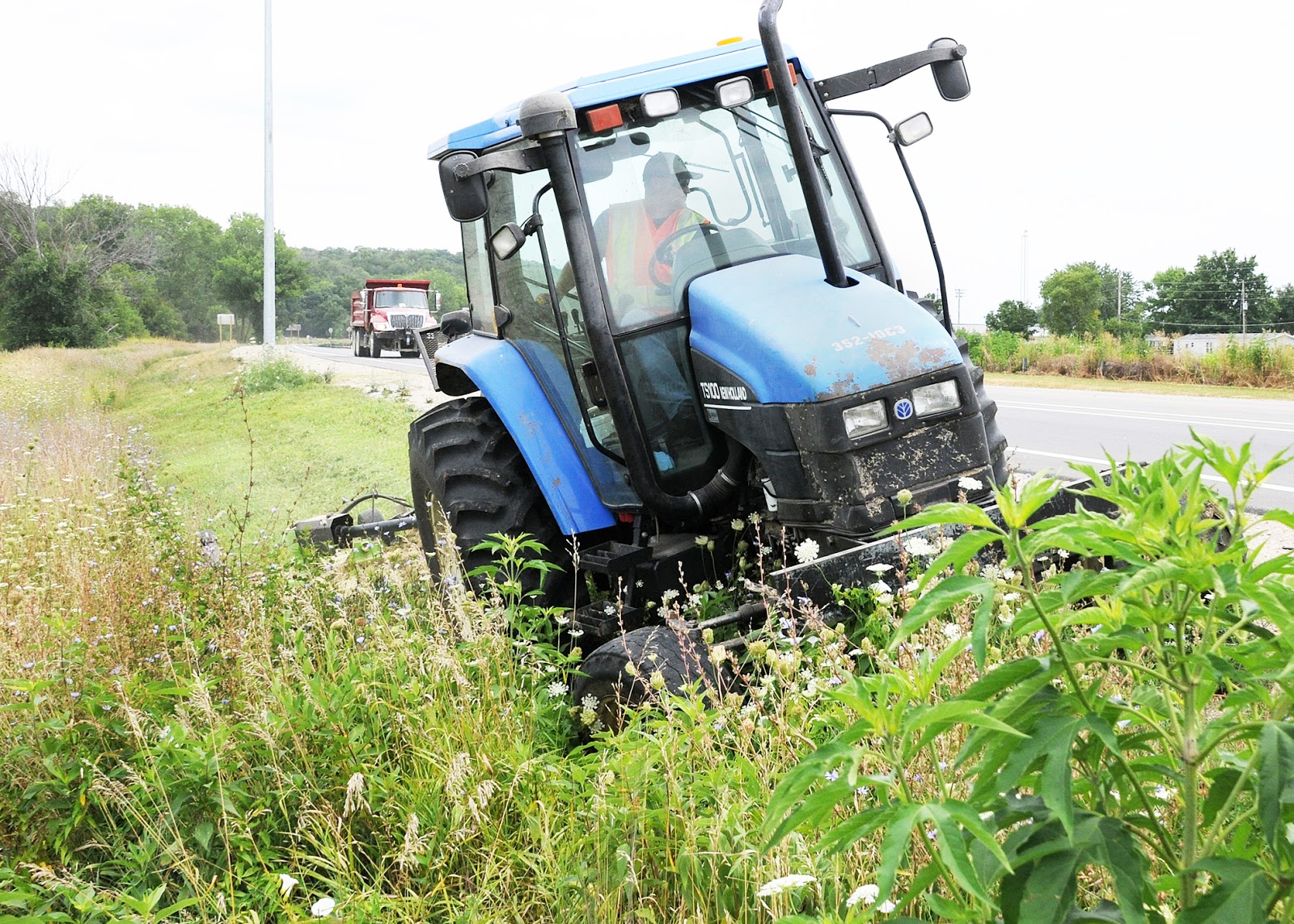
Mowing 101: How KDOT maintains Kansas roadways


KDOT maintains more than 150,000 acres of highway right of way across the state through mowing, weeding and land maintenance. 

Did you know that KDOT maintains more than 150,000 acres of highway right of way?
 As a result that means there is a lot of grass to mow, land to maintain and weeds to control.  Each year KDOT spends approximately $6.7 million on mowing efforts. There are a few situations that KDOT takes into consideration before mowing will take place:

Crews will mow at specific times during the year, but it will also be done as necessary for safety reasons. KDOT’s largest priority are visibility areas in and around intersections, signs and inside of curves.

As seen in recent weeks, mowing after periods of heavy, prolonged rain can make it difficult on equipment and can cause ruts in the land adjacent to highways. Mowing in these conditions can also damage equipment, which can take even longer to repair and get the area mowed. KDOT crews will mow areas when it is safe to do so.

KDOT's priorities are visibility areas in and around intersections, signs and inside of curves.


As summer continues, maintenance crews work hard to keep Kansas moving, please give them room to work.

In order to save time and give our crews more opportunities to fix roads and maintain areas that have a larger impact on traffic, KDOT may mow less frequently in underdeveloped areas. Mowing on steep slopes can be dangerous, and KDOT also limits the amount of times those areas are mowed as well.

There are many benefits for KDOT’s mowing policy and the amount of time and funds saved gives crews more time and resources to maintain highways and bridges. Farmers and adjacent landowners can harvest hay from the roadsides at no cost.  
In addition to all these situations,

As summer continues, KDOT maintenance crews are working hard to keep Kansas moving. Please give them room to do their job, whether its filling potholes, picking up litter or mowing the right of way.

You can find more information about KDOT’s mowing policies and permit information on our webpage:

Tuesday, June 18, 2019

Protecting the pollinators: KDOT adds more habitat


Here’s the buzz! Did you know that pollinators are vital to Kansas’ economy? About three-quarters of the world's flowering plants and many of the food crops eaten in North America depend on pollinators. In the U.S., pollination produces nearly $24 billion worth of products annually.  

The Monarch butterfly caterpillar can only eat the leaves of milkweed. Monarch Butterflies only lay their eggs
on milkweed plants. Losing these important plants could be devastating to these important pollinators.
Unfortunately, bee and Monarch butterfly populations are on the decline. The lack of pollination would mean no apples, blueberries, almonds, melons, pumpkins, chocolate, coffee and more. 

A Monarch butterfly on a Butterfly Milkweed plant. 

In order to help change that, KDOT crews will be busy for the fourth year in a row as they continue to plant  native wildflowers and grasses along our roadways.

One of the many varieties of flowers and plants you'll see along our roadways are the Black-Eyed Susan flowers.


This is all thanks to a partnership with the Kansas Department of Wildlife, Parks and Tourism. Last September, KDOT was awarded $65,000 for the restoration and enhancement of rights-of-way for Monarchs. The grant will provide approximately 125 acres of pollinator habitat to be completed within in the next two summers. 

This year the project locations include:

·         I-35 & U.S. 59 Interchange – 52 acres
·         Linn County Rest Area, U.S. 69 & K-52 Interchange – 26 acres
·         I-35/Homestead Lane Interchange, Johnson County – 22 acres
·         Montgomery County Rest Area, U.S. 400 & U.S.169 Interchange – three acres

Common Milkweed in bloom.

This year around 100 acres will be planted, and next year, an additional 22 acres will be added in Franklin County.  This grant was provided by the U.S. Fish and Wildlife Service.

The next time you take a drive, be on the lookout for these incredibly important pollinator habitats with the help of brand new KDOT Pollinator Habitat signs, which will be installed this year along some of the areas mentioned above.

Be on the lookout for these signs as you travel across the state. They'll be added this year!

For more information on how KDOT is helping pollinators, click here: http://pollinatorpartners.ksdot.org

Tuesday, June 20, 2017

Pollinator preservation part II: Planting milkweed


This week is Pollinator Week and the Kansas Department of Transportation, along with five other state DOTs and the Federal Highway Administration, signed an agreement that will improve pollinator habitat along I-35, a key migratory corridor for Monarch butterflies.

A recent blog discussed how KDOT’s Environmental Services team, along with KDOT crews from the Ottawa area, planted approximately 15 acres of wildflower seeds on three plots of land around the Homewood rest area along I-35. This project will provide an increase in habitat to several pollinator species, whose populations are declining.

A close up view of a milkweed weed plug that was planted on May 23 by KDOT crews form the Ottawa Area Office. 
On May 23, KDOT employees returned to the rest areas to plant the 1,152 milkweed plugs that KDOT received from the Monarch Watch: butterfly milkweed and common milkweed.

KDOT workers plant milkweed plugs on May 23 near the Homewood rest area along I-35 in an effort to assist in rebuilding the pollinator habitat.
Engineering Technician Specialist Melissa Davidson in KDOT’s Right of Way said that there were several steps involved to ensure the 15 acres of land were ready for planting.

“KDOT staff burned the site to clear it from dead and overgrown plant material,” Davidson said. “Next, they pulled out any remaining cedars to prevent them from spreading.”


The first step in making this project happen was to burn away the dead and overgrown plant material.

Davidson said that after burning and clearing the area they disked the soil, or cultivated the soil, using a disk harrow to prepare for the wildflower seeds and milkweed plugs. 

Disking the soil helped cultivate it so the wildflower seedlings and milkweed plugs would grow in healthy soil.

“The Monarch butterfly will only lay eggs on milkweed and the larva will only eat milkweed,” Davidson said, “so it’s very important to the survival of the species to have milkweed available to them.”

Using an auger to dig the holes, the 1,152 milkweed plugs were planted.


KDOT crews planted 1,152 milkweed plugs on May 23, near the Homewood rest area along I-35 in an effort to create more pollinator habitat. 
Scott Shields, KDOT’s Environmental Program Administrator, said that although these milkweed and wildflower plants usually bloom during the early spring and summer months into late fall, it may be a couple of years before they all bloom.

“It depends on moisture and how hot the summers get,” Shields said. “This will influence how much they bloom out.”

A butterfly rests on a butterfly milkweed plant on Monday, June 19. Less than a month has passed since it was planted at the Homewood rest area. 
According to KDOT employees from the Ottawa office, the wildflowers and milkweed plugs are doing very well and a few plants are in bloom this year.

If you want to learn how you can help save pollinators and learn about what kind of flowers typically grow along Kansas highways, check out this graphic and go to 
http://pollinatorweek.ksdot.org