Showing posts with label Biking. Show all posts

Wednesday, July 24, 2019

Tourism cycling helps rural communities

A bike along a rural Kansas road during the Trans Am Race. Photo courtesy: Gert Van Kerkhove 


Cycling is more than just a sport in the U.S.  According to the Adventure Cycling Association, it is one of the fastest growing types of outdoor recreation and tourism activities nationwide.  

With an estimated 48 million people bicycling recreationally per year in the U.S., cycling contributes $96.7 billion per year to the economy, improves health, increases health-related savings, decreases traffic congestion and improves environmental health. 

Many touring cyclists travel through Kansas each year via U.S. Bicycle Route 76 (USBR 76) also known at the TransAmerica Bicycle Trail, one of the most well-known and most popular cross country bicycle routes.  This 4,223-mile route from Astoria, Ore., to Yorktown, Va., meanders across the Kansas plains from just west of Tribune on K-96 at the Colorado state line to just east of Pittsburg on K-126 at the Missouri state line.  

In addition to USBR 76, cycling tourists can often be found on Route 66, the Flint Hills and Prairie Spirit rails and many other non-interstate roads and highways in Kansas. Touring cyclists often choose low-traffic, scenic roads through less traveled areas because these roads and rural communities are easier to travel, offer local services and the opportunity to meet local residents.  

Cyclists tend to travel slower, linger longer and enjoy a community or area for several days, often spending 40 percent more in a community than motorists or other tourists.  

According to the Outdoor Industry Association, bike tourism accounts for an estimated $83 billion in trip-related spending in the U.S each year.  

Cycling tourists who come through Kansas are from across the U.S., but are also from countries like Germany, Belgium, Italy and Australia.  Wherever they are from, they bring the world to rural communities while choosing to see the U.S., “at their own pace and with their own eyes and not through the windshield,” as one German cyclist put it.

As you travel this summer, remember that cyclists are motorists too.  Be sure to share the road.  Take a second look and follow the Kansas three-foot law requiring motorists to give cyclists at least three feet of space at all times and only pass when safe to do so.  

Thursday, September 13, 2018

Joint Legislative Transportation Vision Task Force – Kansas City meeting


Approximately 125 people gathered in Kansas City for the second Joint Legislative Transportation Vision Task Force yesterday, including legislators, industry leaders, local government representatives, and stakeholder advocates.

Kansas is Beachfront Property – Since the beginning of T-WORKS, we’ve emphasized the importance of our state’s central location as a natural advantage in logistics markets. Within one day and 5 miles of the task force meeting, Overstock.com announced it is filling a distribution center in the Turner district and will employee 100 people. Our geographic advantage is vital for business, as more and more companies move distribution centers to Kansas, and transportation infrastructure will be a key component of future economic development.   

Business supports transportation investments – Joe Reardon, CEO, Greater Kansas City Chamber of Commerce addressed the Task Force on behalf of businesses in Kansas City, telling the Task Force nothing affects economic opportunity and quality of life more than transportation.  His briefing emphasized the vital role transportation plays in the state and regional economy and he told the Task Force the Kansas City business community supports funding for transportation.

Opportunities and Impacts. KDOT presented information on demographic and economic trends along with information on aviation, transit and bike/pedestrian modes. Even as Kansas becomes more urban, rural residents depend on quality transportation options to access specialized and urgent care that may be miles from their homes. As the state’s population continues to age and technology like automated and connected vehicles continues to develop, how to adapt the state’s infrastructure and programs must be considered. Whether it’s a potential increase in demand for transit, the need for improved signs and pavement markings or new revenue sources, our transportation system and programs will need to adapt in the future.

Local Testimony Highlights Importance of Transportation Options. The Task Force heard about many ways that transportation is important to Kansans:  regional transit agencies help Kansans get to work on time and to medical appointments, a private citizen talked about the importance of improving the safety of an intersection to reduce traffic collisions, and bike and pedestrian advocates outlined the need for additional funding to increase safety and infrastructure availability for a mode that is seeing increased use around the state. Other stakeholders shared the importance of improving transportation infrastructure to drive economic growth.

The next meeting will be at Pittsburg State University on Sept. 20. Topics include projected transportation needs and funding and financing approaches in Kansas. The Task Force will also look at system conditions and the approach to funding and finance in other states.

The public is encouraged to attend a meeting and provide public testimony about why transportation is important to you, what’s working well and what could be improved.
Future meetings will discuss transportation modes in more detail:
  • Freight / freight rail / passenger rail – Newton, Oct. 4 from 8:00 – 9:30 a.m.
  • Aviation / transit / and bike/pedestrian – Wichita, Oct. 18 from 8:00 – 9:30 a.m.


Presentations from the meeting, information about future meetings, and instructions for providing testimony can be found on the Kansas Legislature website.  

Monday, May 21, 2018

Grassroots effort in Topeka brings bicycling back to kids, in school setting

By Andy Fry,  Topeka Community Cycle Project

Over the last three years, the Topeka Bike Lesson and Safety Training (BLAST) program has reached more than 2,500 Topeka elementary age children, with plans to continue by either utilizing the gym space or outdoors when weather allows.  Grant funding made it possible to purchase the transport trailer and fleet of kids’ bicycles.

Providing the basic understanding of operating a bicycle around their neighborhood as well as basic handling skills better prepares these children to not only ride safe when out enjoying their community with their family, but also prepares them to be considerate road users as adults. In addition, there are typically some students unfamiliar with riding who have not yet had exposure to a bicycle. We provide starter bikes, called balance bikes, and a brief course to get them used to riding and then proceed with pedals and the functional coursework.

With the courses taught in the USD 501 Physical Education curriculum, this program allows the instructor to bring real world safety and healthy activity concepts into the classroom. Teachers have reported children are engaging and enjoying the opportunity to be active on bicycles during their school day.

Currently, all the materials and equipment necessary to operate the program are in place and working effectively. The Topeka Community Cycle Project has partnered with the Shawnee County Health Department and the Kansas Department of Health and Environment through the Chronic Disease Risk Reduction grant to fund an education position to staff the BLAST program and help teachers in the school setting. BLAST allows children to understand some of the physics and science surrounding movement on a bicycle as well as enjoy exploring their community.


Students line up with their bikes as part of their participation in Topeka's Bike Lesson and Safety Training program. 

The Topeka Community Cycle Project (TCCP) is partnered with USD 501 Topeka Public Schools and Safe Kids Shawnee County (Safe Kids) to offer Topeka Bike Lessons and Safety Tools BLAST programming in Topeka's elementary schools. Topeka Community Foundation (TCF) and Heartland Healthy Neighborhoods (HHN), through the Kansas Health Foundation, provided donations and grants needed to launch the program. TCCP applied for the Healthy Initiatives grant from TCF.


The Topeka Community Cycle project strives to broaden access to cycling in the city through education and bike repair..  

The Topeka Community Cycle Project is a 501(c)3 nonprofit community bicycle shop. TCCP strives to broaden access to cycling in Topeka through hands-on education and bike repair and is located at 801 NE Poplar. TCCP is open Thursdays from 5 - 7 p.m. and Saturdays from 10 a.m. to 1 p.m. 
Through a partnership with the Shawnee County Parks and Recreation Department, TCCP is housed in the Oakland Community Center and is open to allow individuals to come and work on their bike for free, as well as earn and learn about bicycles while volunteering. TCCP is currently developing several other programs this summer with Shawnee County Parks and Rec and other community organizations to bring safe, healthy experiences in Topeka.


Please contact TCCP at andy@cycleproject.org if you are interested in participating in BLAST as a volunteer or have another interest in partnership or programming or give us a call at(785) 380-9827.  

Thursday, April 26, 2018

New Kansas Bicycle Map available


The 2018-2019 edition of the Kansas Bicycle Map is now available. Whether you’re looking to ride a bicycle from one county to the next or across the entire state, this edition has a lot to offer for those planning a short trip or a long ride.

“This map is a great resource for those who are already familiar with cycling in Kansas and for those who are interested in trying it for the first time,” said KDOT’s Bicycle and Pedestrian Coordinator, Matt Messina. “It’s full of resources and information that will help people plan ahead to find a route that suits their needs, make connections to our state byways system, and even discover bikeshare programs.”

Some of the newest features to this year’s map include existing Kansas bikeshare programs; the 2016 and 2018 routes for the annual Biking Across Kansas (BAK) events; the East-Central Kansas Gravel Routes inset, where riders can learn about and explore some of the state’s off-road cycling routes in the Flint Hills and Osage Cuestas regions; and information on navigating roundabouts appropriately.

All state and local roadways where bicycles are permitted are color-coded by traffic volume and indicate where paved shoulders exist. No traffic volumes are shown on the map on Interstate routes as cycling on Interstates in Kansas is against the law.

Maps are available free of charge and can be requested by emailing bikeped@ksdot.org or by calling (785) 296-7448. For more information on cycling in Kansas, please visit www.ksdot.org/bikeped.

Tuesday, February 20, 2018

KDOT and Topeka Metro Bikes team up to increase bike share accessibility


While KDOT is known primarily for its maintenance, repair and construction projects on Kansas state roads, there is also a bureau responsible for planning the travel needs of pedestrians and bicyclists, and they have granted the bike share program in Topeka over $76,000 to make traveling by bike more accessible in the Topeka metro area.

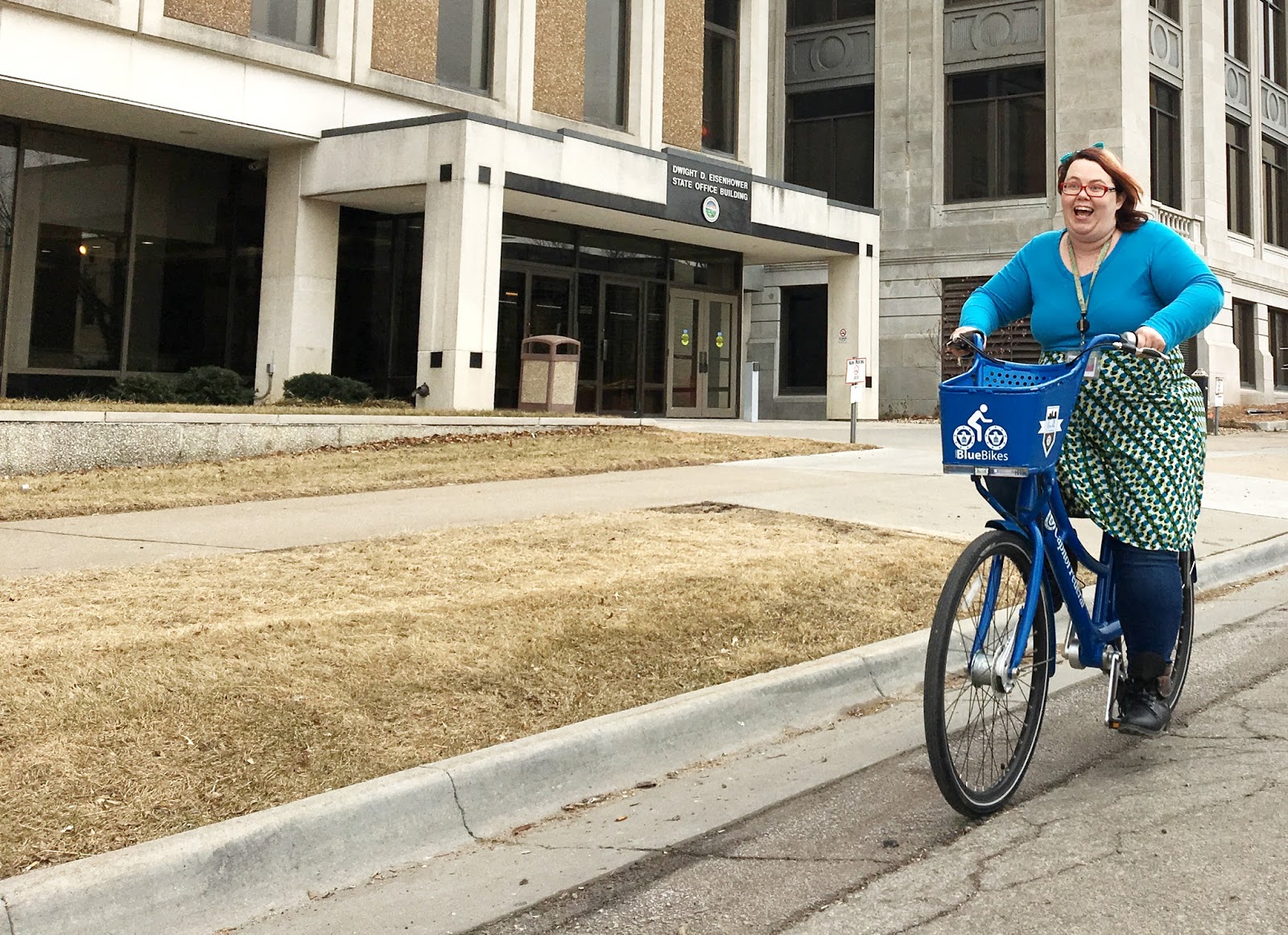
Mallory Goeke, a Communications Specialist for KDOT,
demonstrates how to check out a Metro Bike.
Topeka Metro Bikes has been awarded Transportation Alternatives (TA) funds to add over 200 bicycle parking spots and five bikeshare stations in Topeka.  The new stations and parking spots combined with a corporate sponsorship that increases the number of publicly available bikes in the program will make the city’s bike share program the largest among comparably sized metropolitan areas. 

“Walking and bicycling are important modes of travel for people of all ages and abilities throughout our state,” said Matthew Messina, bike and pedestrian coordinator for KDOT.  “By addressing these transportation needs, we help improve the quality of life for our communities by providing healthy and affordable forms of transportation that connect people to places of work, worship, education, public transit and recreation.”

Karl Fundenberger, Metro Bike director at the Topeka Metropolitan Transit Authority, said the funds will be used to help address the first mile-last mile gap for transit riders and provide infrastructure for a rapidly growing bike share program.

“Bike Share is thriving in Topeka,” Fundenberger said. “Biking provides additional mobility options, reduces traffic congestion and adds money to the local economy.”

The Transportation Alternatives (TA) Program provides funding for projects and programs defined as transportation alternatives that advance non-motorized transportation facilities.  Those federal dollars come directly to KDOT to be used specifically to assist in developing accessible transportation for those who can’t or choose not to use motorized transportation.

Mallory Goeke, a KDOT Communications Specialist, takes a spin on a Metro Bike. Topeka Metro Bikes was recently awarded a KDOT Transportation Alternatives grant to help expand biking as a transportation option in Topeka.
Topeka Metro Bikes has been working on helping biking grow as a transportation alternative in Topeka, starting in 2015 with 100 bikes available to rent and growing to 300 in 2018. 
“It’s going to get easier and easier to be able to choose to ride a bike in Topeka,” Fundenberger said.  “When more people choose alternative transportation, traffic flows smoother and more parking spaces are available.”

Both Messina and Fundenberger said addressing the equitability of transportation options is an important way to improve both the culture and the economy of the local area.
“By addressing the last mile barrier, the program helps contribute to the growth of our state by helping connect people to the rest of the city,” Messina said.

Fundenberger said the TA grant will be used in part to help fill in bikeshare gaps in eastern Topeka.  TA grant money will also be used to retrofit bus stops with racks to lock bikes and will add bike share stations as well as public bike racks in high-use areas. 

For more information on riding with Topeka Metro Bikes or to learn more about biking in Topeka, visit www.topekametrobikes.org or contact Karl Fundenberger at 785-730-8615.