Wednesday, February 28, 2018

Check this out: Buffalo Solider Memorial in Junction City

The Buffalo Solider Memorial is located in Junction City.

We finish Black History Month by visiting The Buffalo Soldier Memorial, which is located in Junction City and is dedicated to the 9th and 10th Horse Cavalry Regiments stationed at Ft. Riley – the famous “Buffalo Soldiers.”  The memorial wall is constructed of native limestone and serves as a backdrop for a 9-foot bronze sculpted statue of a Buffalo Soldier by his horse.  The site of the memorial is near a one-of-a-kind 1940s government housing area once designated for the Buffalo Soldiers and their families. These brick single-family dwellings are the only remaining set in existence today.

A close up of the Buffalo Soldier Memorial.
From 1866 through the Second World War, Buffalo Soldiers selflessly served and courageously fought in defense of our Nation and they are a reflection of the courageous sacrifice and magnificent service these men gave to the United States of America.  Native American tribes dubbed the black troopers “Buffalo Soldiers” as a sign of respect for the tenacity and valor they displayed in combat throughout the western frontier.

Tuesday, February 27, 2018

KDOT lets project to reconstruct pavement on U.S. 169 in southeast Kansas

KDOT will begin a pavement reconstruction on U.S. 169 in Allen County this spring. The 7.2-mile project begins five miles north of the Neosho-Allen county line and ends 2.7 miles south of U.S. 54 at Iola.

A project to reconstruct the pavement on a section of U.S. 169 in Allen County was included in KDOT’s February letting. Emery Sapp & Sons, Inc., of Kansas City, Mo., was the apparent low bidder on the $17 million improvement.

The U.S. 169 concrete driving surface has deteriorated since it was constructed close to 40 years ago.

The scope of the work involves replacing the mainline concrete driving pavement and the pavement on interchange ramps. The project begins at Delaware Road, located approximately five miles north of the Neosho-Allen county line, and continues north for just over seven miles to Minnesota Road. Work is expected to begin in late spring and continue into 2019. During construction traffic will be placed on a signed detour along U.S. 54, U.S. 75 and K-39.

Numerous cracks in the U.S. 169 pavement have required considerable maintenance through the years.

This stretch of U.S. 169 in Allen County was built with concrete in the early 1980’s. Heavy traffic use and varied weather conditions have resulted in numerous driving surface imperfections. In previous years these flaws were smoothed out by a process known as diamond grinding, which helped preserve the pavement while limiting disruptions to traffic. A full pavement replacement is now necessary. The reconstruction will take place within the existing highway right-of-way.

This photo shows diamond grinding on U.S. 169 in Neosho County, performed during 2017. Several times in previous years diamond grinding has been used on the Allen County highway pavement to smooth out imperfections.
“Because I know someone who is still with KDOT who provided inspection on this project when it was initially constructed, it doesn’t seem like it but, that pavement is approaching 40 years old,” said Jim Metcalfe, KDOT Southeast District Construction Engineer. “Maintaining it to an acceptable standard has become increasingly difficult in recent years and it will be a relief to our maintenance personnel to have this pavement replaced.”

Thursday, February 22, 2018

Transit Day at the Statehouse to take place Feb. 28


The Kansas Department of Transportation and the Kansas Public Transit Association invite you to attend Transit Day at the Kansas Statehouse in Topeka from 8 a.m. to noon on Wednesday, February 28.

“This year’s Transit Day will highlight the work that more than 150 agencies do to provide reliable, clean and useful transit and paratransit services to the people of Kansas,” said Transportation Secretary Richard Carlson. “Come meet the people who make our programs successful by transporting Kansans to where they live, work, learn, heal and play every day.”

Legislators and other attendees are invited to meet the state’s service providers, tour new transit and paratransit vehicles, learn how transit reinforces economic development in our state, and learn about new technologies being used in Kansas. The free event will include display tables located in the first-floor rotunda and vehicles available to tour outside on the apron surrounding the capitol.

A briefing on public transportation in Kansas will take place at 10 a.m. and speakers will include Secretary of Transportation Richard Carlson, House Transportation Chair Rep. Richard Proehl, Senate Transportation Chair Sen. Mike Petersen, and Susan Duffy, Chair of the Kansas Public Transit Association.

“Public transit is here for all – rural, urban, young and old alike. It supports the local economy and gives access to jobs and healthcare,” said KDOT Public Transit Manager Mike Spadafore. “Transit Day will give everyone the opportunity to learn about transit and paratransit services in Kansas and our goal of keeping the people of Kansas living in and connected to their communities for as long as possible.”

Wednesday, February 21, 2018

#IAMKDOT: Melissa Poe


When Melissa Poe arrived in the District 5 office on Oct. 21, 1996, to start work as an Office Assistant II, she never would have thought she’d still be working for KDOT 21 years later.
But the people – and the opportunity to move up in her career – keeps her in the Hutchinson office.

“I like the camaraderie between all of us in the office,” Poe said. “I enjoy what I do and like to help others.”

Poe, a diehard Broncos fan, has been the District Accountant for the past three years. In that role, she audits and approves payment vouchers, creates purchase orders, ensure policies and procedures are followed and answers questions from District 5 employees.
Poe and her wife, Kara, married on New Year’s Day. They have three teenagers.

Known for belting out tunes to beat the mid-afternoon blues, Poe enjoys singing karaoke and dancing. But she spends most of her time outside work with family – just the way she wants it.

She describes herself as hard-working, caring and understanding – just the way KDOT wants it.

#IAMKDOT is an illustration project that recognizes KDOT employees who work hard to keep Kansans moving. This series also serves as a reminder for travelers to slow down and remember that underneath those neon vests are individuals with families, friends and hobbies waiting for them at home.


Do you know a KDOT worker that deserves recognition? Nominations are open! Email Mallory.Goeke@KS.gov today to get started!
 

Tuesday, February 20, 2018

KDOT and Topeka Metro Bikes team up to increase bike share accessibility


While KDOT is known primarily for its maintenance, repair and construction projects on Kansas state roads, there is also a bureau responsible for planning the travel needs of pedestrians and bicyclists, and they have granted the bike share program in Topeka over $76,000 to make traveling by bike more accessible in the Topeka metro area.

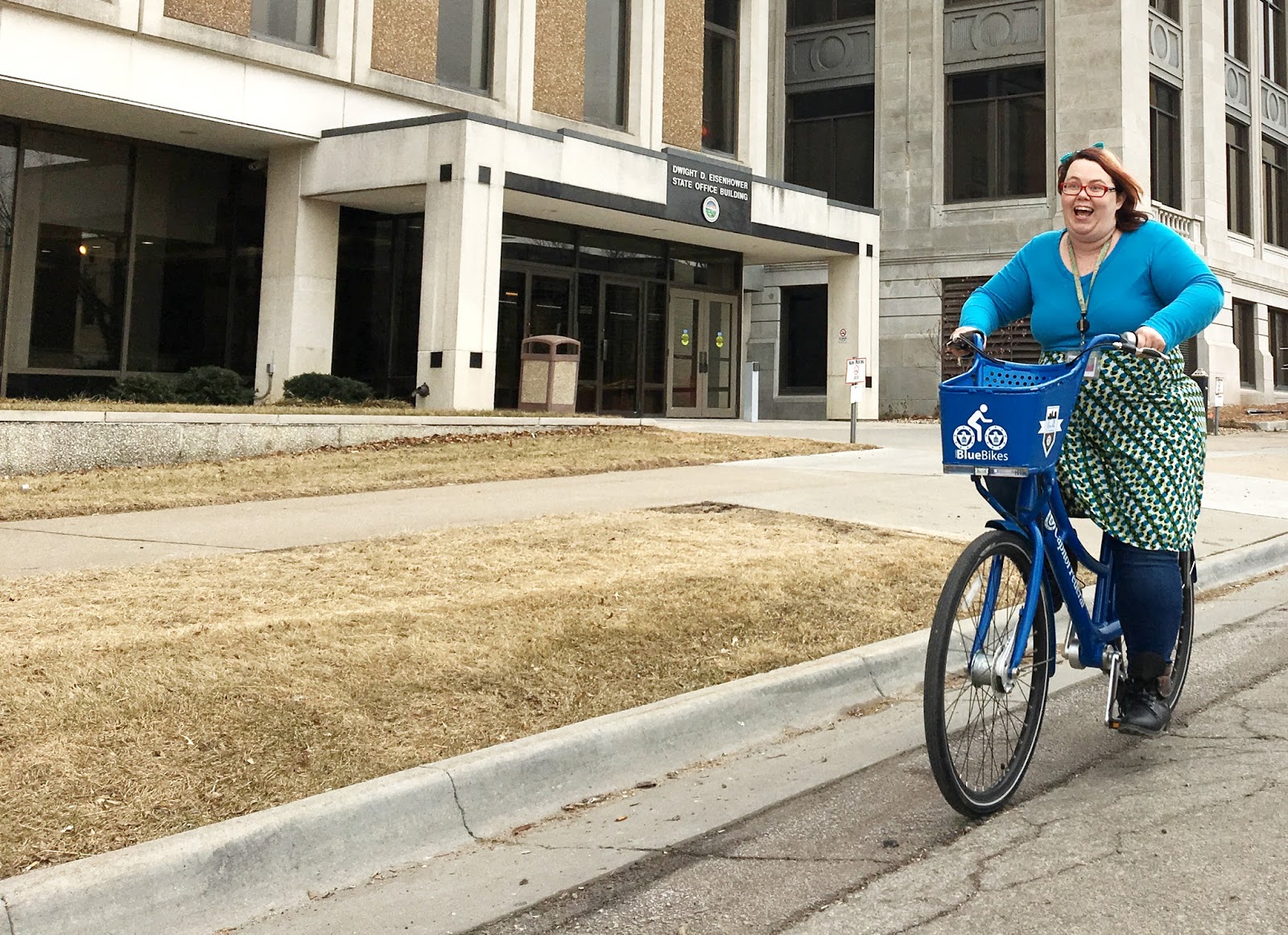
Mallory Goeke, a Communications Specialist for KDOT,
demonstrates how to check out a Metro Bike.
Topeka Metro Bikes has been awarded Transportation Alternatives (TA) funds to add over 200 bicycle parking spots and five bikeshare stations in Topeka.  The new stations and parking spots combined with a corporate sponsorship that increases the number of publicly available bikes in the program will make the city’s bike share program the largest among comparably sized metropolitan areas. 

“Walking and bicycling are important modes of travel for people of all ages and abilities throughout our state,” said Matthew Messina, bike and pedestrian coordinator for KDOT.  “By addressing these transportation needs, we help improve the quality of life for our communities by providing healthy and affordable forms of transportation that connect people to places of work, worship, education, public transit and recreation.”

Karl Fundenberger, Metro Bike director at the Topeka Metropolitan Transit Authority, said the funds will be used to help address the first mile-last mile gap for transit riders and provide infrastructure for a rapidly growing bike share program.

“Bike Share is thriving in Topeka,” Fundenberger said. “Biking provides additional mobility options, reduces traffic congestion and adds money to the local economy.”

The Transportation Alternatives (TA) Program provides funding for projects and programs defined as transportation alternatives that advance non-motorized transportation facilities.  Those federal dollars come directly to KDOT to be used specifically to assist in developing accessible transportation for those who can’t or choose not to use motorized transportation.

Mallory Goeke, a KDOT Communications Specialist, takes a spin on a Metro Bike. Topeka Metro Bikes was recently awarded a KDOT Transportation Alternatives grant to help expand biking as a transportation option in Topeka.
Topeka Metro Bikes has been working on helping biking grow as a transportation alternative in Topeka, starting in 2015 with 100 bikes available to rent and growing to 300 in 2018. 
“It’s going to get easier and easier to be able to choose to ride a bike in Topeka,” Fundenberger said.  “When more people choose alternative transportation, traffic flows smoother and more parking spaces are available.”

Both Messina and Fundenberger said addressing the equitability of transportation options is an important way to improve both the culture and the economy of the local area.
“By addressing the last mile barrier, the program helps contribute to the growth of our state by helping connect people to the rest of the city,” Messina said.

Fundenberger said the TA grant will be used in part to help fill in bikeshare gaps in eastern Topeka.  TA grant money will also be used to retrofit bus stops with racks to lock bikes and will add bike share stations as well as public bike racks in high-use areas. 

For more information on riding with Topeka Metro Bikes or to learn more about biking in Topeka, visit www.topekametrobikes.org or contact Karl Fundenberger at 785-730-8615.

Monday, February 19, 2018

Aviation Day Expands! Industry growth, economic development the focus for Mar. 1


The Kansas Department of Transportation Division of Aviation, in partnership with the Kansas Commission on Aerospace Education (KCAE) will hold their 4th annual Aviation Day event from 10 a.m. to 2 p.m. on Thursday, Mar. 1.

The event was initially created to provide networking opportunities and industry exposure but has expanded in scope and purpose. During this year’s event, a large gathering of legislators, manufacturers, suppliers, and aviation organizations, is structured specifically to help facilitate industry growth opportunities and address development potentials for Kansas economic stakeholders.

To facilitate, KDOT Division of Aviation will host an economic development training event for city officials at Memorial Hall from 9 a.m. to 10 a.m., before the start of Aviation Day. This will prepare commerce and development stakeholders to discuss, with over 36 industry leaders, how best to harness state and local resources to boost the aviation industry and best address global aviation and UAS needs for the future.

“This event highlights strong partnerships that Kansas manufacturers enjoy as a globally recognized aviation team,” said Bob Brock, KDOT’s Director of Aviation. “We are honored by the enthusiastic response to this event, and look forward to a year of growth for this industry.” 

In addition to the available industry development opportunities throughout the day, the event also serves to spread awareness regarding STEM and aviation education through the Kansas Commission on Aerospace Education (KCAE). Lindsey Dreiling, President of KCAE, also highlighted the mentorship opportunities that the event provides Kansas aviation organizations. “Today, we celebrate the opportunity for aviation leaders to shape the future of our state by leveraging their resources to train Kansas youth as leaders of tomorrow.”

Companies that will be present include: Airmap, Bombardier, Garmin, Spirit Aerosystems, Textron Aviation, University of Kansas Engineering, Wichita State University, Lee Aerospace, Kansas Air National Guard, Westar, AOPA, Butler Community College, Burns & McDonnell, Civil Air Patrol, Commemorative Air Force, Cosmosphere, Explorer Post 8, Flight Safety, Garver, Kansas Associate of Airports, Manhattan Regional Airport, Kansas Agricultural Aviation Association, Kansas State Polytechnic, Lifeteam, NIAR, Pilots for Christ, Pulse Aerospace, VAA, Wichita Aero Club, Exploration Place, Dodge City Community College, Kiewit, Kansas Aviation Museum, EAA Chapter 88, NBAA, Wichita Area Technical College, NCAT, National Weather Service, and Mission Aviation Fellowship

Thursday, February 15, 2018

Black History Month transportation legends: Garrett Morgan


There is a lot of technology in the modern day that our society takes for granted. Yet, all the technology we use on daily basis came from inventions created to make life a little easier, and in some cases, safer. Today’s featured transportation legend saw a problem that needed to be fixed and laid down the foundation for an object most people use every day: The three-signal traffic light.

Garrett Morgan was an inventor who was born on March 4, 1877, in Paris, Kentucky.  After leaving home at the age of 14, he made it to Ohio and became a handyman in Cincinnati. Later, he moved to Cleveland and worked as a sewing machine repairman. After a few years, he was able to open his own sewing machine repair shop.

In the early 1920s, horse-drawn carriages, bikes, wagons, streetcars, automobiles and pedestrians shared the same infrastructure and streets became quickly congested. At this time, there were manually operated traffic signals at intersections but their effectiveness left much to be desired. They switched between “Stop” and “Go” quickly and gave drivers little-to-no warning. Without time to react, collisions were common.

 It is said that Morgan saw a serious crash and it prompted to him to design a three-way traffic signal to help give drivers more time and clear intersections before traffic entered.

“The signal Morgan patented was a T-shaped pole with three settings,” according to History.com. “At night, when traffic was light, it could be set at half-mast (like a blinking yellow light today), warning drivers to proceed carefully through the intersection.”

An example of Morgan's traffic signal. Source: National Museum of American History
Ohio History Central’s website said that the invention had three types of signals that said; “Stop,” “Go,” and “Stop in all directions.” The latter signal was created to allow pedestrians to cross the streets safely.

Morgan sold the rights to his invention to General Electric for $40,000. He is responsible for several other inventions, including the gas mask. He even developed his own newspaper called the Cleveland Call.

Morgan died in 1963 and although his traffic signal is not the same model we use today, it is because of Morgan that we have an interim or “caution” signal that helps clear intersections so traffic can move at a safer pace.