Showing posts with label Trucks. Show all posts

Thursday, January 24, 2019

Beet juice offers alternative solution to snow fighting


By Lisa Mussman
Public Affairs Manager for northwest Kansas

For decades, KDOT has used a combination of sand, salt and salt brine as part of their snow fighting efforts, but crews in parts of northwest Kansas have added a new tool to their arsenal in recent years: Beet juice.

Beet juice is an agricultural by-product from the process to make goods such as table sugar and cattle feed. As a standalone product, beet juice has little to no melting properties, but when mixed with salt brine, it will help the brine continue to work at lower temperatures to treat icy and snow-packed surfaces. Regular salt brine begins to lose effectiveness at around 15 degrees Fahrenheit. When beet juice is added, the freezing point can be lowered by another 15 to 20 degrees.

Colby Subarea Supervisor Brad Reeh says his crew has been using the product for about five years and has had success with it.

“We have been mixing it at a 10 percent ratio with brine and only using it when the temps are going to be below 15 degrees.” Reeh said. “When combining it with brine and salt and sand, it seems to stick to the snow-pack better and keep the product working on the road longer.”

That stickiness and staying power is important in allowing KDOT crews more time to work on other routes if needed. But don’t expect to see the roads turning red or purple. The solution is actually brown in color and can be easily washed off vehicles.

While beet juice is still relatively new to Kansas, it has been used in the Northeast and Upper Midwest since the early 2000's. It is among a handful of alternative products including molasses, beer waste, pickle brine and cheese brine that other departments of transportation are experimenting with to reduce salt usage.

Wednesday, February 14, 2018

Show someone how much you care: Drive safely


Valentine’s Day means different things to different people. Today can be a day of romance, a day to celebrate with friends or even treating yourself to that extra piece of chocolate.

Whether you are celebrating today, or looking forward to the discounted candy tomorrow, keep in mind there are many ways to express that you care about others. One of those ways is by driving responsibly and teaching others to do the same.

You can teach those you care about to protect themselves every time they get in a vehicle by explaining the importance of seat belt use. Lead by example and wear a seat belt each and every time you get behind the wheel. They’ll get the message.

Driving while distracted, especially with other people in the vehicle can seem like it’s not a big deal. At the same time, if someone is looking at their phone and texting while driving, a message is sent in more ways than one. It only takes a few seconds for a seemingly harmless message to change the lives of the people in  your vehicle forever.

Similarly, driving over the speed limit or not following the rules of the road can send the message that getting to your destination is more important than the lives of the people you share the road with.

Showing care for others is both a verb and a choice. By making smart decisions, like wearing a seat belt, ditching the distractions, driving sober and obeying the speed limit, you express to everyone how much you truly care.
What message will you send the next time you get behind the wheel?

Tuesday, January 9, 2018

#KDOTTUESDAY: Mine grouting continues on K-7 modernization project

An agitator truck is ready to pump grout through the hoses to the stinger. The grout mix can be pumped directly into the top of the truck at the concrete plant on the project.

The long pipe on the track hoe boom,
called a stinger, pumps grout through
previously drilled holes to fill the 
underground voids and form a 
barrier wall.
Today's #KDOTTUESDAY takes us to southeast Kansas.

Long-abandoned underground mine voids that were part of the Weir-Pittsburg coal bed are being filled as part of the K-7 widening and modernization project in Cherokee County. Crews have been working steadily to pump concrete grout into holes drilled five feet apart along a four-mile section of the project.

 The grouting will create a barrier wall to support the new highway alignment to the west of the centerline.  According to Regional Geologist Denny Martin, the completed barrier wall will convert the mine voids into room-like spaces. These small underground rooms will then be filled with more grouting material.

The entire project includes 11 miles of K-7 from U.S. 160 at Columbus north to U.S. 400 at Cherokee. The roadway is being widened to 44 feet, with 12-foot driving lanes and 10-foot shoulders. The first phases of work started in 2016. 

The mine grouting is part of the final phase of highway reconstruction, from U.S. 160 north to K-102. Koss Construction of Topeka is the primary contractor.


Tuesday, December 26, 2017

#KDOTTUESDAYS: Sharing the road with Semi-Trucks


With more  than 2 million semis on the road every day, it is easy for other drivers to take the semi and the driver for granted.  However, by understanding the challenges that semis and their drivers face, others on the road can drive more defensively and possibly avoid a serious collision.

According to the National Highway Traffic Safety Administration, there are nearly 450,000 collisions, approximately 140,000 people are seriously injured and at least 5,000 motorists die as a result of a crash involving a semi or large truck in the U.S. each year.

Because a commercial semi can weigh as much as 80,000 pounds and most passenger vehicles weigh 3,000 pounds or less, collisions involving commercial trucks are often the most damaging and dangerous on the roads.  Many drivers believe that because the truck is bigger, the truck is at fault.  However, statistics show that 72 percent of crashes involving semis are the fault of the other vehicle. 

Drivers can minimize the risk of a collision involving a semi by better understanding these vehicles, the challenges semi drivers face and by driving defensively.

Semis have blind spots just like passenger vehicles, but because semis are taller and longer, they have twice as many blind spots. To limit the possibility of a crash, drivers should avoid the blind spot or “no zones,” when sharing the road with semis.

The passenger side of a semi has a much larger blind spot than the driver side. As a result, drivers should pass on the left side of the semi whenever possible and not drive in the blind spot on either side unless passing.  In addition, drivers should allow extra room before cutting back in after passing, to avoid the front blind spot.

Because semis are much larger and heavier than a passenger vehicle it is much more difficult to maneuver, especially in tight situations where quick movements or lane changes are necessary. Their size also makes it impossible to come to a sudden stop. It can take a semi traveling 60 miles per hour almost the length of three football fields to come to a complete stop.  Passenger vehicles should always give the semi plenty of room and respect the semi’s space.

Finally, many trucking companies require speed limiters which limit the top speed at which the semi can travel.  This means the semi may not be able to maintain the same pace as the surrounding traffic.  Drivers should be patient and move around the semi when it is safe to do so.

Monday, December 18, 2017

Truck Parking Information Management System project underway

Truck Parking Information Management Systems help inform truck drivers about parking availability in rest areas. 

The Kansas Department of Transportation has joined together with seven other states in the Mid America Association of State Transportation Officials (MAASTO) to develop a multi-state Truck Parking Information Management System.  This TPIMS project will improve the safety and efficiency of America’s freight network by providing real-time parking availability information to truck drivers through dynamic message signs, smart phone applications, traveler information websites, and other communication methods.  With implementation of the regional TPIMS project, commercial truck drivers will be able to find available parking more easily and efficiently route themselves to those locations, increasing their productivity and lowering their costs.

In 2013 a national survey revealed that 83 percent of drivers routinely took longer than 30 minutes to find parking.  Drivers who have not located parking before reaching their hours of service limits are often forced to park illegally or unsafely, often on the shoulders of highways, on off ramps, or at abandoned facilities.  This loss of productivity adds six percent or more to labor costs associated with moving goods through the national freight network.

KDOT began installation of TPIMS on Monday, December 11.  These signs will provide the number of available truck parking spaces at 18 rest areas along I-70.  Each sign shows parking spaces available for two to three rest areas to give trucks an idea how full parking areas are five, 30, 60 miles ahead, as an example.  We are using a “computer vision” 
system that uses cameras to build a 3D image of the parking area so available spaces can be automatically detected.  Most rest areas will have two camera poles installed near the truck parking area and each pole will have three cameras mounted on it to produce the 3D image.

Deployment of this innovative system is scheduled for the Fall of 2018.

Wednesday, October 18, 2017

Preparing for winter weather: KDOT employees participate in snow-fighter training

Sunshine will soon be replaced by snow and when that happens, the Kansas Department of Transportation will be ready.

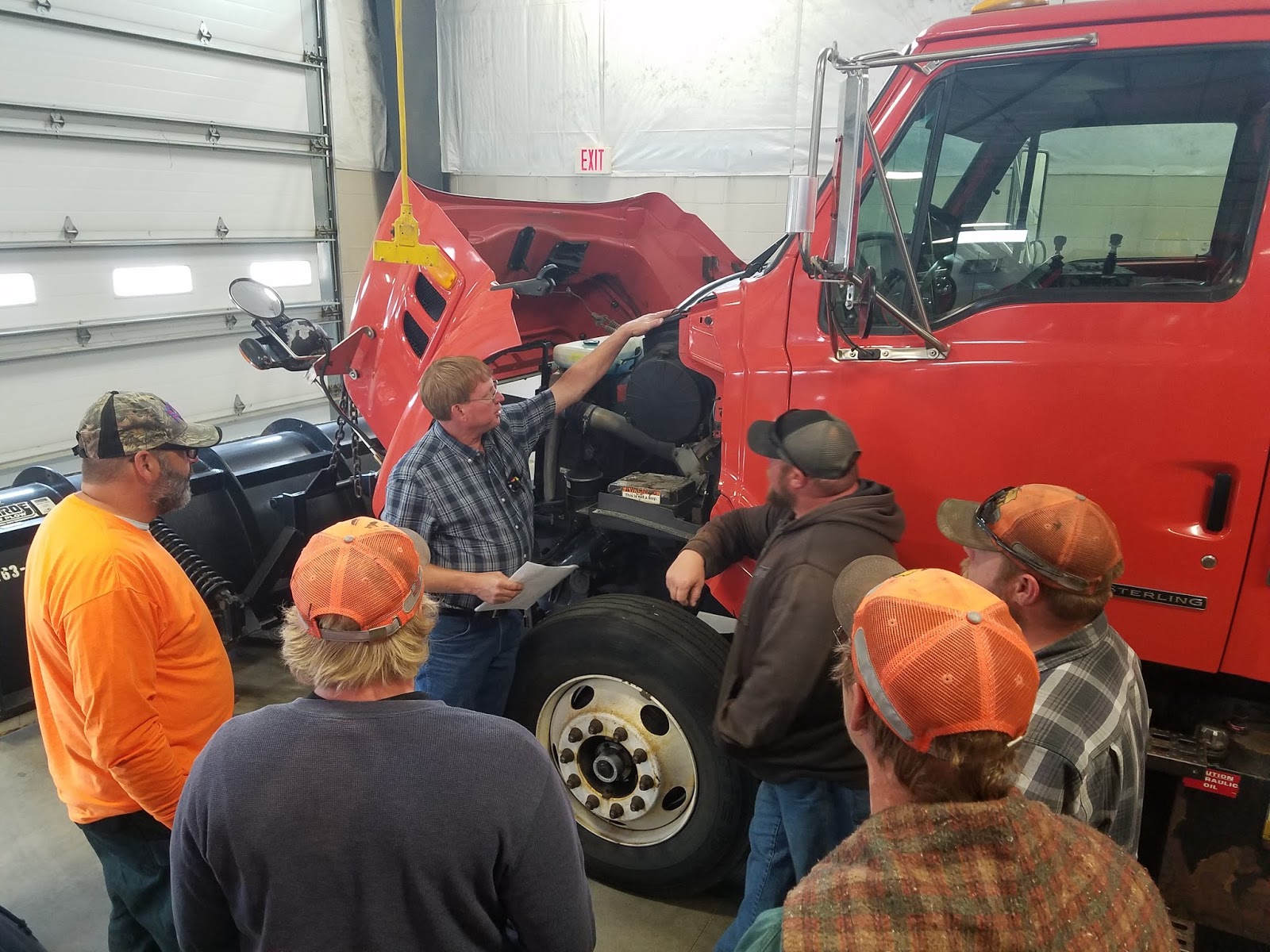
 In preparation for the upcoming snow and ice season, KDOT Equipment Operators from across northwest Kansas completed Snow-fighter Basic Training last week in Wakeeney.

KDOT Equipment Operators from across northwest Kansas took part in the snow-fighter training last week in Wakeeney. 
This is the fourth year the training has been held. Sessions were led by experienced KDOT operators and consisted of both classroom and hands-on activities. KDOT equipment operators learned about plowing procedures, chemical application, front and wing plow usage, spreader operations, towing safety, mechanic training and decision making. 

Earlier this month, crews in north central Kansas also participated in snow-fighter training. All new Equipment Operators, Equipment Mechanics and Engineering Technicians from the area received both classroom work and hands-on training. 


KDOT crews practice using maneuvering the snow plow earlier this month at the Salina Subarea.

So when the precipitation starts, your local KDOT operators will be on the job. No matter what the weather is doing, you can check out www.Kandrive.org for traffic and road information. 

KDOT crews underwent snow-fighter training earlier this month in north central Kansas. 

Thursday, July 6, 2017

Touch a Truck event provides fun for all ages

The Touch a Truck event hosted more than 1,500 children and families and gave them a chance to experience a variety of important vehicles in person. 
More than 1,500 children and families had the chance to see and experience 30 vehicles on display at the Touch a Truck event last Saturday in Finney County. The event, which was hosted by the Finney County Public Library, hosted 24 organizations, including the Kansas Department of Transportation.

KDOT employees from the Garden City Sub Area stand in front of a KDOT dump truck.
The event kicked off with the arrival of the Life Team helicopter and included lunch for those attending and volunteers.  People of all ages seemed to enjoy seeing the vehicles up close. Children who attended the event interacted with KDOT vehicles by honking the horns and exploring the equipment. 

Young children explore the inside of a KDOT vehicle during the Touch a Truck event held in Garden City on July 1. 
Lisa Knoll, the KDOT Public Affairs Manager for Southwest Kansas, said that KDOT crew members answered questions and taught visitors about how the vehicles are used and how they help keep Kansas moving in various situations.
"The first thing most kids did was go straight for the loader," Knoll said. "They were intrigued with sitting in the loader and they loved honking the horn. We also showed them the dump truck.”


Knoll said that KDOT would love to participate in an event like this again if the opportunity arises.