Showing posts with label Kansas Highway Patrol. Show all posts

Tuesday, November 12, 2019

Highway Safety 101: Don’t get lulled over


Technical Trooper Chad Crittenden pulls over to watch traffic near I-235 and Zoo Boulevard in Wichita.


By Tim Potter
Southcentral Kansas 
Public Affairs Manager

I’m belted comfortably into the passenger seat of a gleaming, heavily equipped Kansas Highway Patrol SUV. It’s one of those sun-drenched fall days when a driver can see for miles. It’s a perfect time for traveling, on highways engineered for ease and safety.

The person driving me around the Wichita area in a 2018 Ford Interceptor Utility is an expert driver -- Technical Trooper Chad Crittenden. He’s been patrolling state highways as a trooper for more than 16 years. He teaches defensive driving.

Yet, even on days like these, people still die or get maimed on Kansas highways.
Why?

“Complacency,” Crittenden says without hesitating. Complacency is a dominating factor in car crashes that he responds to in the Wichita metro area.

By complacency, he means the situation where a driver gets lulled into a false sense of security. They’ve never been in a bad accident. They assume the driver on the side road will not suddenly pull out in front of them. To compound the risks, they might not wear a seat belt. They might drive while on their cell phone, chatting, texting or fidgeting with the radio or comfort controls. So far, the multitasking has led to nothing tragic. So they keep doing it, eyes and brain diverted as they cruise at 60, 70, 75 … 

“We’re not as focused as we possibly should be,” Crittenden says. “You have to be looking here and there,” he says, his eyes scanning back and forth as he motors west on K-254 past a side road. It’s the same spot where two vehicles collided with fatal consequences a few months back.

According to Kansas traffic statistics, the by-far biggest single factor in crashes during 2017 was inattention.

That same year, most accidents occurred during daylight hours, 63 percent; in good weather conditions, 88 percent; with dry pavement, 87 percent; and where the road was straight and level, 77 percent.

To Crittenden, winning the game of safe driving starts with a mindset, a discipline – to always be prepared to survive when the unexpected happens. It includes practicing the most basic death-defying thing that people keep ignoring – wearing a seat belt.
How does he enforce safe habits?

From his driver seat near I-235 and Central, he zeros in on a small, white Nissan sedan because he can see that the woman driving it is not wearing her seat belt. She quickly pulls over after he activates his flashing lights, and he will issue a ticket for not wearing a seat belt but only warn her for not signaling a lane change.

When he tells her why he stopped her, she says about the seat belt, “I just left class. I think I forgot. … I remembered it when I saw your lights, though.”

He suggests that she stick a note on her dash to remind herself to buckle up. “Yeah, I guess,” she good-naturedly replies. “Please wear your seat belt,” he responds. “OK,” she says. “Thank you.”

Not all drivers react so politely. “Don’t you have anything better to do?” the rude ones say. Some still contend it’s their “right” not to wear a seat belt.

Technical Trooper Chad Crittenden stops a driver along I-135 for an expired license tag. For his safety with passing traffic, he stands to the passenger side of the vehicle while talking to the driver. 

In teaching safety, Crittenden urges his defensive-driving students to avoid the situation that often causes aggressive driving: leaving late and giving in to the urge to drive too fast and on edge. So he reminds his students to leave early and avoid the aggression and stress.

It comes down to this, he says: Patience saves lives. It translates to not speeding around every car, maybe waiting a second or two longer and passing safely, under control.
When he exits onto a ramp, for example, he checks his mirror to make sure someone isn’t closing in on him too quickly. He’s alert to the potential danger of impatient drivers.
And then it happens: Minutes after he talks about the importance of staying patient, while driving east on K-96 approaching Rock Road, he notices a car right behind his marked patrol unit.

The driver “is in a hurry,” he says. “She’s going to tailgate a trooper,” he exclaims, before she veers off onto the exit ramp to Rock, seemingly oblivious to or unfazed by the traffic safety enforcer in front of her.

She was lucky this time.

Another thing that should be part of the mindset, part of preparation for driving: Getting enough sleep. Crittenden views a drowsy driver as being just as dangerous as a drunken driver. The only difference is the legality.

So while teaching his defensive-driving classes, he asks his students how many of them got eight hours of sleep the night before.
Only a few raise their hands.

Tuesday, October 15, 2019

Kansas kids win poster/video contests, focus on improving traffic safety


Von Woleslagel of Hutchinson's poster was a statewide winner in the 11-13 year-old age group.  

Statewide winners of two contests have been announced as part of the national safety campaign Put the Brakes on Fatalities Day.

For the poster contest – Quincy Coup of Hope, Emma Kuhlman of Topeka and Von Woleslagel of Hutchinson are the statewide winners. Each student was selected as a regional winner and will receive a bicycle donated by the Kansas Turnpike Authority and a helmet donated by Safe Kids Kansas at presentations at their schools. A total of 434 Kansas kids ages 5 to 13 participated.

Emma Kuhlman of Topeka, was the statewide winner in the 8-10 year-old age group. 
As statewide winners in their age categories, they will also receive a Kindle Fire tablet from the KTA, a $50 gift card from the Petroleum Marketers and Convenience Store Association of Kansas and movie passes from AAA Kansas along with a $200 donation to the school, class or booster club. 

Quincy Coup of Hope's poster won in the 5-7 year-old age group. 


For the video contest – Students from Lansing High School won first place. They will receive first choice of an iPad, GoPro or DJI Osmo Pocket along with a $500 donation to the school, class or booster club, donated by the KTA.

Students from Eudora captured second place, and students from Shawnee Mission West High School placed third in the video contest. Each will receive one of the remaining prizes listed above. There were 35 entries from teens across the state. To see the winning videos, go to https://bit.ly/2ANyoHk


Organizations that work together on this safety campaign include the Kansas Department of Transportation, Kansas Turnpike Authority, Kansas Highway Patrol, Kansas Traffic Safety Resource Office, AAA of Kansas, Kansas Contractors Association and the Federal Highway Administration – Kansas division.

Put the Brakes on Fatalities Day is a nationwide effort to increase roadway safety and reduce all traffic fatalities. For more information and a list of all the winners across Kansas, go to www.ksdot.org and click on the Put the Brakes on Fatalities Day information.

Wednesday, August 14, 2019

Kansas Law Enforcement warns: Don’t drink and drive


Impaired drivers to be tested during “No Refusal Weekend”


Topeka, KS - As the summer season concludes over the next few weeks, Kansas law enforcement will be doing all they can to keep the roads safe from impaired drivers. Beginning on Aug. 14 and through the Labor Day weekend, more than 150 law enforcement agencies from across the state will join forces in a concentrated effort detecting and removing the impaired driver.

This year’s campaign includes a No Refusal Weekend, Aug. 16 – 17, when all suspected impaired drivers who refuse breath testing may be subject to blood testing for alcohol and/or drugs. This No Refusal Weekend, law enforcement officials may work in coordination with prosecutors to obtain blood draw warrants for drivers who refuse breath and/or drug testing. No Refusal programs help ensure that prosecutors obtain the scientific evidence needed to effectively prosecute cases involving impaired driving.

“My hope is there are no impaired driving crashes or fatalities in the state of Kansas,” said Kansas Highway Patrol Superintendent Herman Jones.  “Make the right decision, don’t get behind the wheel impaired. The impaired driver makes the choice to endanger themselves and everyone else on the road.”

According to the National Safety Council, 40 percent of car fatalities occur in the summer months. The Labor Day holiday brings increased traffic and unfortunately, a higher-than-normal number of deaths related to impaired drivers on the road. On average, impaired drivers cause about one-third of all traffic fatalities in Kansas. Across Kansas, impaired drivers injure or kill more than 2,200 people each year in car crashes.

“We want everyone’s summer to end on a high note and not in a senseless death that is 100 percent preventable,” said Chris Bortz, Kansas Department of Transportation Traffic Safety Program Manager. “Law enforcement will be vigilant in their efforts to keep everyone safe, but everyone has a personal responsibility in this effort; not just law enforcement.”

The 22-day enforcement campaign will be supported with statewide education and on-the-street vigilance by law enforcement.  This year’s campaign reinforces that no excuse is a good excuse for driving impaired. Designate before you celebrate, use a ride sharing service or get a ride from a sober friend are just a few ways to get home safely.

Impaired drivers can face jail time, suspension of their driving privileges, fines and other costs of up to $10,000. In addition, the offender will be required to install and pay monthly services fees on an ignition interlock. Beyond the financial and legal penalties, impaired drivers face the risk of losing their own lives or taking someone else’s.

Tuesday, July 2, 2019

Be prepared for Independence Day and summer travel


Summer travel is heating up across the country and many people will celebrate this holiday weekend by hitting the road and traveling to - and through - the Sunflower State. The Kansas Turnpike Authority and Kansas Highway Patrol and The Kansas Department of Transportation are partnering to remind motorists to travel safely during Independence Day, and throughout the rest of the summer.

From July 3 through July 5, KHP personnel will be working in support of the Combined Accident Reduction Effort (C.A.R.E.) enforcement, along with personnel from other states. C.A.R.E. focuses on occupant protection, impaired driving laws, and other crash-causing traffic violations. C.A.R.E.’s goal is increased safety and ease of travel on our nation’s roadways.

Being prepared for any summer travel is a big factor in keeping your trip running smoothly,” said Steve Hewitt, Kansas Turnpike Authority CEO. “For our travelers on the Turnpike, if you find yourself needing roadside assistance, our State Farm Safety Assist program is available in our busy corridors to help get you back up and running.”

Before travelers pack their cars, they can check their route for potential delays or construction with the help of KanDrive, www.kandrive.org. KanDrive includes camera images and interactive maps as well as links to rest areas and travel and tourism sites.

Smartphone users can access the site by going to www.kandrive.org and bookmarking it to your home screen so it’s ready when you need it. If users would prefer to use the text-based mobile website, it can be found at 511mm.ksdot.org.

Much of the same information can be accessed by calling 5-1-1 in Kansas or 1- 866-511-KDOT (5368) in the U.S. Before hitting the road, drivers and their passengers need to buckle up.

“Drivers need to set a good example by wearing their seat belts,” said Julie Lorenz, Kansas Secretary of Transportation.

Studies in Kansas show that if the driver is belted, about 95 percent of all other passengers in the vehicle are properly restrained.  If the driver is NOT belted, it’s only 25 percent of the other passengers.

“Seat belts save lives every day,” Lorenz said. "It is easy to do and could save your life.”

The agencies wish all of those traveling during the upcoming holiday, safe travels. If you are in need of help on a Kansas highway, you can call KHP for assistance at *47 (*HP) or *KTA (*582) for the Kansas Turnpike.

As you enjoy your summer travels and celebrate Independence Day, the agencies offer some tips to help you and your family have a blast:

  • It’s hot out there so make sure your vehicle is in proper working order for the heat of summer - check fluids, tires, the air conditioning and cooling system.
  • When you leave, start off with a full tank of gas and a fully charged phone.
  • Plan your route of travel and check www.kandrive.org for construction, and other issues with your travel plans. The site also has links to other states’ travel information. Also give a family member your travel plans. 
  • As you travel, remember to Move Over for first responders and highway maintenance crews. If you are unable to Move Over, then Slow Down.
  • In case of a break down, keep emergency supplies in your car, including bottles of water, a phone charger, and non-perishable food items.
  • Ensure everyone in your vehicle is using their seat belt and/or an appropriately-fitted child safety seat.
  • Arrange for a designated driver ahead of time if you’ll be consuming alcohol. Do not drink and drive.
  • If you’re hosting a party, have non-alcoholic drink alternatives available for designated drivers. 


Tuesday, April 2, 2019

Below 100: Law enforcement training combats complacency with safe practices


By Priscilla Petersen, southeast Kansas Public Affairs Manager 

Transportation safety is for everyone all the time. We recently had a chance to sit in on safety training for law enforcement officers, which was sponsored by KDOT. 

“We’re still killing ourselves by driving too fast and not wearing our seat belts,” instructor Adam Kary reminded his audience of law enforcement officials. An officer with the Topeka Police Department, Kary visited Iola recently to present the “Below 100” training to southeast Kansas police, sheriff and highway patrol staff.

 Adam Kary of the Topeka Police Department conducts ‘Below 100’ training for area law enforcement officers.
Below 100 is based on “Honoring the Fallen by Training the Living.” As the course began, Kary had everyone close their eyes and imagine themselves at a funeral for a fellow officer killed in the line of duty.

Every year since 1943, more than 100 law enforcement officers have been lost to line-of-duty deaths (LODD’s). “We need to hold ourselves accountable for our own actions,” Kary said.


The goal of Below 100 is to take LODD’s down to less than 100 each year, and to continue to reduce law enforcement deaths by addressing five crucial areas:

  • Wear seat belts;
  • Wear vest (body armor);
  • Watch speed;
  • Decide what is most important now;
  • Complacency kills.

Kary told the class that the three factors in vehicular LODD’s are excessive speed, not wearing seat belts, and being struck by another vehicle. He asked the group to consider the time it takes to drive from point to point, and to think about whether speeding would actually get them to their destinations more quickly. Kary added that vehicular stopping distances increase at higher speeds. “We are not just killing ourselves” by not controlling behaviors such as speeding, he said, but are putting others at risk.

Throughout the session Kary showed videos and camera footage from traffic stops to illustrate how important it is for officers to remain vigilant, keep themselves safe, and be able to prioritize what is most important about each traffic stop and interaction with the public. He encouraged officers to engage in ‘courageous conversations’ with colleagues about seat belt use and the other LODD contributing factors. “Ignored behavior is condoned behavior,” Kary said.

Although changing organizational policy and culture will take time, Kary reminded the group that “complacency kills.”


Thursday, March 7, 2019

Sky troopers: KDOT flies with the KHP Air Support Unit


Kansas Highway Patrol Captain Jason Vanderweide took us on a tour of the northeast corner of Kansas.

Normally when people think of the Kansas Highway Patrol, they often think of flashing lights, blue and gold uniforms and patrol vehicles on the highways. But did you know the KHP also has troopers that take to the skies?


They are the KHP Air Support Unit, and they respond to requests for air support from public safety agencies across the state.  Earlier this week, we were given the opportunity to join KHP Captain Jason Vanderweide in a Cessna 206 on a tour of northeast Kansas. We learned a lot about these sky troopers.


One of the planes that the KHP uses in its flights is a Cesnna 206, pictured here just before takeoff. 
According to Vanderweide, the KHP acquired its first airplane in 1961. Currently, there are three bases of operation: Topeka, Wichita and Hays. The unit consists of six aircraft, including the Executive Aircraft, which is a King Air 350.  

“We first used aircraft for traffic enforcement and soon added blood relays,” Vanderweide said. “We still transport blood today. When an outlying medical facility needs blood in an emergency, the most expeditious means of getting it there is to fly it. We routinely pick up boxes of blood in Wichita and fly it to the rural areas of Kansas.”


Vanderweide said that there are a variety of missions that the KHP responds to, and each day brings a unique mission for the pilots.

“There isn’t a typical day for a KHP pilot,” Vanderweide said. “No two days are ever the same. As the KHP provides the only public safety air support to Kansas, we are often called to all areas of the state for a variety of missions. When pilots aren’t on a mission, they are training for advanced pilot ratings, helping the maintenance crew or out working the road - stopping cars or working accidents.”

They also relay information that they see in the air to the troopers on the ground and they can do that through the statewide radio network, or in person for time-sensitive material.
After major weather events, the KHP Air Support Unit assesses road conditions and attempts to identify stranded motorists. These events can include winter storms, floods, tornadoes and even wildfires. Once they spot the signs of a stranded vehicle, they then alert troopers on the ground.

There are other types of missions that the KHP Air Support Unit supports, such as:
  • Shootings / LE shootings / Active shooters
  • Crime scene photos / Accident photos
  • Missing persons / children
  • Prison riots  
  • Aircraft accidents
  • Infrastructure disasters – chemical plant explosion / derailments
  • Executive visits
  • Transportation of personnel and equipment
  • Pursuits
  • Manhunts
  • Surveillance flights
  • Safety programs and public relations
A view of K-10 from about 1,000 feet above the ground.

During our flight earlier this week, we learned that the aircrafts can travel at different altitudes depending on the situation. If the troopers are looking for a missing person or stranded vehicle, they typically fly around 1,000 feet above the ground. If they are doing surveillance work, they typically fly at altitudes of 4,000 feet or higher.

Vanderweide said that he has been flying with the KHP since 2008 and has logged more than 1,900 flight hours. There are other pilots who have anywhere from 4,000 to 9,000 flight hours and they even have other troopers who are training to become pilots.

“All KHP pilots were troopers first,” Vanderweide said. “We select troopers after they have served time working the road, and we bring them into the unit and train them to fly. The training aspect can take years to obtain the advanced rating to fly the Executive Aircraft or helicopter.”

Aside from manned aircraft, the KHP is also in the process of purchasing several Unmanned Aerial Systems (UAS) that will be used in a variety of missions.

“The UAS will be used in the area of accident reconstruction, Special response team missions and mobile field force,” Vanderweide said. “The Air Support Unit oversees administering the UAS program to ensure KHP is deploying the UAS appropriately and following all pertinent FAA regulations. It will be an integration project involving manned aircraft and unmanned aircraft working together to accomplish the mission in the quickest means available.”

Thanks once again to Vanderweide and the KHP Air Support Unit for taking us up with you!

Wednesday, May 9, 2018

Teens from across the state gather to learn about traffic safety


The Kansas Teen Transportation Safety Conference started out with a  video greeting from Trooper Ben Gardner and surprise guest, American actor Eric Stonestreet. Together, they welcomed a group of more than 200 high school students who attended the first day of the event in Topeka. The students are leaders of traffic safety programs at their schools.

Laykn Leigh, a sophomore from Ellsworth High School, said that the first day of the conference was very interesting.
"The conference was really eye-opening," Leigh said. "We plan on bringing a lot of information back to our school."
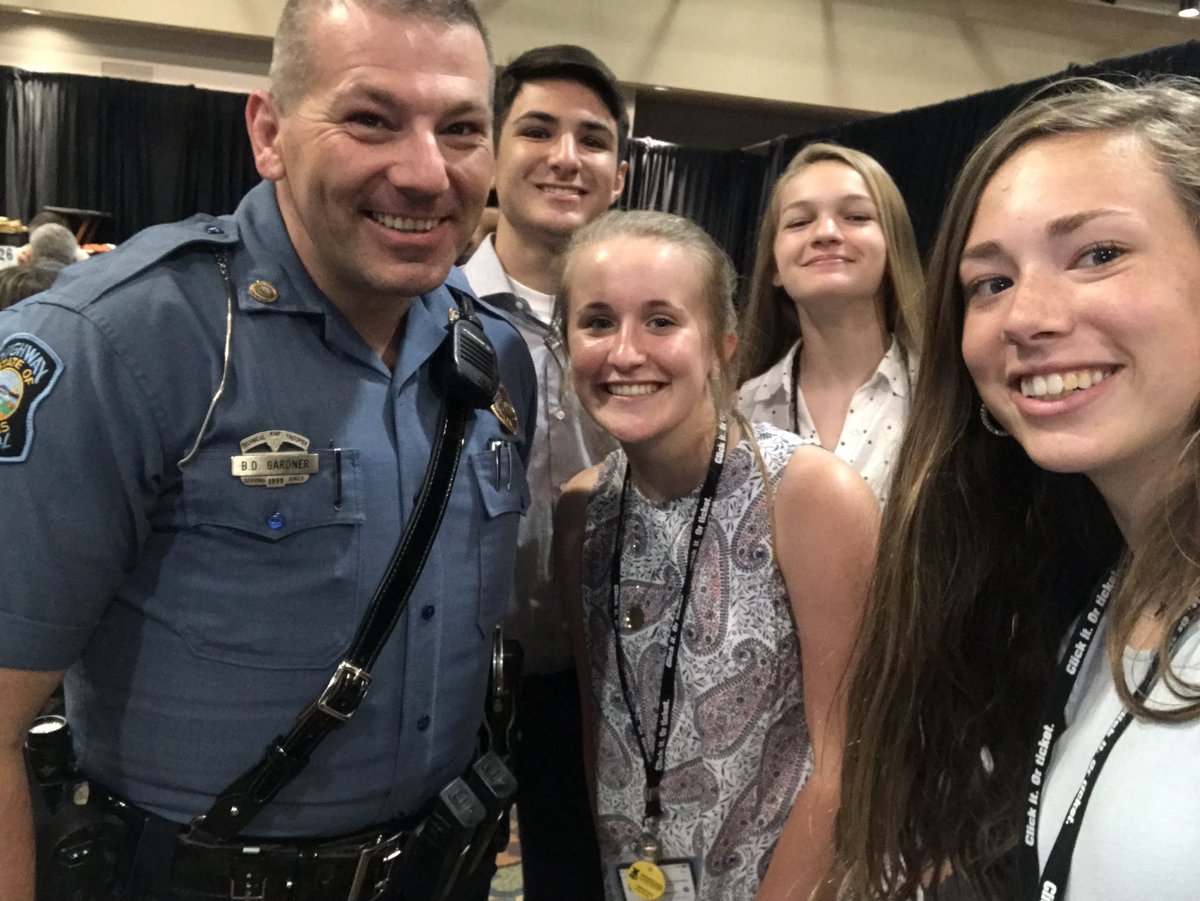
Students from Ellsworth High School snap a selfie with Trooper Ben Gardner. They were a few of the many students who attended the Teen Traffic Safety Conference in Topeka. (Courtesy photo)

The conference, which is sponsored by the Kansas Department of Transportation and AAA, is designed to share timely topics of interest to the transportation community. It is bringing students together to collaborate, develop their leadership and strengthen their communications and teamwork skills. Once they return home, they will then have the opportunity to educate their peers and communities about the importance of improving traffic safety behaviors.

Students from Goodland High traveled across the state to attend the first Kansas Teen Transportation Safety Conference. 
While at the event, traffic safety professionals and Kansas safety advocates will continue to have the opportunity to share with the students during interactive sessions. Scholarship opportunities from Stonestreet are being awarded during the conference. The event ends this afternoon. 


Monday, April 23, 2018

KDOT rides along with the Kansas Highway Patrol

KDOT took a ride with Master Trooper Neil Stanley on April 20 to teach others
about the importance of driving sober and to learn what its like to be a trooper. 
There is a popular saying that encourages others to walk a mile in someone else’s shoes, so you can understand what their world is like.  Last Friday, we decided to trade in shoes for a Kansas Highway Patrol vehicle when we got a chance to experience a day in the life of a Kansas Highway Patrol Trooper with Master Trooper Neil Stanley. 

Our goal was to ride along at the beginning of the drugged driving enforcement and tweet about our experiences as they happened. One of the biggest messages that Stanley hopes people will understand is impaired driving isn’t just limited to alcohol. He said if there is any substance being used that can impair your driving, it is something that could result in an arrest and have a license revoked.

While on the ride, Stanley explained how KHP officers rely on both their observation skills and radar technology to determine how fast drivers are going.  While a few of the stops were to enforce the speed limit, there were several instances where Stanley was able help stranded and lost drivers.

As we rode along, it was obvious that there is still a lot of work to be done when it comes to encouraging drivers to slow down and move over when emergency vehicles and highway crews are on the side of the road.
Graphic of a KHP vehicle crash last year.  Give them room

During a stop where Stanley was assisting a person towing a boat, vehicles whizzed by at high speeds. Stanley said he wants the public to understand that when you are going that fast you have less time to react if something unexpected happens. He gave an example of a highway worker who trips into the road. If someone is going faster than the speed limit, people can get hurt.  

While we didn’t encounter any drugged driving during our short ride, we had the opportunity to see and feel what it is like sitting in the front seat of a patrol vehicle. The life of law enforcement officers, emergency responders or highway workers can be challenging. They need to be ready for the unexpected at any moment.

The next time you are out on the road and you see a Highway Patrol Trooper don’t overreact, just drive normally, slow down and give them room to work. And if you ever get the chance, be sure to thank them for what they do. Just like highway workers, their job can be dangerous and at the end of the day they also want to see their loved ones.
KDOT and the KHP will ride together again next month, stay tuned on our twitter page: www.twitter.com/KDOTHQ


Tuesday, November 21, 2017

#KDOTTUESDAYS: Section of U.S. 75 dedicated to fallen hero Eldon K. Miller

KHP Master Trooper Ryan Mosher and his brother Sergeant Darren Mosher of the Johnson County Sheriff’s Office, unveil a sign dedicating a section of U.S. 75 to their great uncle, Eldon K. Miller who also served as a KHP Officer. 

A major manhunt took place in Overland Park the afternoon of January 19, 1968. The search was on for two suspects who had robbed $13,000 from the Metcalf State Bank, shooting and wounding a local motorcycle officer during their getaway.

The abandoned getaway vehicle was located near an apartment complex in the 8400 block of Newton. Officers formed a perimeter and searched each apartment. As officers entered one of the apartments, shots were fired. Stationed outside, Sergeant Eldon Miller of the Kansas Highway Patrol jumped into a nearby Johnson County Sheriff’s car and began driving to the apartment windows to provide cover for officers pinned down by the shooting. As Miller was moving the car, gunfire erupted from the windows. The bullets struck and immediately killed him.

Sgt. Miller was 48 years old. He served in the United State Air Army Corps from 1942-45, attaining the rank of Staff Sergeant. Miller had been with the KHP for over 15 years. He was the first member of the Patrol to be killed by gunfire.

Family, friends and citizens gathered Nov. 1 at Yates Center for a sign unveiling ceremony to designate a section of U.S. 75 as the Eldon K. Miller Memorial Highway.

Family, friends and citizens gathered Nov. 1 at Yates Center for a sign unveiling ceremony to designate a section of U.S. 75 as the Eldon K. Miller Memorial Highway. The words of family members and officials recalling Miller’s commitment, enthusiasm and bravery warmed the chilly setting on the courthouse lawn.


According to Colonel Mark Bruce of the KHP, Miller’s family worked tirelessly with legislators to designate the highway. The Eldon K. Miller Memorial Highway is part of the U.S. 75 corridor. It starts at the north city limits of Yates Center, his hometown, and continues north to the Woodson-Coffey county line.

Thursday, July 20, 2017

Reminder: Speed Limit Enforcement Blitz this weekend


TOPEKA, Kan. – The Kansas Department of Transportation has partnered with law enforcement agencies across the state to launch a tough new speed enforcement blitz statewide. The intensified enforcement effort against speeding drivers underscores the severity of the problem in cities and towns across Kansas.
“Speeding greatly reduces a driver’s reaction time,” said Chris Bortz, KDOT Traffic Safety Program Manager. “A speeding driver puts everyone on the road at a greater risk of a crash.”
On average in Kansas, 25 percent of fatal crashes are speed-related. Nationwide, speeding was a contributing factor in 27 percent of all fatal crashes, leading to more than 9,500 deaths, according to the latest data from the National Highway Traffic Safety Administration (NHTSA).
During campaign from July 21-23, officers will intensify enforcement of posted speed limits on Kansas roads, highways and interstates, targeting and ticketing speeding drivers.
“We’ll stop and cite anyone caught speeding—especially in construction zones and on interstates—where most of our speed-related crashes occur,” said Lt. Adam Winters with the Kansas Highway Patrol.
As speed increases, the severity of crashes increases, leading to a rise in fatalities and/or serious injuries. According to NHTSA, a crash on a road with a posted speed limit of 65 miles per hour or greater is more than twice as likely to result in a fatality than a crash on a road with a speed limit of 45 or 50 miles per hour, and nearly five times as likely to result in a fatality than a crash on a road with a speed limit of 40 miles per hour or below.

“On the drive to zero fatalities, you are in the driver’s seat,” Bortz said.

Tuesday, July 11, 2017

Emergencies happen: How to stay safe on the side of the road


During these busy summer months, you may encounter a stranded motorist on the side on the road or experience a disabled vehicle yourself. Blown tires and engine troubles are a fact of life while traveling. If you find yourself in either of these situations, the Kansas Highway Patrol has some tips to keep you safe.

If you experience a road side emergency and need to pull over do the following:

• Park your vehicle as far off the busy roadway as possible.

• Turn on your four-way emergency flashers (hazard lights).

• Stay in your vehicle until help arrives, especially at night or in inclement weather.

• If someone stops, crack your window and ask them to phone the police for assistance.

• If you must leave your vehicle along the highway, notify the police, sheriff or KHP of its location and the circumstances.

Remember, one of the best ways to prevent a roadside emergency is to maintain up-to-date maintenance on your vehicle.

What to do if you see someone who has a disabled car on the side of the road.

According to KHP, your personal safety is of utmost importance. If you see a stranded motorist on the roadside, do not stop your vehicle.

Instead, it is recommended that you call the KHP, or if you are traveling on the Kansas Turnpike, the Kansas Turnpike Authority and explain to them where you saw the stranded motorist. Here are the numbers below:

*47 to reach the Kansas Highway Patrol
*KTA (582) while on the Kansas Turnpike

If you don’t have a phone, proceed to the next gas station or rest area to reach the numbers above.

Remember:
If the vehicle’s emergency flashers are on, give them room. Slow down or move over if you can to avoid injuring the motorist or crashing into their stalled vehicle.

Visit the KHP’s Motor Assist Program to learn more about staying safe in a roadside emergency.

Want to know if your travel plans will be impacted by a crash or highway construction? Visit Kandrive.org for Kansas Highway Conditions.

Share your roadside emergency stories with us in the comments. How did you stay safe?


Tuesday, May 23, 2017

Riding for those who can't: Run for the Wall stops in Kansas

More than 300 Run for the Wall participants enter the service area under the American and Kansas flags. 

They ride for those who can’t. The 29th annual Run for the Wall began last week in Ontario, Calif., and more than 300 motorcyclists rolled through Kansas, making several stops along I-70. The Kansas Turnpike Authority’s Topeka  EZ-Go service area hosted riders yesterday where they were welcomed by the  KTA, Kansas ABATE chapter and KDOT and the riders were able to refuel and were given water with the  KTA donating $500 of gasoline to the riders. Check out a video of Monday's stop that also features some of the participants -

The KTA donated $500 of gasoline to the riders. 

Run for the Wall recognizes the sacrifices and contributions of veterans who served our nation. According to the Run for the Wall website, www.rftw.us,  the ride promotes healing among all veterans and their loved ones.

Vietnam War Veteran Billl Zimmerman said that part of the reason for the ride is to pay respects to the Vietnam Wall and what it represents.

“It means personal feeling toward the veterans that give up their lives for the country,” Zimmerman said. 

More than 300 Run for the Wall participants stopped at the KTA service area to refuel on their journey across country. 


Dallas Hageman has participated in the Run for the Wall for 10 years and said that the ride exists to honor and recognize those who were Killed in Action, Prisoners of War, or who are Missing in Action.

“We ride for those who can’t,” Hageman said. “So up at the front of the pack we have an open spot we call, ‘The Missing Man Spot,’ and we are all there for that one guy or gal that can’t be there.”

Hageman said that while some riders are not veterans, they ride as a way to say, “thank you,” to those who have served.

 “This is the best way I have found, as a civilian, to give back a very, very small  portion of what they have given to me and that’s my freedom,” Hageman said.
A Run for the Wall participant stops at KTA's Topeka service area.

Ron Maston said that this ride also exists to provide all veterans the opportunity to get their own “welcome home.”

“We are making sure they realize that we appreciate them, that their service meant something and that we are standing behind them all the way,” Maston said.  “It’s an amazing experience for those that participate. To see the healing and the impact on our veterans as we go across the country and to see the outpouring of patriotism, which is still a very strong item in this country.” 

Ride for the Wall began in 1989 and was started by two Vietnam Veterans, James Gregory and Bill Evans, who raised awareness about the thousands of men and women who are still unaccounted for from all wars.

“We don’t give political speeches or stage demonstrations,” the website said. “RFTW gets its message to the public by riding across the United States: coast to coast. 

Bikes line up after receiving fuel before returning to the road. 


The trip is a 10-day journey consisting of three different routes. Each route will come together at the Vietnam Memorial in Washington, D.C., where the Run for the Wall officially ends.  Along the way, riders are able to stop at various memorials, veteran’s hospitals, schools and parades. 

Run for the Wall riders leave KTA's Topeka service area and return to the road. 

Tuesday, May 16, 2017

“Click it. Or ticket.” campaign seeks to stop preventable traffic deaths


WICHITA, Kan. – As summer kicks off and families hit the road for vacations, Kansas Department of Transportation officials and law enforcement agencies across the state are reminding motorists to Click it. Or ticket.  The statewide seat belt enforcement crackdown runs from May 22 through June 4, concurrent with one of the busiest travel and holiday weekends of the year. More than 150 law enforcement agencies across the state will be on the lookout day and night.
“This effort starts with you,” said Chris Bortz, KDOT Traffic Safety Program Manager. “It’s your responsibility to make sure every passenger is buckled up. On the drive to zero fatalities, you are in the driver’s seat.”
Officials from KDOT, the Kansas Turnpike Authority, and the Kansas Highway Patrol detailed the 2017 campaign at a news conference at the Towanda Service Area, off I-35 near Wichita.  Featured speaker, Vonnie Rickerson, of Fort Scott, shared her personal story of seeing seat belts save lives, and seeing crashes take lives away.
“When I was eight years old, our school bus passed beside a wreck,” Rickerson said.  “I’ll never forget the crashed vehicle I saw from my window seat.  The driver was not wearing a seat belt. The impact of the crash caused the driver to fly forward, hitting the steering wheel and dislodging her heart. She died instantly. The driver of the vehicle was my mom.”
Rickerson shed tears as she continued. It was July 2016 when she drove up to another, all-too-familiar crash scene. This time, her 15-year-old daughter and her daughter’s friend were inside the mangled car.
“I can't express all of the emotions I felt as I drove through the horrific scene of the crash, then seeing a crumpled car that I didn't think anybody could walk away from,” she said.  “I was sure we had lost our babies.”
After hitting a tree, the car rolled twice and flipped end to end.  When it finally came to rest, it was unrecognizable. Her daughter Hallie was unresponsive and was taken by helicopter to the hospital an hour away. But this time, both teens were wearing seat belts. And just two weeks later, they were back to living their lives.  
“I believe with all my heart that seat belts saved the lives of my daughter and her friend that day,” Rickerson said. “And I believe if my mom had been wearing a seat belt the day of her wreck, she may have lived as well.”
According to the National Highway Traffic Safety Administration, nearly half of the 22,441 passenger vehicle occupants killed in crashes in 2015 were unrestrained. At night (from 6 p.m. to 5:59 a.m.), that number soared to 57 percent of those killed. During the Click It. Or Ticket campaign, law enforcement agencies will be taking a no-excuses approach to seat belt law enforcement, writing citations day and night.
In Kansas, 127 of those who died in passenger vehicle crashes were not using a seat belt. Nationally, almost twice as many males were killed in crashes compared to females. Of the males killed in crashes in 2015, 52 percent were unrestrained. For females killed in crashes, 42 percent were not buckled up.
“We want travelers to do the one thing that gives them the best chance of surviving a serious crash: buckling up,” said Jason Weber, KTA Roadway Operations Manager. “If this enforcement campaign makes more people aware of the dangers of unrestrained driving and they begin to buckle up, we’ll consider it a success.”

“Many of us know someone who was killed in a crash because they did not buckle up,” said Technical Trooper Ben Gardner, Kansas Highway Patrol.  “Please, help us spread this life-saving message before one more friend or family member is killed as a result of this senseless inaction. Seat belts save lives, and everyone – front seat and back, child and adult – needs to remember to buckle up, every trip, every time.”

Thursday, January 26, 2017

Give them room: Roadside crashes are preventable

The lights are flashing and the sirens are wailing. Whether it’s an emergency vehicle, law enforcement car or a KDOT employee, your response should always be the same. Move over and give them room.

Earlier this week, two crashes involving Kansas Highway Patrol vehicles and officers occurred on two different days and in two different areas.  Both incidents required temporary road closures for clean-up and investigations.

“Anytime one of these events occurs it hits home pretty hard,” Stephen La Row, a KHP Technical Trooper, said. “It’s an eye opening experience for everyone involved and for anyone that works on the side of the road for that matter.”

La Row said that while these crashes are not an uncommon occurrence, they can be prevented.

“What (motorists) should be doing is paying attention to the task at hand,” La Row said.
“And that should be driving.  We can minimize our distractions such as cell phones and other electronic devices that are needless when driving a car.” 

Steve Baalman, a KDOT Area Four Engineer in Topeka, said that because of our connected society and the need for some people to use their cell phones at all times has made it noticeably scarier in work zones.

“We too often see folks with their faces buried in their cell phones,” Baalman said. “Obviously with the texting, it’s very spooky for us and it’s very unsafe.”

Both KHP and KDOT have experienced tragedy when workers were killed when working along the highways.

“The last trooper killed in the line of duty was doing a roadside inspection,” La Row said.

 “We are looking out for all our roadside workers. We all want to do our jobs and we want to do them safely. We want to be able to go home.”


“My goal is that all of the employees who work with me and work for me go home at the end of the day.” Baalman said. “I did lose one of my employees last year on U.S.  24. And although it wasn’t  work-related, it still hurt. It wasn’t the first time. I lost one of our EO Specialists on an accident on K-10. And both incidents were caused by inattentive cross over accidents. It hurts.  Every time I drive over certain sections of K-10, I remember that one of my guys lost his life there and so did his wife and baby daughter; on Father’s Day no less.”

Baalman said that despite the risks, working along the highways is worth it.

“The work keeps us coming back,” Baalman said. “I presume most folks are like me. We like the work, the service and the sense of accomplishment.  It makes it worthwhile for those folks who are driving it every day.”

Kansas enacted the Move Over Law in 2006.

“The fines are very steep as well they should be,” La Row said. “The law states that you have to move over and if traffic doesn’t allow you to, then the minimum you should do is slow down. That just keeps all our roadside workers safe.”