Showing posts with label Pilots. Show all posts

Thursday, March 7, 2019

Sky troopers: KDOT flies with the KHP Air Support Unit


Kansas Highway Patrol Captain Jason Vanderweide took us on a tour of the northeast corner of Kansas.

Normally when people think of the Kansas Highway Patrol, they often think of flashing lights, blue and gold uniforms and patrol vehicles on the highways. But did you know the KHP also has troopers that take to the skies?


They are the KHP Air Support Unit, and they respond to requests for air support from public safety agencies across the state.  Earlier this week, we were given the opportunity to join KHP Captain Jason Vanderweide in a Cessna 206 on a tour of northeast Kansas. We learned a lot about these sky troopers.


One of the planes that the KHP uses in its flights is a Cesnna 206, pictured here just before takeoff. 
According to Vanderweide, the KHP acquired its first airplane in 1961. Currently, there are three bases of operation: Topeka, Wichita and Hays. The unit consists of six aircraft, including the Executive Aircraft, which is a King Air 350.  

“We first used aircraft for traffic enforcement and soon added blood relays,” Vanderweide said. “We still transport blood today. When an outlying medical facility needs blood in an emergency, the most expeditious means of getting it there is to fly it. We routinely pick up boxes of blood in Wichita and fly it to the rural areas of Kansas.”


Vanderweide said that there are a variety of missions that the KHP responds to, and each day brings a unique mission for the pilots.

“There isn’t a typical day for a KHP pilot,” Vanderweide said. “No two days are ever the same. As the KHP provides the only public safety air support to Kansas, we are often called to all areas of the state for a variety of missions. When pilots aren’t on a mission, they are training for advanced pilot ratings, helping the maintenance crew or out working the road - stopping cars or working accidents.”

They also relay information that they see in the air to the troopers on the ground and they can do that through the statewide radio network, or in person for time-sensitive material.
After major weather events, the KHP Air Support Unit assesses road conditions and attempts to identify stranded motorists. These events can include winter storms, floods, tornadoes and even wildfires. Once they spot the signs of a stranded vehicle, they then alert troopers on the ground.

There are other types of missions that the KHP Air Support Unit supports, such as:
  • Shootings / LE shootings / Active shooters
  • Crime scene photos / Accident photos
  • Missing persons / children
  • Prison riots  
  • Aircraft accidents
  • Infrastructure disasters – chemical plant explosion / derailments
  • Executive visits
  • Transportation of personnel and equipment
  • Pursuits
  • Manhunts
  • Surveillance flights
  • Safety programs and public relations
A view of K-10 from about 1,000 feet above the ground.

During our flight earlier this week, we learned that the aircrafts can travel at different altitudes depending on the situation. If the troopers are looking for a missing person or stranded vehicle, they typically fly around 1,000 feet above the ground. If they are doing surveillance work, they typically fly at altitudes of 4,000 feet or higher.

Vanderweide said that he has been flying with the KHP since 2008 and has logged more than 1,900 flight hours. There are other pilots who have anywhere from 4,000 to 9,000 flight hours and they even have other troopers who are training to become pilots.

“All KHP pilots were troopers first,” Vanderweide said. “We select troopers after they have served time working the road, and we bring them into the unit and train them to fly. The training aspect can take years to obtain the advanced rating to fly the Executive Aircraft or helicopter.”

Aside from manned aircraft, the KHP is also in the process of purchasing several Unmanned Aerial Systems (UAS) that will be used in a variety of missions.

“The UAS will be used in the area of accident reconstruction, Special response team missions and mobile field force,” Vanderweide said. “The Air Support Unit oversees administering the UAS program to ensure KHP is deploying the UAS appropriately and following all pertinent FAA regulations. It will be an integration project involving manned aircraft and unmanned aircraft working together to accomplish the mission in the quickest means available.”

Thanks once again to Vanderweide and the KHP Air Support Unit for taking us up with you!

Friday, December 8, 2017

Reaching new heights: Twenty pilots receive Wright Brothers Master Pilot Award


Six hundred months, 18,250 days…they both equal 50 years. That is the amount of time that pilots are required to fly before they can receive the most prestigious award that the Federal Aviation Administration issues ---  the Wright Brothers Master Pilot award. 

Last Saturday, 20 pilots from across the state gathered to receive the award from the FAA, which recognized their contributions to building and maintaining the safest aviation system in the world. For more than 50 years the pilots recognized and promoted safe air travel and operations.  This ceremony was the single largest collection of pilots that the FAA has recognized in the country. 

Pilots present  received their Wright Brothers Master Pilot Awards on the South lawn of Larksfield Place in Wichita.
To receive this award, the nominees must have flown accident free, exhibited professionalism, skill and a high degree of aviation expertise for at least 50 years as an active pilot.  The date of nominees’ first solo flight is the effective start date to receive the award. Having any airman certificate revoked would disqualify the nominees and they needed to have three letters of recommendation from peer pilots to be considered. Their piloting history was also a major factor.

Captain Doug Moler, a recipient of the award and the organizer of the event, said that, like most pilots, he was fascinated with flying early on in life.
“When I was a child, my dad would take the family out to the old municipal airport in the family car to watch airplanes come and go,” Moler said in his pilot biography. “This was great fun and unforgettable good times. As I got older, I began riding my bicycle out the old terminal every time I got the chance. It was quite a ride, about five miles each way, but well worth it.”

Moler said that when he turned 15 he rode in his first airplane, a Cessna 172.
“I wanted nothing more than to fly more and more, but it seemed as though I didn’t have a lot of help and guidance along the way,” Moler said.

When Moler turned 20 he began flight school and by 1965 he had learned to fly solo.
“The greatest day in my training was on March 10, 1965 when I flew my first solo,” Moler said. “Three takeoffs and landings to a full stop on runway 19 and I was in heaven! Soon I was out practicing all the maneuvers and flying cross-country. On August 21, 1965, I became a private pilot and flew every chance I got.”

Moler said he has had a successful piloting career and continues to stay active in the aviation community through several organizations and groups. He and his wife attend three or four fly-ins a year and share their love of aviation with their friends.
“I feel gifted by the Lord that I have been able to spend most of my working life doing something I dearly love and that I got paid well for it,” Moler said. “That’s something I thank God for everyday!”


Past award recipients and supporters were also in attendance at the ceremony. Spouses were given a pin for their support and dedication as well. 

Monday, March 20, 2017

Kansas couple accomplishes aerial feat


There are 137 public-use airports in Kansas and Kent and Cindy Stone decided to visit all of them.

On Friday, March 10, as their plane landed at the Philip Billard Municipal Airport in Topeka, they accomplished their goal with a total of 12 days of flying under their wings.   


Cindy and Kent Stone were honored with a certificate of merit from Kansas Department of Transportation Division of Aviation for visiting all 137 public-use airports


The couple began their flight in December and according to their Facebook page, they had visited all 52 airports in Western Kansas in just four days.

“Boredom got us going,” Kent said. He and his wife kept flying their renovated Beechcraft E33 Bonanza to the rest of the public-use airports in Kansas.

Although the couple took a break for a few weeks, they started up again early last month. Their arrival in Topeka ended their saga and earned them a certificate of merit from the KDOT Division of Aviation and the compliments of Aviation Director Merrill Atwater. 


“Kent and Cindy show how passion fuels aviation,” Atwater said. “They exemplify for anyone that aviation has something for everyone.”
Kent Stone (middle) shows off his well-earned certificate with representatives of  KDOT Division of Aviation: Dennis O'Connor (right) and Lindsey Dreiling. (left) 


After visiting 137 airports, the Stones said they still found something new each time they landed.

“Every airport has a story to tell or an experience to be enjoyed,” Kent said.
                                     
Their endeavor may have had a turbulent start over thirty years ago when the couple bought their Beechcraft E33 Bonanza.

“There was a long interval of engine troubles after buying the plane in 1986,” Kent said. “It kept cutting in and out after (doing) virtually everything to fix it. I had three choices: Hanger it, sell it, or start over and restore it.” 


It would appear that they made the correct choice.
No automatic alt text available.
This image from Kent and Cindy's Facebook page shows all 137 airports they visited. 

For more information on their journey check out their Facebook page.
https://www.facebook.com/flykansas138/

Monday, February 13, 2017

Interest in aircraft, UAS soar at Aviation Day at the Capitol


The aviation industry is incredibly important to the state of Kansas. On Thursday, that fact was celebrated at the Aviation Day at the Capitol. The event welcomed both the public and legislatures to tour and learn from 30 aviation businesses and organizations.

"Aviation, as you all know, has a huge impact in our state," Transportation Secretary Richard Carlson said. "Kansas is home to one of the five world-largest clusters of aviation. More than 48,000 jobs are created directly by our businesses, our tenants and other activities located at commercial services and general aviation airports in the state of Kansas."
The Kansas Air National Guard was just one of the 30 organizations that were represented at Aviation Day at the Capitol. 

Ed Young, Vice President of the Kansas Commission on Aerospace Education (KCAE), said that this event drives all levels of aviation together so they can meet with legislatures about how important aviation is to Kansas.

Joe N. Miniace, the Central Region Regional Administrator for the Federal Aviation Administration, said that 76 percent of the world's fleet of aircraft have been manufactured in Kansas.

One of the biggest presences at this year's Aviation Day at the Capitol was Unmanned Aerial Systems. Dean of Research at Kansas State University, Kurt Barnhart, said that the one of the major reasons for the use of UAS devices was to help people.
Kansas State University's Booth at the Aviation Day at the Capitol event. 

“We are doing the things we have always done, with less risk and a fraction of the cost,” Barnhart said. "We are excited. It's a revolution." 


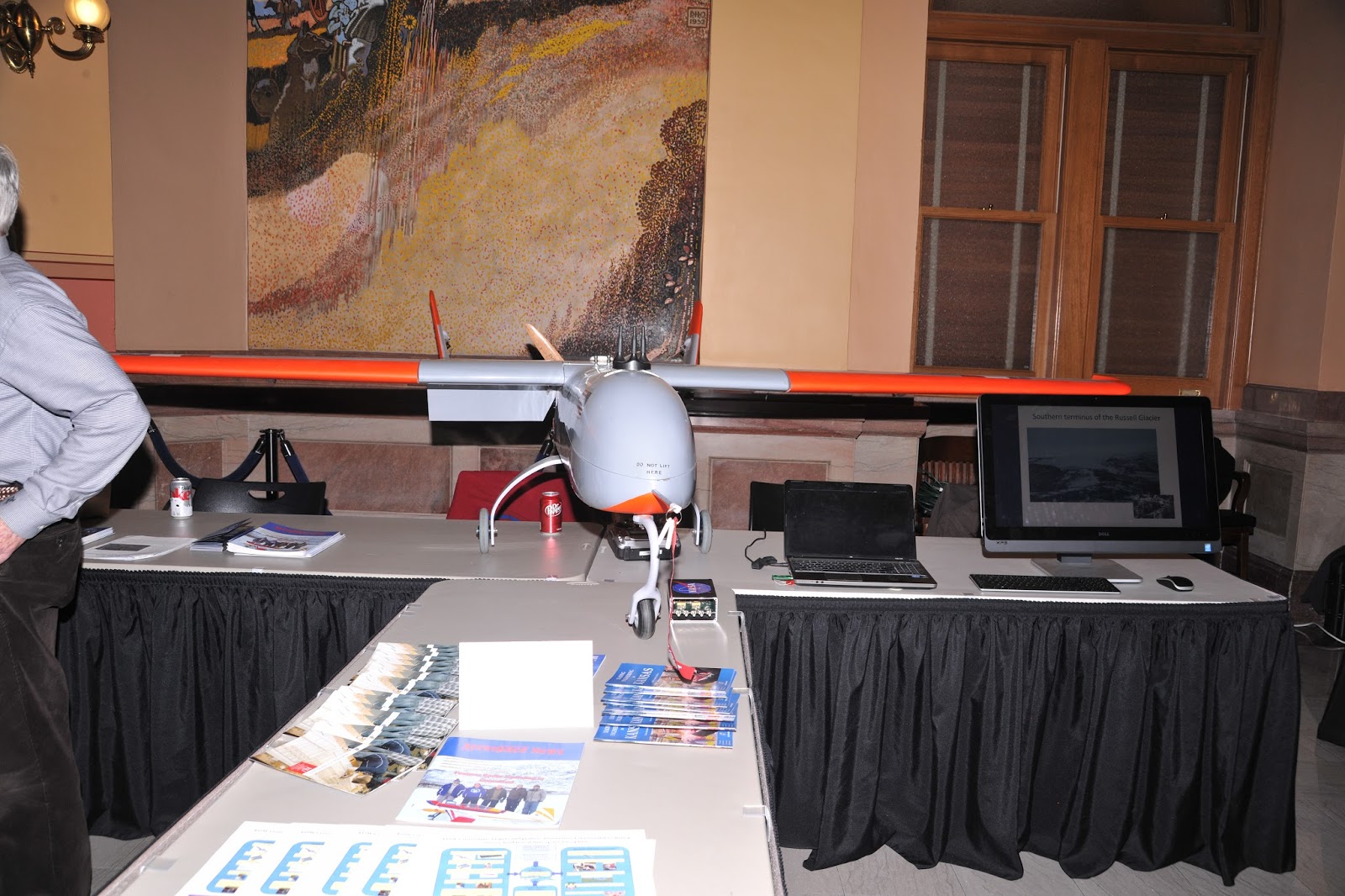
The University of Kansas Department of Aerospace Engineering partnered with NASA to display a 65 pound UAS system, dubbed the Argus, that will be testing flight in the next month. 
University of Kansas' 65 pound UAS, Argus, on display at the Aviation Day at the Capitol event. 

The Argus is an airborne radar sensor built for collision avoidance. 
With over 2.5 hours of flight time, this device could replace older models that fly over glaciers in West Greenland to determine the thickness of the ice. The older models could only fly for 1 hour. 

Businesses like Westar Energy, explained that at times they use UAS devices when they inspect potential damage to various infrastructures because it could be safer than sending out a technician in dangerous situations.


Check out a video of some of the speakers at the event below: