Showing posts with label Pollinator Week. Show all posts

Tuesday, June 18, 2019

Protecting the pollinators: KDOT adds more habitat


Here’s the buzz! Did you know that pollinators are vital to Kansas’ economy? About three-quarters of the world's flowering plants and many of the food crops eaten in North America depend on pollinators. In the U.S., pollination produces nearly $24 billion worth of products annually.  

The Monarch butterfly caterpillar can only eat the leaves of milkweed. Monarch Butterflies only lay their eggs
on milkweed plants. Losing these important plants could be devastating to these important pollinators.
Unfortunately, bee and Monarch butterfly populations are on the decline. The lack of pollination would mean no apples, blueberries, almonds, melons, pumpkins, chocolate, coffee and more. 

A Monarch butterfly on a Butterfly Milkweed plant. 

In order to help change that, KDOT crews will be busy for the fourth year in a row as they continue to plant  native wildflowers and grasses along our roadways.

One of the many varieties of flowers and plants you'll see along our roadways are the Black-Eyed Susan flowers.


This is all thanks to a partnership with the Kansas Department of Wildlife, Parks and Tourism. Last September, KDOT was awarded $65,000 for the restoration and enhancement of rights-of-way for Monarchs. The grant will provide approximately 125 acres of pollinator habitat to be completed within in the next two summers. 

This year the project locations include:

·         I-35 & U.S. 59 Interchange – 52 acres
·         Linn County Rest Area, U.S. 69 & K-52 Interchange – 26 acres
·         I-35/Homestead Lane Interchange, Johnson County – 22 acres
·         Montgomery County Rest Area, U.S. 400 & U.S.169 Interchange – three acres

Common Milkweed in bloom.

This year around 100 acres will be planted, and next year, an additional 22 acres will be added in Franklin County.  This grant was provided by the U.S. Fish and Wildlife Service.

The next time you take a drive, be on the lookout for these incredibly important pollinator habitats with the help of brand new KDOT Pollinator Habitat signs, which will be installed this year along some of the areas mentioned above.

Be on the lookout for these signs as you travel across the state. They'll be added this year!

For more information on how KDOT is helping pollinators, click here: http://pollinatorpartners.ksdot.org

Wednesday, June 20, 2018

KDOT continues to protect pollinators

A butterfly lands on a milkweed plant. 

The Kansas Department of Transportation is buzzing about pollinators lately.
This week is National Pollinator Week and KDOT, along with five other state DOTs and the Federal Highway Administration, signed an agreement that will improve pollinator habitat along I-35, a key migratory corridor for monarch butterflies.

Bee and monarch butterfly populations are on the decline.  About three-quarters of the world's flowering plants and many of the food crops eaten in North America depend on pollinators. In the U.S., pollination produces nearly $24 billion worth of products annually. The lack of pollination would mean no apples, blueberries, almonds, melons, pumpkins, chocolate, coffee and more. 
  
For the third year in a row, KDOT continues to help protect pollinator habitats by planting native wildflowers and grasses.  

Last year,  KDOT’s Environmental Services unit, along with KDOT crews from the Ottawa Subarea, planted approximately 15 acres of wildflower seeds on three plots of land around the Homewood rest area along I-35.

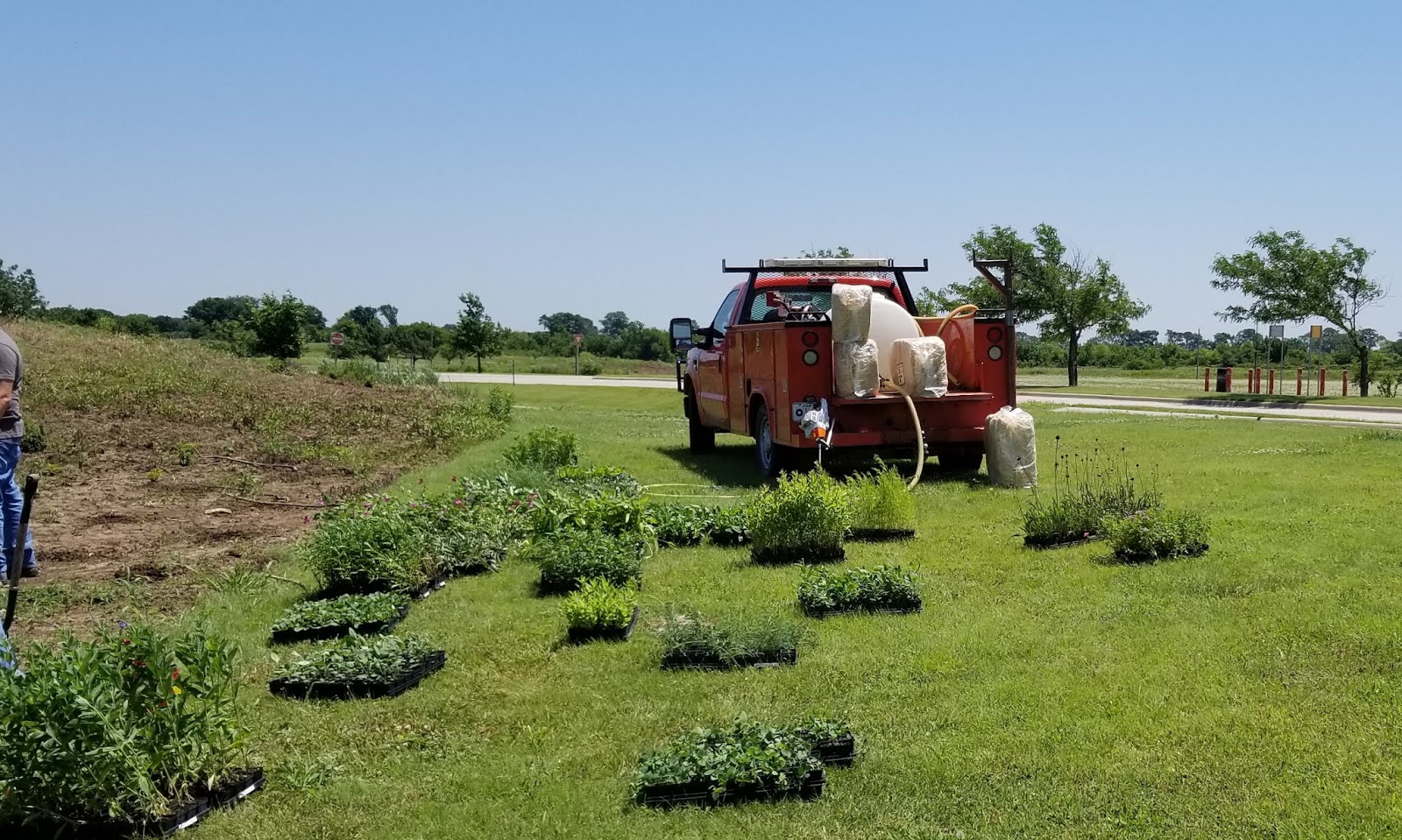
KDOT crews plant 1,196 milkweed plugs at the U.S. 59 and I-35 interchange east of Ottawa.
Recently, KDOT received a grant from the Monarch Watch and planted 1,196 milkweed plugs consisting of Common, Butterfly, Whorled and Green Antelopehorn species.  KDOT Headquarter and the Ottawa Subarea office staff completed the project. This monarch habitat restoration project is located at the interchange at U.S. 59 and I-35 east of Ottawa and covers approximately 36 acres.

KDOT crews plant 2,000 native wildflower pants, consisting of 32 different species at the U.S. 400 and U.S. 169 Junction in Montgomery County. 

Earlier this month, KDOT Headquarters and the Independence Subarea office staff used a grant from the Monarch Watch to plant 2,000 native wildflower plugs, consisting of 32 different species. This pollinator habitat project is located at the Montgomery County rest area, near the U.S. 400 and U.S. 169 junction, northeast of Independence. The plant beds are easily accessible to by sidewalk to those who utilize the rest stop and that meander through the area. Soon, informational signage will be placed along the pathways for visitors as they enjoy a leisurely walk near the colorful wildflowers.

Once these wildflowers and milkweed plugs are established, these areas will become havens for monarchs and many other pollinators.

Table display at KDOT Headquarters. 

KDOT also has a table display located at the Eisenhower State Office Building with brochures and posters available until Friday in Topeka.
You can find more information on what KDOT is doing for pollinators at 

Tuesday, June 20, 2017

Pollinator preservation part II: Planting milkweed


This week is Pollinator Week and the Kansas Department of Transportation, along with five other state DOTs and the Federal Highway Administration, signed an agreement that will improve pollinator habitat along I-35, a key migratory corridor for Monarch butterflies.

A recent blog discussed how KDOT’s Environmental Services team, along with KDOT crews from the Ottawa area, planted approximately 15 acres of wildflower seeds on three plots of land around the Homewood rest area along I-35. This project will provide an increase in habitat to several pollinator species, whose populations are declining.

A close up view of a milkweed weed plug that was planted on May 23 by KDOT crews form the Ottawa Area Office. 
On May 23, KDOT employees returned to the rest areas to plant the 1,152 milkweed plugs that KDOT received from the Monarch Watch: butterfly milkweed and common milkweed.

KDOT workers plant milkweed plugs on May 23 near the Homewood rest area along I-35 in an effort to assist in rebuilding the pollinator habitat.
Engineering Technician Specialist Melissa Davidson in KDOT’s Right of Way said that there were several steps involved to ensure the 15 acres of land were ready for planting.

“KDOT staff burned the site to clear it from dead and overgrown plant material,” Davidson said. “Next, they pulled out any remaining cedars to prevent them from spreading.”


The first step in making this project happen was to burn away the dead and overgrown plant material.

Davidson said that after burning and clearing the area they disked the soil, or cultivated the soil, using a disk harrow to prepare for the wildflower seeds and milkweed plugs. 

Disking the soil helped cultivate it so the wildflower seedlings and milkweed plugs would grow in healthy soil.

“The Monarch butterfly will only lay eggs on milkweed and the larva will only eat milkweed,” Davidson said, “so it’s very important to the survival of the species to have milkweed available to them.”

Using an auger to dig the holes, the 1,152 milkweed plugs were planted.


KDOT crews planted 1,152 milkweed plugs on May 23, near the Homewood rest area along I-35 in an effort to create more pollinator habitat. 
Scott Shields, KDOT’s Environmental Program Administrator, said that although these milkweed and wildflower plants usually bloom during the early spring and summer months into late fall, it may be a couple of years before they all bloom.

“It depends on moisture and how hot the summers get,” Shields said. “This will influence how much they bloom out.”

A butterfly rests on a butterfly milkweed plant on Monday, June 19. Less than a month has passed since it was planted at the Homewood rest area. 
According to KDOT employees from the Ottawa office, the wildflowers and milkweed plugs are doing very well and a few plants are in bloom this year.

If you want to learn how you can help save pollinators and learn about what kind of flowers typically grow along Kansas highways, check out this graphic and go to 
http://pollinatorweek.ksdot.org