Showing posts with label Wildlife. Show all posts

Thursday, June 20, 2019

Mowing 101: How KDOT maintains Kansas roadways


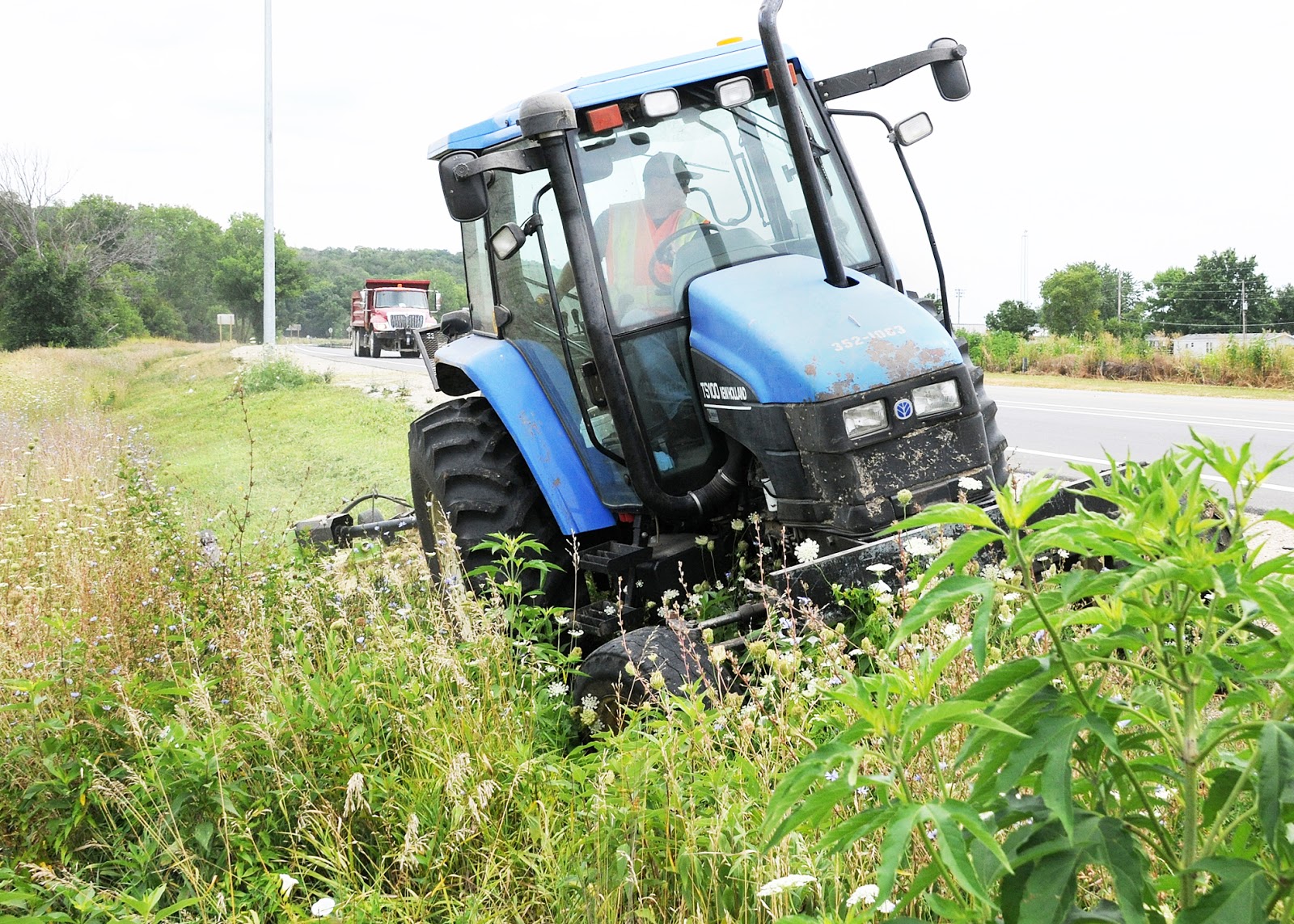
KDOT maintains more than 150,000 acres of highway right of way across the state through mowing, weeding and land maintenance. 

Did you know that KDOT maintains more than 150,000 acres of highway right of way?
 As a result that means there is a lot of grass to mow, land to maintain and weeds to control.  Each year KDOT spends approximately $6.7 million on mowing efforts. There are a few situations that KDOT takes into consideration before mowing will take place:

Crews will mow at specific times during the year, but it will also be done as necessary for safety reasons. KDOT’s largest priority are visibility areas in and around intersections, signs and inside of curves.

As seen in recent weeks, mowing after periods of heavy, prolonged rain can make it difficult on equipment and can cause ruts in the land adjacent to highways. Mowing in these conditions can also damage equipment, which can take even longer to repair and get the area mowed. KDOT crews will mow areas when it is safe to do so.

KDOT's priorities are visibility areas in and around intersections, signs and inside of curves.


As summer continues, maintenance crews work hard to keep Kansas moving, please give them room to work.

In order to save time and give our crews more opportunities to fix roads and maintain areas that have a larger impact on traffic, KDOT may mow less frequently in underdeveloped areas. Mowing on steep slopes can be dangerous, and KDOT also limits the amount of times those areas are mowed as well.

There are many benefits for KDOT’s mowing policy and the amount of time and funds saved gives crews more time and resources to maintain highways and bridges. Farmers and adjacent landowners can harvest hay from the roadsides at no cost.  
In addition to all these situations,

As summer continues, KDOT maintenance crews are working hard to keep Kansas moving. Please give them room to do their job, whether its filling potholes, picking up litter or mowing the right of way.

You can find more information about KDOT’s mowing policies and permit information on our webpage:

Tuesday, June 18, 2019

Protecting the pollinators: KDOT adds more habitat


Here’s the buzz! Did you know that pollinators are vital to Kansas’ economy? About three-quarters of the world's flowering plants and many of the food crops eaten in North America depend on pollinators. In the U.S., pollination produces nearly $24 billion worth of products annually.  

The Monarch butterfly caterpillar can only eat the leaves of milkweed. Monarch Butterflies only lay their eggs
on milkweed plants. Losing these important plants could be devastating to these important pollinators.
Unfortunately, bee and Monarch butterfly populations are on the decline. The lack of pollination would mean no apples, blueberries, almonds, melons, pumpkins, chocolate, coffee and more. 

A Monarch butterfly on a Butterfly Milkweed plant. 

In order to help change that, KDOT crews will be busy for the fourth year in a row as they continue to plant  native wildflowers and grasses along our roadways.

One of the many varieties of flowers and plants you'll see along our roadways are the Black-Eyed Susan flowers.


This is all thanks to a partnership with the Kansas Department of Wildlife, Parks and Tourism. Last September, KDOT was awarded $65,000 for the restoration and enhancement of rights-of-way for Monarchs. The grant will provide approximately 125 acres of pollinator habitat to be completed within in the next two summers. 

This year the project locations include:

·         I-35 & U.S. 59 Interchange – 52 acres
·         Linn County Rest Area, U.S. 69 & K-52 Interchange – 26 acres
·         I-35/Homestead Lane Interchange, Johnson County – 22 acres
·         Montgomery County Rest Area, U.S. 400 & U.S.169 Interchange – three acres

Common Milkweed in bloom.

This year around 100 acres will be planted, and next year, an additional 22 acres will be added in Franklin County.  This grant was provided by the U.S. Fish and Wildlife Service.

The next time you take a drive, be on the lookout for these incredibly important pollinator habitats with the help of brand new KDOT Pollinator Habitat signs, which will be installed this year along some of the areas mentioned above.

Be on the lookout for these signs as you travel across the state. They'll be added this year!

For more information on how KDOT is helping pollinators, click here: http://pollinatorpartners.ksdot.org

Thursday, May 31, 2018

Turtle time: How to help turtles cross the road


Did you know that the state reptile is the ornate box turtle?  This species of turtle is one of many that you may see as you drive Kansas highways this spring and summer.  During the warmer months of the year, turtles are looking for territory and places to build their nests.

Because of their slow-moving nature, they are often unfortunate casualties on the side of the road. Drivers can do their best to avoid hitting them, but they may also need help crossing the highway safely. There are things to consider before you make the choice to stop and help.

Your safety comes first. Be aware of your surroundings and traffic. Double check to make sure the road is clear. If the road is too busy, don’t risk it. Before you even leave your vehicle to help, make sure you are pulled well off the road and put your hazard lights on.

If you pick up a small turtle, grasp it carefully behind the front legs on both sides. Move the turtle in the same direction it was heading. Don’t turn them around. The turtle obviously wants to go in the direction it is facing. Placing it in the opposite direction will just cause the turtle to try crossing the road again. Some websites suggest placing the turtle at least 30 feet from the road so that it won’t get startled by oncoming traffic.

If you encounter a larger turtle you can approach them from behind and scoot them across with a blunt object.

Don’t take the turtle home with you or relocate it. Turtles thrive in the territories they call home and removing them can lead to confusion and may cause them to stop eating. They may also wander around and be at an even greater risk for getting struck by a vehicle.

Some turtles may have been injured by a vehicle. If that is the case, contact your local vet or wildlife rehabilitator. The Kansas Department of Wildlife, Parks and Tourism has an updated list of wildlife rehabilitators here.

If you follow these safety suggestions you can be a turtle’s biggest hero! 

Thursday, May 24, 2018

Animal ambassador: KDOT employee rescues wildlife

Abbie Wisdom-Williams holds a raccoon she rehabilitated. 
It all started with a turkey.

“My cat started chasing it around,” Abbie Wisdom-Williams remembers.
Abbie lived in Wichita at the time, right in the middle of the city, and started feeding the turkey in her yard.

“I left the food out on the front porch, and pretty soon, there was an opossum and raccoons,” she says.

She quickly got hooked rehabilitating wildlife.

Abbie, a Senior Administrative Assistant in the Kansas Department of Transportation’s South Central Kansas office, has been a licensed wildlife rehabilitator with the Kansas Department of Parks, Wildlife and Tourism for about 20 years now.

Abbie Wisdom-Williams feeds a newborn skunk.


In that time, she has taken in a real menagerie of animals. So far this year, she’s come to the rescue of newly-born raccoons, skunks, opossums, foxes and bunnies. Fawns will start needing her help in June.

She and her husband, David, also have rehabilitated badgers, bobcats, beavers and coyotes.

Abbie would love to get a call about a porcupine or a baby badger.

“I remember my Dad trying to catch a baby badger once. When my parents got a divorce, they didn’t fight over me. They fought over who got the cat,” she says, laughing.
Abbie has loved animals for as long as she can remember.

She and her husband have a pet skunk named Isadora Skunkin and five dogs. The skunk came to them as a baby. Its hips are not functional, so the skunk scoots everywhere using the power of its front feet.

Skunks are her favorite animals to rehabilitate.

A new-born skunk receives milk from a syringe. 

“The beavers were cool, but they’re an incredible amount of work,” she says.
She gathered limbs and twigs for them and had to fill, clean out and refill a stock tank every day for them.

“I was trimming everybody’s trees” when she had the beavers, Abbie says.
Her least favorite animals to work with are baby bunnies.

“I hate raising bunnies because baby bunnies have a tendency to be fine one minute and dead the next and you have no idea why,” she says.

Her crowning achievement as a rehabilitator, she says, was a raccoon that had been badly burned in a wildfire in the spring of 2016 near Burrton.

Photos she took show the raccoon’s progress — from burned to the bone and unrecognizable to ready to release. The raccoon stayed under Abbie’s care for eight weeks. Caring for the raccoon wasn’t easy.

“It hated me, and that was OK,” she says.


A baby opossum drinks form a baby food lid. The young marsupial was brought in after a dog found it. 

She continues to rehabilitate animals because “it’s my way of trying to repay them for all the damage that we as humans inflict upon them. And I’m trying to educate people to give them respect and space and not be so afraid.”

Abbie gets referrals from fellow rehabilitators and calls from the public. She remembers one call years ago from a woman concerned about a rabbit she had seen on a neighbor’s porch. It hadn’t moved in two days, the woman reported. Abbie drove out to the area, looked around and called the woman to confirm she was in the right place.

“Lady,” she remembers saying, “that rabbit is cement.”