Showing posts with label UAS. Show all posts

Wednesday, November 13, 2019

KDOT conducts first UAS flight without visual observers

Transportation Secretary Julie Lorenz addresses the crowd about the importance of investing
in our future success with aviation.

It’s another first in the U.S. for the Kansas Department of Transportation as the Division of Aviation conducted its first unmanned aircraft system (UAS) flights without visual observers and using only onboard detect-and-avoid systems.

Kansas has a proud tradition of recognizing the opportunities that can be achieved through the skies,” said. Lt. Gov. Lynn Rogers. “Implementing new technology is never easy, but KDOT is up to the challenge.”

Aviation is a vital mode of transportation in Kansas that supports thousands of jobs, transports good across the state and improves safety through access to air ambulance service.

“The investments we make in aviation are not only important for our economy today, but they’re critical for future success,” Secretary Lorenz said. “I look forward to working with all of you to build transportation infrastructure that will propel our state to the next level.”

KDOT was selected in May 2018 by the U.S. DOT as one of only 10 organizations in the nation to lead the UAS Integration Pilot Program (IPP), an initiative aimed at shaping the future of drones. In August 2018, KDOT flew the first beyond the line of sight UAS flight under the program.


Thursday, August 15, 2019

Kansas approved for first Beyond Visual Line of Sight drone flight in the nation


KDOT received the first-ever FAA authorized operation to fly without a requirement of visual observers or ground-based radar. 


The Kansas Department of Transportation (KDOT) received permission to conduct the first ever Beyond Visual Line of Sight (BVLOS) drone operation in the nation leveraging only onboard detect-and-avoid systems. This is the first-ever FAA authorized operation to fly without a requirement for visual observers or ground-based radar and is the result of the 31-member Kansas Unmanned Aircraft Systems (UAS) Integration Pilot Program (IPP) team efforts to advance drone technologies.

In a collaborative effort between Kansas State University Polytechnic Campus (K-State Polytechnic), Westar Energy, Iris Automation and KDOT, the Kansas IPP team will fly a nine-mile track to evaluate technologies to inspect power lines in rural Kansas. This approval is the first of its kind for long line linear infrastructure and is the first step to enable routine commercial infrastructure inspection across the state.

“The UAS industry has worked over 10 years to demonstrate the most significant commercial benefit of drone operations within the United States,” said Bob Brock, KDOT Director of Aviation. “We are proud of the joint state, university and industry team effort that made this landmark decision possible.”

“The ability to fly BVLOS missions without ground-based radar or visual observers is a significant advancement, and Westar Energy views this as an opportunity to play a key role in shaping the future of UAS operations within the utility industry,” said Mike Kelly, Westar Energy Senior UAS Coordinator. “Being able to operate under this waiver allows the Kansas IPP team the ability to research and develop truly scalable BVLOS UAS operations for the automated inspection of linear infrastructure.”

The Applied Aviation Research Center on the K-State Polytechnic Campus will be responsible for the training and flight operations with a cross-functional team from the KDOT IPP. Flights will take place over the next few months, providing the FAA with much-needed data on true BVLOS activity.

“We look forward to leveraging this waiver to integrate UAS technology into the transmission line inspection process,” said Kurt Carraway, UAS Executive Director of the K-State Polytechnic Applied Aviation Research Center. “We are certain that utilities will be able to quickly realize a return on investment while mitigating safety to their maintenance personnel and increasing the reliability of their infrastructure to the general public.”

This is the first UAV flight in history to leverage onboard sense-and-avoid systems alone for collision avoidance. It also marks the first required automated avoidance action. Historically, all FAA-issued Part 107 BVLOS waivers have required visual observers or ground-based radar. These mitigations limit the possibility of true BVLOS flights, as they are typically prohibitively expensive and limit operations to pre-defined corridor areas with radar coverage. 

This important milestone is facilitated by Kansas UAS IPP partner Iris Automation’s Casia onboard collision avoidance system.

“Flying rural missions like these without a human pilot onboard or costly radar on the ground is exponentially safer and more cost effective,” said Iris Automation CEO and Co-Founder Alexander Harmsen. “The FAA is trusting us to pave the way for a safer, scalable future together with this precedent-setting second approval of our system.”

Wednesday, May 29, 2019

KDOT Aviation Director chosen for national committee

KDOT's Director of Aviation Bob Brock
was recently named one of 12 people
appointed to the U.S. DOT's Drone Advisory
Committee.

Bob Brock, Kansas Department of Transportation (KDOT) Director of Aviation, is one of 12 people appointed to the Drone Advisory Committee (DAC) by the U.S. Secretary of Transportation. The Federal Aviation Administration's DAC will provide advice on key Unmanned Aircraft System (UAS) integration issues by helping to identify challenges, prioritize improvements and create support for strategy and vision.
“Continuing to grow aviation in Kansas is a priority for KDOT, and we can’t be more pleased to have innovative people like Bob lead the way for transportation in this important industry,” said Julie Lorenz, Secretary of Transportation.
Brock was named the first Director of UAS in the nation in 2016. Since then, Kansas has been recognized nationally in the UAS industry on several occasions –
sThe first to have a statewide unmanned traffic management system;
sOne of five states to conduct advanced UAS research flights in the FAA’s UAS Integration Pilot Program;
sWinner of the 2019 Operations and Safety Xcellence Award from the Association of Unmanned Vehicle Systems International.
“Aviation inspires creativity. We are fortunate in Kansas to be surrounded by smart pioneers and entrepreneurs - willing to take risks that may very well change the world through aviation,” Brock said. 

Monday, March 4, 2019

Annual Aviation Day highlights innovation in Kansas


The Kansas Department of Transportation’s (KDOT) Division of Aviation, in partnership with the Kansas Commission on Aerospace Education (KCAE), will host the fifth annual Aviation Day in the State Capitol rotunda from 10 a.m. to 2 p.m. on Thursday, March 7.

Numerous legislators, manufacturers, suppliers and aviation organizations are participating in this event that helps facilitate industry growth opportunities. The aviation industry  supports nearly 91,300 jobs, generates more than $4.4 billion in annual payroll, and produces nearly $20.6 billion in annual economic output for the state of Kansas according to the 2017 Kansas Aviation Economic Impact Study.

As part of the event, city officials and those interested in boosting aviation economic development in their region are invited to a workshop starting at 1 p.m. in room 4N on the Capitol’s ground floor near the Visitor’s Center. This workshop will prepare community stakeholders to explore how best to harness state and local resources for future efforts. A panel of aviation experts will also be on hand to answer questions.

“Aviation Day highlights the culture of innovation in Kansas,” said Bob Brock, Director of Aviation. “We appreciate partners from industry, university and non-profit organizations working together to promote a message of growth and hope for Kansas.” 

Industry leaders scheduled to attend include: 190th Air Refueling Wing, Ainstein, Air Force, AirMap, Amelia Earhart Birthplace Museum, American Bonanza Society, AOPA, Bombardier, Burns and McDonnell, Butler CCC, CAP, Combat Air Museum,  Cosmosphere, DCN, EAA, Explorer Post 8, Flight Safety, Garmin, Garver USA, GBA, Harris Corporation, Heartland Airplanes LLC, HOA Wing of Commemorative AF, International Aviation, Jacobs Instruments and Sales Inc., Kansas Association of Airports, Kansas Aviation Museum, Kansas Historical Society, Kansas Soaring Association, Kiewit, KS Ag Aviation Association, K-State Polytechnic, Lee Aerospace, Life Save Transport, Mission Aviation Fellowship, National Weather Service, NBAA, Pilots For Christ, RANS, Textron, Spirit, University of Kansas, Westar Energy, Wichita Airport Authority, Wichita Dwight D. Eisenhower Airport and WSU/NIAR.

Tuesday, February 5, 2019

Public encouraged to take survey on statewide UAS usage


The Kansas Department of Transportation’s (KDOT) Division of Aviation is seeking public opinion on the use of unmanned aerial systems (UAS) or drones in Kansas airspace.

Individuals of all ages, occupations and backgrounds are encouraged to participate in the 10-question online survey available at https://www.ippkansas.org/ks-uas-ipp-survey until Feb. 28. 

Through the survey, KDOT hopes to gain a better understanding of the public’s familiarity and opinion on UAS use scenarios to drive operations for the Kansas UAS Integration Pilot Program (IPP).

This federally-initiated program will help tackle the most significant challenges to integrating drones into the national airspace and will reduce risks to public safety and security. The Kansas team is focused on efforts in Long Line Linear Infrastructure Inspection (i.e. highways, railroads, energy distribution lines, etc.) and Precision Agriculture. IPP partners include state universities, Kansas UAS joint task force members and industry leaders. For a full list visit: www.ippkansas.org/partners.

KDOT is currently conducting UAS test flights in the airspace north of Gypsum and over partner right-of-way infrastructure and partner-owned land. These operations will support a Phase II safety case that will include Beyond Visual Line of Sight (BVLOS) operations.

About Kansas UAS IPP
KDOT is one of only 10 national leaders conducting advanced UAS operations to guide future rule-making that will result in access to new technologies for the nation. The IPP is the result of a 2017 Presidential Memorandum issued to the U.S. Department of Transportation.  

Wednesday, August 15, 2018

Kansas leads the nation with UAS flight

The Kansas State University Polytechnic Applied Aviation Research program performs the first UAS
beyond line of sight flight. The modified "K-State Aero" was flown with FCC certified radios on board
.


The first beyond the line of sight Unmanned Aircraft Systems (UAS) flight in Kansas was flown on Monday north of the town of Gypsum in a joint effort by the Kansas Department of Transportation (KDOT) and more than 30 university and corporate partners. This was also the second flight in the nation to take place under the U.S. DOT’s UAS Integration Pilot Program (IPP).

The first flight was scheduled to take place yesterday, however, with rain and storms predicted, it was conducted on Monday. Weather did allow Tuesday’s flight to also take place at the news conference, and Kansas State University Polytechnic took the lead on both flights. More flights will continue this week with AirMap, Pulse Aerospace and Iris Automation.

UAS technicians use computers to assist with flying the UAS.
“We’re proud of what we’re doing in Kansas to create new jobs, improve flight safety and advance agriculture,” said Bob Brock, KDOT Director of Aviation and UAS. “Our flights mark the beginning of a new generation of Kansas innovation.” 

KDOT was selected in May as one of only 10 organizations in the nation to lead the UAS IPP, an initiative aimed at shaping the future of drones. The flights this week, and future flights, will test aircraft capability and reliability for continued beyond line of sight operations while collecting data to expand advanced UAS operations nationwide.

A UAS flies low to the ground during the event.


Over the next two years, various Kansas IPP team partners will conduct tests over transmission lines, farms, roads and other infrastructure well clear of Kansas citizens. This program will also assist the U.S. DOT and Federal Aviation Administration (FAA) in shaping new rules to expand safe UAS integration into the National Airspace System and create new opportunities for the state and UAS industry.

“Kansas has been a valuable aviation partner for decades and the launch of the IPP is another opportunity for us to work with all of the professionals here in Kansas as we take the next steps that will pave the way toward full integration of unmanned aircraft into the national airspace,” said Dennis King, FAA Program Manager for Kansas UAS IPP.

A Close up of one of the UAS that participated in the flights.
The Kansas IPP team’s partners will focus on integrating UAS operations into Kansas industries involved in infrastructure inspection and precision agriculture. Partnerships with the FAA and Kansas IPP team members will continue to foster expansion of UAS operations for the state and the nation. 

More information about the FAA UAS IPP can be found at: https://www.faa.gov/uas/programs_partnerships/uas_integration_pilot_program/


Wednesday, May 23, 2018

KDOT announces test of drones in road survey projects

Kirkham Michael employee Wayne Scritchfield gets ready to launch the drone.
Topeka – The Kansas Department of Transportation has partnered with Kirkham Michael to test the effectiveness of new technologies in advancing project design processes and improving worker safety on Kansas highway projects.
Kirkham Michael and KDOT worked jointly on an approved project that will survey and design a passing lane on a two-mile section of U.S. 75 north of Topeka.  As part of the joint effort, Kirkham Michael surveyed the area via a series of drone flights yesterday.
Scritchfield retrieves the photo card after the drone flew for several minutes along the survey project area.
 “We are very excited to be partnering with industry to improve our processes that will not only save taxpayers money in the project planning and design phases, but also improve worker safety,” said Ron Feldkamp, KDOT survey coordinator.
Currently, road surveys for every road project are conducted by workers physically out on highway right-of-ways.  The data that they collect is transferred to design programs and used to by engineers to plan and design the project.
The use of drones to conduct the three-dimensional surveys can potentially save time, limit traffic impacts and significantly reduce the risks to employees.
Scritchfield, at right, talks about the benefits of surveying a road project with a drone after the test flight.


Thursday, May 17, 2018

KDOT employee turns love of UAS into more than a hobby

AJ Wilson maneuvers his drone during a demonstration.
AJ Wilson spent $50 on his first drone.

“It was really junky,” Wilson admits about the purchase in January 2017.

So Wilson, the Kansas Department of Transportation’s Area Engineer in Winfield, upgraded, buying a new model for just more than $1,000 — including replacement insurance.

“It’s become an expensive hobby,” Wilson says.

Flooding of the Ninnescah River in September 2016 is what inspired Wilson to look into getting his own UAS — unmanned aircraft system.

“You can’t visualize how big a flood it was until you can get up above it,” he says.


 Wilson used his drone during an emergency project to repair and replace steel pile jetties in the river, which runs close to U.S. 81. The steel piles help prevent erosion. He used the drone to make a new map every few days to show progress of the project.

Wilson uses his Mavic Pro for work and pleasure. He’s on his third version of his current model.

The first two became victims of trees. The camera broke in the first one when it got caught in a tree and fell out. The second fell out of a tree and into a river.

“So it’s not so much getting caught in a tree as it is falling out of a tree,” he says.

Wilson uses his drone for work. He makes maps, including elevation and 3-D maps. Drones can be used to calculate the volume of stockpiles and for survey work. Wilson is excited to serve on KDOT’s UAS committee. 

He’s also excited about the recent announcement that KDOT was chosen as one of 10 entities to participate in the U.S. Department of Transportation’s Unmanned Aircraft Systems Integration Pilot Program, an initiative aimed at shaping the future of drones in America.

“I’m excited to hear about this selection,” Wilson says. “This will allow KDOT to be a big player in the conversation about drone integration into both the construction and maintenance of our highway infrastructure.”


Thursday, May 10, 2018

KDOT announces selection to drone test program


Close up of a drone in the grass during the U.S. DOT's announcement that Kansas was selected to participate in the Unmanned Aircraft System Integration Pilot Program. 

The Kansas Department of Transportation has been selected as one of 10 participants to participate in the U.S. Department of Transportation’s Unmanned Aircraft Systems (UAS) Integration Pilot Program, an initiative aimed at shaping the future of drones in America.
The UAS Integration Pilot Program is an opportunity for state, local and tribal governments to partner with private sector entities, such as UAS operators or manufacturers, to accelerate safe UAS integration.

“This is a terrific opportunity to explore new ways to use this technology to reduce the risks to our workers during infrastructure inspections, search and rescue and remote area assessments,” said Secretary of Transportation Richard Carlson. 

Undersecretary of the U.S. DOT Derek Kan said that Kansas has been a trail blazer of aircraft design and that yesterday's announcement continues Kansas leadership in the aerospace industry.

"
Kansas submitted an outstanding proposal because it gave us a chance to work with a transportation agency that supports aviation innovation," Kan said. "The Kansas application will enable long distance-beyond visual line of sight operations over a large geographic area utilizing a state-wide Unmanned Traffic Management system."

Kan said there were two big reasons the application stood out.

"The proposal utilizes extensive in-state resources and a fantastic partnership with several key agencies. Most notably, a fiber optic network to support operations," Kan said. "Kansas has deployed a UTM system across the state. This system offers an airspace management dashboard that integrates with FAA radar data. The development of this UTM is particularly exciting for the agriculture sector— and agriculture, of course, is one of the most important industries that could be revolutionized by drone technologies."

Secretary Carlson, Lt. Gov. Tracey Mann and other Kansas officials cheer when Kansas is selected to participate in the program. 
With about 140,000 miles of public roads, many in rural areas, Kansas is an ideal location to test the technology, which will benefit not only transportation but also agriculture and many other industries doing business in Kansas.

The program will partner with industry and local agencies to test the use of unmanned aircraft across a variety of applications that will help transportation departments operate more safely and efficiently, including assessing weather-affected roads, conducting bridge inspections with minimal impact to traffic and even locating and assisting stranded motorists more quickly.

Lt. Gov. Tracey Mann said that UAS impacts lives of Kansans today and that will only grow in the future. 

"Kansas has a deep history in aviation and we understand the existing UAS positively impacts our economy, and its future growth in Kansas represents a truly historic opportunity," Mann said. "The potential improvements and advancements of emergency response search and rescue will save lives both in rural and urban areas. UAS' likely effect on production agriculture will be huge. Decreasing costs and increasing yields are crucial for our farmers and ranchers as agriculture producers in Kansas and the farmers around America work to feed a hungry world."

The program is expected foster a meaningful dialogue on the balance between local and national interests related to UAS integration and provide actionable information to the U.S. DOT regarding the expanded and universal integration of UAS into the National Airspace System.

“KDOT strives to be on the cutting edge of transportation technology,” Carlson said. “We are always looking for better, more efficient ways to help make travel safer for Kansans, visitors and the commercial industries that depend on our roads.”

More information on the UAS Integration Pilot program can be found here

Thursday, May 11, 2017

KDOT unites with strategic partners for UAS

KDOT Director of UAS,  Bob Brock, (center) and Director of Aviation, Merrill Atwater (right) meet with FAA Administrator Michael Huerta and other visitors at the Xponential 2017 conference in Dallas, Texas

The Kansas Department of Transportation (KDOT) Division of Aviation visits Dallas, Texas this week for the largest gathering of Unmanned Aerial Systems (UAS) industry leaders in the world at the Association of Unmanned Vehicle Systems International’s (AUVSI’s) Xponential 2017. Over 7000 industry professionals and 850 exhibitors unite to participate in a 3 day workshop and exhibition.
“This is great opportunity to showcase Kansas as a leader in UAS, continue the growth of this segment and foster strong relationships in UAS,” said KDOT Director of Aviation, Merrill Atwater.
“Xponential allows us to highlight the outstanding talent and expertise we have in Kansas. There’s an obvious reason we are called the ‘Air Capital of the World,’” he added.

Participants in the Xponential conference visit KDOT's Division of Aviation display. 
KDOT Director of UAS, Bob Brock stated, “Xponential is an ideal venue for established aviation leaders from Kansas to meet the UAS industry and continue our rich history in aviation.
Kansas is building on its established leadership in aviation, working in conjunction with in-state partners to promote the UAS industry, including:
·              Kansas Department of Agriculture
·              Kansas Department of Commerce
·              Kansas State University
·              Greater Wichita Partnership
·              Salina Community Economic Development Office
·              University of Kansas  
Kansas Aviation activity accounts for $20.6 billion in economic impact. Over 700 aerospace and aviation companies live and work together in the Sunflower State. Ninety-two percent (92%) of Kansas airports support flight training and over 60% have aviation outreach programs. Aviation activity supports over 91,000 high-paying jobs in the state.
More than 18 years of active UAS research – including one of the first UAS Bachelor’s degrees in the country – add to Kansas’s industry leadership. The state’s rich aviation history is built on a century of aircraft production. Over 73% of the world’s general aviation fleet is manufactured in Kansas.


The Kansas Department of Transportation Division of Aviation demonstrated Kansas' important leadership role in the aviation industry at the Xponential conference in Dallas, Texas. Pictured in this photo: Halee Lindstrom, (far left) Bob Brock, Merrill Atwater, Lindsey Dreiling and Greg Chenoweth

Monday, February 13, 2017

Interest in aircraft, UAS soar at Aviation Day at the Capitol


The aviation industry is incredibly important to the state of Kansas. On Thursday, that fact was celebrated at the Aviation Day at the Capitol. The event welcomed both the public and legislatures to tour and learn from 30 aviation businesses and organizations.

"Aviation, as you all know, has a huge impact in our state," Transportation Secretary Richard Carlson said. "Kansas is home to one of the five world-largest clusters of aviation. More than 48,000 jobs are created directly by our businesses, our tenants and other activities located at commercial services and general aviation airports in the state of Kansas."
The Kansas Air National Guard was just one of the 30 organizations that were represented at Aviation Day at the Capitol. 

Ed Young, Vice President of the Kansas Commission on Aerospace Education (KCAE), said that this event drives all levels of aviation together so they can meet with legislatures about how important aviation is to Kansas.

Joe N. Miniace, the Central Region Regional Administrator for the Federal Aviation Administration, said that 76 percent of the world's fleet of aircraft have been manufactured in Kansas.

One of the biggest presences at this year's Aviation Day at the Capitol was Unmanned Aerial Systems. Dean of Research at Kansas State University, Kurt Barnhart, said that the one of the major reasons for the use of UAS devices was to help people.
Kansas State University's Booth at the Aviation Day at the Capitol event. 

“We are doing the things we have always done, with less risk and a fraction of the cost,” Barnhart said. "We are excited. It's a revolution." 


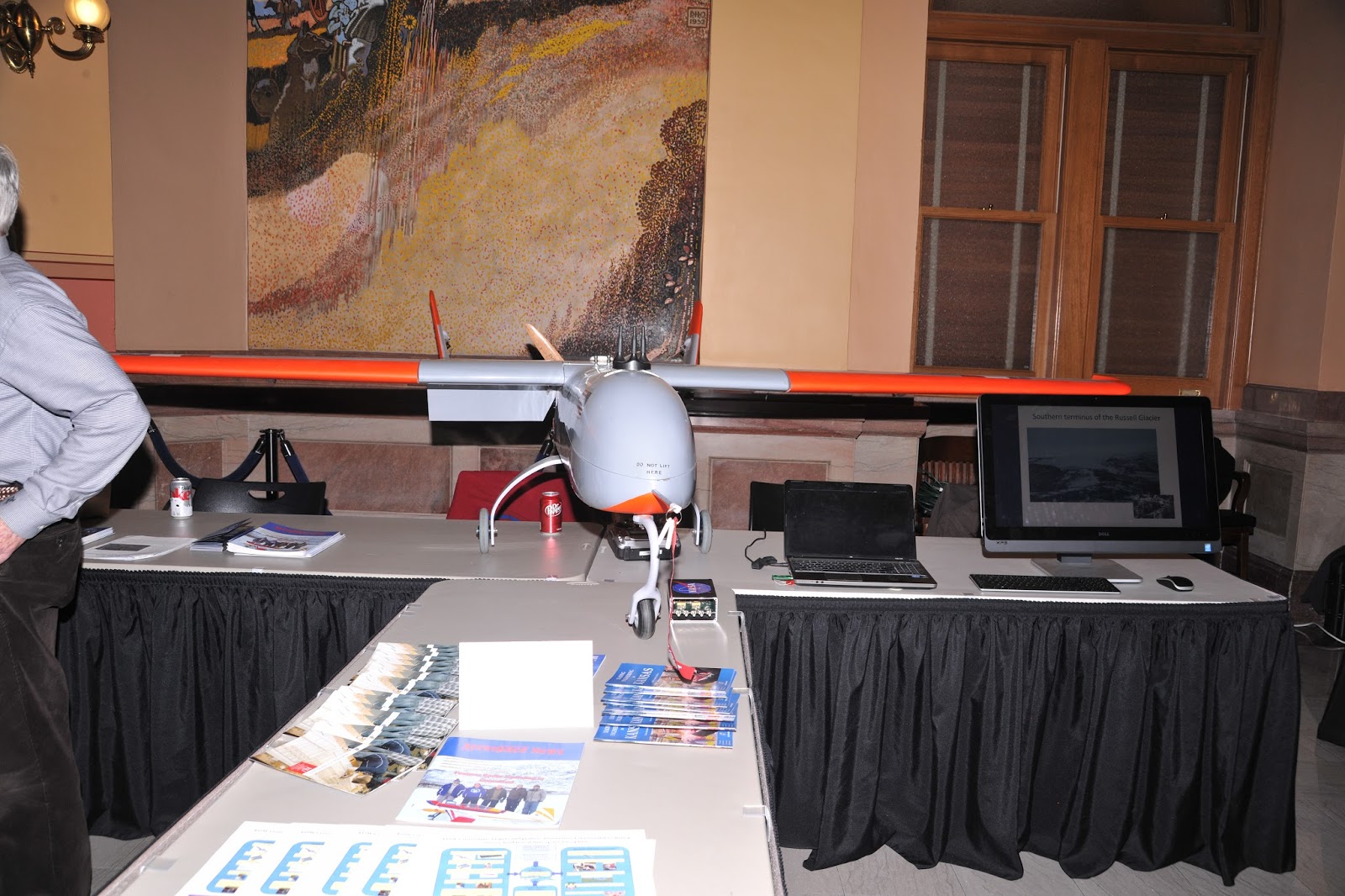
The University of Kansas Department of Aerospace Engineering partnered with NASA to display a 65 pound UAS system, dubbed the Argus, that will be testing flight in the next month. 
University of Kansas' 65 pound UAS, Argus, on display at the Aviation Day at the Capitol event. 

The Argus is an airborne radar sensor built for collision avoidance. 
With over 2.5 hours of flight time, this device could replace older models that fly over glaciers in West Greenland to determine the thickness of the ice. The older models could only fly for 1 hour. 

Businesses like Westar Energy, explained that at times they use UAS devices when they inspect potential damage to various infrastructures because it could be safer than sending out a technician in dangerous situations.


Check out a video of some of the speakers at the event below:


Tuesday, November 8, 2016

Kansas UAS program tests drones for bridge, tower inspections

KDOT Aviation and Bridge Inspection teams use a UAS to get a closer look at a structure.

The new Kansas Unmanned Aerial Systems program started test flights last Friday to find ways to use drones for bridge and tower inspections. 

“Our Aviation and Bridge inspection teams are doing great work in testing drones to enhance the safety of KDOT workers and improve cost efficiencies,” said Acting Transportation Secretary Richard Carlson. “We believe UAS may reduce the need to place our engineers in potentially dangerous situations and we intend to pursue every opportunity that makes them more efficient.”

 This is the first of several cooperative efforts KDOT is leading to employ new UAS technologies that increase public safety.

 “It’s important we keep safety and personal privacy our top priorities for this program,” said KDOT’s UAS Director Bob Brock. “KDOT inspectors working directly with UAS operators is an exciting first step that we will follow with many more flight tests to ensure we meet the stringent requirements associated with bridge inspection. 

“We also believe UAS is an industry that creates new jobs to help Kansas graduates stay in Kansas, so we are working with universities and other state agencies to investigate additional opportunities for engagement that will be announced in the coming months,” he said. 

Tuesday, July 5, 2016

Air Force veteran selected to be state's first UAS director

Bob Brock, a Pittsburg native who retired from the Air Force as a lieutenant colonel, will oversee the establishment of policy and procedures for the operation of UAS, or drones, in Kansas. During his Air Force career, Brock gained experience in UAS operations and training. He also served as a flight safety officer and instructor pilot.
“Bob has extraordinary experience with UAS and will play a pivotal role in helping develop our program in Kansas,” said Kansas Transportation Secretary Mike King. “Under his guidance, the state will become a national leader in the industry.”
 Brock said that among his priorities will be protecting the privacy and public safety of Kansans as drones become part of our world.
“Our team will work very closely with the FAA, universities and aviation leaders to deliver systems that make Kansas safer, provide economic growth and also save time and money,” said Brock.
Brock will maintain offices at Kansas Department of Transportation headquarters in Topeka and at the Kansas State University Polytechnic Campus in Salina, which has a nationally ranked UAS program.
"Kansas State Polytechnic is very excited about the state's new UAS director having an office on our campus," said Kurt Barnhart, associate dean of research and executive director of the Applied Aviation Research Center on the Polytechnic Campus. "This allows both KDOT and K-State to work together more easily to help advance the industry statewide and bring lasting economic benefit to Kansas."