Showing posts with label Bikes. Show all posts

Monday, November 18, 2019

New signs will highlight U.S. Bicycle Routes 76, 66 across Kansas


Officials unveil the new U.S. Bicycle Routes 76 and 66 at the event on Thursday. There will be more than 900 new signs installed along the route throughout the state.  

Highway signs that will help show the way for U.S. Bicycle Routes (USBR) 76 and 66

throughout Kansas were unveiled today at an event along Historic Route 66 in Riverton as part of the sign initiative currently underway.

“Signage is beneficial because it provides wayfinding for cyclists and it alerts motorists to
diligently be aware of and respectful to cyclists sharing the road,” said Kansas Department of Transportation Planning and Development Director Chris Herrick. Other speakers included Bourbon County Economic Development Director Jody Hoener, Cherokee County Sheriff Groves and Joplin Convention and Visitors Bureau Director Patrick Tuttle.

More than 900 new road/highway signs will be placed across Kansas marking the two bicycle routes. These routes in Kansas were approved by the American Association of State Highway and Transportation Officials (AASHTO), as a result of collaborative efforts between KDOT and the Adventure Cycling Association (ACA), beginning in 2015. The USBR system connects bicycle routes across the country for safer, long-distance cycling.

USBR 76 is also known as the TransAmerica Bicycle Trail. It extends more than 480 miles and runs from Greely County on the Colorado border to Crawford County on the Missouri border. The Kansas stretch of USBR 66 is 13 miles long and runs through the southeast corner of the state.

“Thousands of cyclists ride these routes through Kansas every year offering great tourist
opportunities for the over 30 communities they pass through, especially rural towns,” said

KDOT Bicycle and Pedestrian Coordinator Jenny Kramer. “Many towns take advantage of this opportunity for economic growth and development by making their towns more bicycle-friendly and creating attractive resting and overnight spots for travelers.”

Sign installation will begin in spring 2020 and should all be placed by June. KDOT has
developed signing plans to assist with installation along the state and local systems. In
addition, KDOT plans to release the 2020-21 Kansas Bicycle Map by next summer.

For more information on KDOT’s Bicycle and Pedestrian Program and resources on cycling in Kansas, go to: https://www.ksdot.org/burRail/bike/default.asp.

Thursday, November 14, 2019

Cyclists to give back this weekend in Topeka


‘Tis the season of giving! This year marks the 7th annual Cranksgiving in Topeka. What is 
Cranksgiving? It’s the perfect combination of a fun bike ride and a charitable food drive, and it isn’t just a Topeka thing.

Every year cities across the U.S. host their own version of a Cranksgiving event, helping to stock pantries and provide other much needed supplies for their communities. In 2018, more than 150 cities participated in Cranksgiving to support local food banks, helping to feed thousands of families.

While the overall purpose of Cranksgiving is the same in each city, the individual events take on their own identities.

In Topeka, participants can compete in a race against the clock to pick up as many grocery items that will fit on their bike or they can take part in a non-competitive, family-friendly, slow-paced group ride called “The Haul” for a one-stop shop to purchase grocery items with donated funds. In the last three years, Topeka’s Cranksgiving participants have continued to increase the amount of food collected by bike:

2016 - 310 pounds
2017 - 540 pounds
2018 - 720 pounds
 
Come support Topeka and help reach a new record weight! This year’s Cranksgiving event is on Sunday, Nov. 17 at The Burger Stand at College Hill. Registration begins at 12:30 p.m. and race will begin at 1pm. For more details, and ways you can get involved, visit: https://biketopeka.com/2019/10/31/cranksgiving-topeka-sunday-nov-17th/

Topeka’s Cranksgiving is brought to you by Topeka Community Cycle Project and The Burger Stand at College Hill. All donations will be used to support the Doorstep Topeka: Topeka’s Home for Hope.

Wednesday, July 24, 2019

Tourism cycling helps rural communities

A bike along a rural Kansas road during the Trans Am Race. Photo courtesy: Gert Van Kerkhove 


Cycling is more than just a sport in the U.S.  According to the Adventure Cycling Association, it is one of the fastest growing types of outdoor recreation and tourism activities nationwide.  

With an estimated 48 million people bicycling recreationally per year in the U.S., cycling contributes $96.7 billion per year to the economy, improves health, increases health-related savings, decreases traffic congestion and improves environmental health. 

Many touring cyclists travel through Kansas each year via U.S. Bicycle Route 76 (USBR 76) also known at the TransAmerica Bicycle Trail, one of the most well-known and most popular cross country bicycle routes.  This 4,223-mile route from Astoria, Ore., to Yorktown, Va., meanders across the Kansas plains from just west of Tribune on K-96 at the Colorado state line to just east of Pittsburg on K-126 at the Missouri state line.  

In addition to USBR 76, cycling tourists can often be found on Route 66, the Flint Hills and Prairie Spirit rails and many other non-interstate roads and highways in Kansas. Touring cyclists often choose low-traffic, scenic roads through less traveled areas because these roads and rural communities are easier to travel, offer local services and the opportunity to meet local residents.  

Cyclists tend to travel slower, linger longer and enjoy a community or area for several days, often spending 40 percent more in a community than motorists or other tourists.  

According to the Outdoor Industry Association, bike tourism accounts for an estimated $83 billion in trip-related spending in the U.S each year.  

Cycling tourists who come through Kansas are from across the U.S., but are also from countries like Germany, Belgium, Italy and Australia.  Wherever they are from, they bring the world to rural communities while choosing to see the U.S., “at their own pace and with their own eyes and not through the windshield,” as one German cyclist put it.

As you travel this summer, remember that cyclists are motorists too.  Be sure to share the road.  Take a second look and follow the Kansas three-foot law requiring motorists to give cyclists at least three feet of space at all times and only pass when safe to do so.  

Thursday, May 16, 2019

Guest Blog: Gravel rocks! Biking on gravel leads to adventure

Riding bikes on gravel roads is becoming a popular way to travel. Photo Courtesy: Tiffany Burris
By Tiffany Burris, 
Founder and Head Coach at DarkEarly Racing LLC 

I started cycling as part of the triathlon sport. Back then, I just saw the bike as a way to get from the swim to the run. In order to up my triathlon game I turned to my local bike shop, Santa Fe Trails Bicycle and Coffee Shop, in Leavenworth and they encouraged me to enter some local road races and join them on some group rides. I had fun and my eyes were opened to a new world, a subculture I had no idea even existed. 
Photo Courtesy: Tiffany Burris

It was in the spring, when some of the group rides took to the gravel in the hills of Leavenworth County when I lost my heart to those white rock, wash boarded, cursing under your breath but beautiful backroads. Years, miles and a whole fleet of bikes later I’m still hooked and share the gravel gospel with anyone who will listen.

The Dirt Road Debutante Gravel Academy was an Idea that came to me in a place I never thought I would find myself. I was competing in The Win For KC women’s triathlon. 

I was awestruck at how many ladies had entered this event. I spoke with several competitors and the general feeling was that events like this were lower stress and less pressure. During the cycling portion of the race I found myself doing something unheard of in triathlon. I saw a racer on the side of the road struggling with a derailed chain. I pulled over to help her to get it back on and got her back in the race. This is the very moment I decided how I can serve my true passion of gravel cycling and bring women into this community. 

In the world of gravel cycling this act of kindness is the norm, sure there are lots of fast racers that go out hard and play to win, but the vast majority just want to cover the distance, push themselves, have fun and collect stories and memories.

The Dirt Road Debutante Gravel Academy is my best effort to provide an all-inclusive gravel cycling experience aimed at beginner to intermediate lady riders. The clinic will empower women with the skills, knowledge, and tools to be confident on gravel and enter this cycling community.


Gravel riders on the Katy Trail in Atchison. 
Photo Courtesy: Tiffany Burris

The Clinic Info

I have picked some of the best and nicest local female cyclist in Kansas City, Karen Pritchard, Catherine Walberg and Jen Barr, to teach the ladies how to ride gravel with confidence.  They will cover techniques and gravel related topics in class. Some of the topics will include: Tire pressure and type, clips vs flat pedals, how to pack enough water for the ride, what to wear, how to position yourself on the bike for the given terrain and a lot more. Then they will head out on the road to practice what they have learned, under the watchful eye of the pros. 

I have paired with my local bicycle shop, Sante Fe Trails Bicycle and Coffee Shop – where the clinic will be held, to cover bicycle maintenance and common roadside repairs and to do a lactic acid threshold test for those wanting to really train to become better and stronger.  
Riders will have the opportunity to learn about hydration, nutrition, calorie consumption and recovery from Candice McField, a local nutritionist.

A local bicycle safety advocate, Bob Vervecke, will teach the ladies about basic bicycle safety, how to be seen, and to give them information on the different technologies available to protect oneself and to alert family if something happens.

I will cover topics related to training, incorporating a family into your training, ways to sneak it in, goal setting and planning a race/event schedule.


Gravel riders on the Katy Trail in Atchison.
Photo Courtesy: Tiffany Burris

The clinic is made possible by the local and corporate support.  I am not the only one that would like to see more women cyclists.  It is a common discussion around the cycling community but has remained a mystery as to how to make it happen.  It is my belief that many women would like cycling if they knew how to juggle it with all the demands they already have.  

I think women believe they need to be their best or it is not worth doing.  I think you can be your best when you challenge yourself, accept that your best today is different than your best will be later in life. With different life circumstances and understanding, people need to see gravel cycling is about the ride and not the finish line.  Finding a close-knit group is part of the experience and will help get you out of the door on the tough days.  

Making time for yourself, improving your health and seeing things from a new view is often all it takes to have a better outlook on life.

For more information check out www.darkearly.com 

KDOT note: Check back in June for another blog about how gravel riding is having an impact on Kansas communities! 

Thursday, May 9, 2019

Share the road: May is Bicycle and Motorcycle Safety Awareness Month


May is Bicycle and Motorcycle Safety Awareness Month and more and more, Americans see walking, running and bicycling as a cost effective, healthy and convenient way to travel. Recognizing this, some communities have become more bicycle and pedestrian friendly by adding bicycle lanes and trails to their infrastructure.  However, this is not possible in every community, making it necessary for motorists and cyclists to share the road.  

With the arrival of warmer weather, here are some tips from the National Highway Traffic Safety Administration (NHTSA) for drivers to help keep everyone as safe as possible on the roads.

1. Bicyclists have the same rights and responsibilities to the road as drivers.

2. Treat bicyclists as you would other drivers and be as aware of them in traffic as you are of vehicles.

3. Pass bicyclists as you would vehicles – pass on the left and only when it’s safe to move over into an adjacent lane.  Give them room and don’t pass too closely. Kansas law requires motorists to give bicyclists three feet of space at all times. 

4. Drive defensively. Check your blind spots for bicyclists and pay special attention at stop signs and cross walks.  Before making a right-hand turn, make sure a bicyclist isn’t approaching from the right rear of your vehicle.  Look left, then right and left again. Remember to check behind you as well. 

In addition to recreational bicyclists, Kansas welcomes several cycling events each year including the Great TransAmerica Race, Race Across America, Bike Across Kansas, The Dirty Kanza and other events which will bring hundreds of local, national and international riders to our cities and towns this summer.  

Remember to ditch the distractions and share the road.

Thursday, January 3, 2019

Enjoy riding your bike in the winter — with preparation


Riding a bike in the winter can still be an enjoyable experience, if you prepare correctly.
Photo Courtesy: Andrew Escandon
By Mallory Goeke
KDOT Communications Specialist

Riding a bike during the winter is not as crazy as some people may think. We should know: We asked our social media followers who ride their bikes this time of year and received so many responses. Biking when it’s cold outside may not be for everyone, but according to these winter bicyclists, you can hop on those two wheels and take off with some planning.
Megan Merryman said one of the challenges bikers face is other drivers.

“Staying safe during winter cycling is a bit tricky and challenging,” Merryman said. “Drivers are not expecting to see cyclists out on the roads this time of year, and visibility can be questionable on any given day. Plus, conditions can change quickly. It can be perfectly clear all day and then the low clouds and fog can settle in late in the day, which makes my evening commute a little dicey.”

Merryman suggests wearing reflective clothing while riding a bike because the days are shorter and they increase your chance of being seen.

“For commuting, my bike panniers have large reflective squares on them, and my cycling jacket has a reflective stripe on the back,” Merryman said.
Nancy Naethe Baker agrees and adds that staying aware of where you ride is also important.

“Biking in the winter frequently means lower light, even during daylight hours, so I make sure my clothes are bright and reflective, and I have a headlight and taillight on at all times,” Baker said. “I'm also more cautious about which roads I ride and what times I'm on them -- the difference in light levels, different sunrise and sunsets, and angle of the sun all mean changes in when the drivers have the sun in their eyes and are less able to see a cyclist at the side of the road.  I am aware of these things in other seasons, but they're all more prevalent during late fall and winter.”

Vincent Needham said it’s important to have a kit you can mix and match to meet the conditions you are riding in.

 “Versatility is key here, since morning and evening conditions can be quite different,” Needham said. “Modern LED lights are small and convenient, and I never actually take them off the commuter bike. It concerns me when I see out students riding without lights in winter darkness, and I've donated several sets of lights in an effort to fix that.”
Andrew Escandon, a volunteer at the Topeka Community Cycle Project, said when it comes to winter biking, preparation is key and the clothes you wear can make a big difference.
“Staying warm and comfortable is almost as important as staying visible,” Escandon said. “If you don’t wear adequate gloves and your fingers go numb, your ability to brake in time for unexpected obstacles greatly decreases.”

Escandon said dressing properly is different for everyone, and it’s important to find out what works for you.
Protecting yourself from the elements is key to winter bike riding. Photo Courtesy: Andrew Escandon

“For my face, I try and think of dressing as if I were going sledding or skiing,” Escandon said. “When it’s really cold, I wear a balaclava, scarf or face mask. The one drawback to this is the warm air from your breath will fog up most eyewear. To solve this problem, I invested in a snowboard helmet and ski goggles. The lens is positioned farther away from your face, which reduces fogging, and you can wear prescription eyewear underneath them.”
Merryman said being comfortable while riding a bike in the cold is easier if you dress in layers that are easy to remove.

One factor that is important to remember is how easy it is to overheat, even in the cold weather.

“You’d be surprised once your core is warmed up from the exercise how much easier it is to overheat in the winter,” Escandon said.  “When it’s between 18-25 degrees F, I’ll wear a base layer, fleece jacket and wind layer. The wind chill at those temperatures can be really uncomfortable. Anything over 30F, and I tend to leave off the wind layer, as it traps heat and makes you sweat more. The worst part is usually the start. It feels a lot colder than you will be once you’ve been pedaling for 15 minutes. More often than not, I end up over-dressing and have to stop to remove layers.”

One common caution we heard from winter bicyclists is that riding in the snow and ice can be tricky, especially when it comes to braking.

Baker said while she chooses not to ride on snow and ice, there are times when she’ll run into an icy patch on the road.

“I do not ride on ice, but if there's a patch I didn't expect and can't avoid, I coast over it -- no pedaling, no brakes, and no attempts to steer as any of those things can cause the bike to slide out of control,” Baker said.

Out of the many responses we received, only a small handful said they would try to ride their bikes if there were snow and ice on the roads. Most said they choose to wait until the roads are clear.

If you do choose to try to ride in the snow and ice, wider tires are available that can handle snow, and you would also want to use tires with studs in them to increase traction when it’s icy. Following the same rules as driving a car during inclement weather can still be followed:
  • Slow down
  •  Don’t brake suddenly
  •  Maintain a safe distance
  • Plan for more time to reach your destination.
Thanks to everyone who answered our questions! Do you think you’d ever try riding a bike in the winter?

Tuesday, February 20, 2018

KDOT and Topeka Metro Bikes team up to increase bike share accessibility


While KDOT is known primarily for its maintenance, repair and construction projects on Kansas state roads, there is also a bureau responsible for planning the travel needs of pedestrians and bicyclists, and they have granted the bike share program in Topeka over $76,000 to make traveling by bike more accessible in the Topeka metro area.

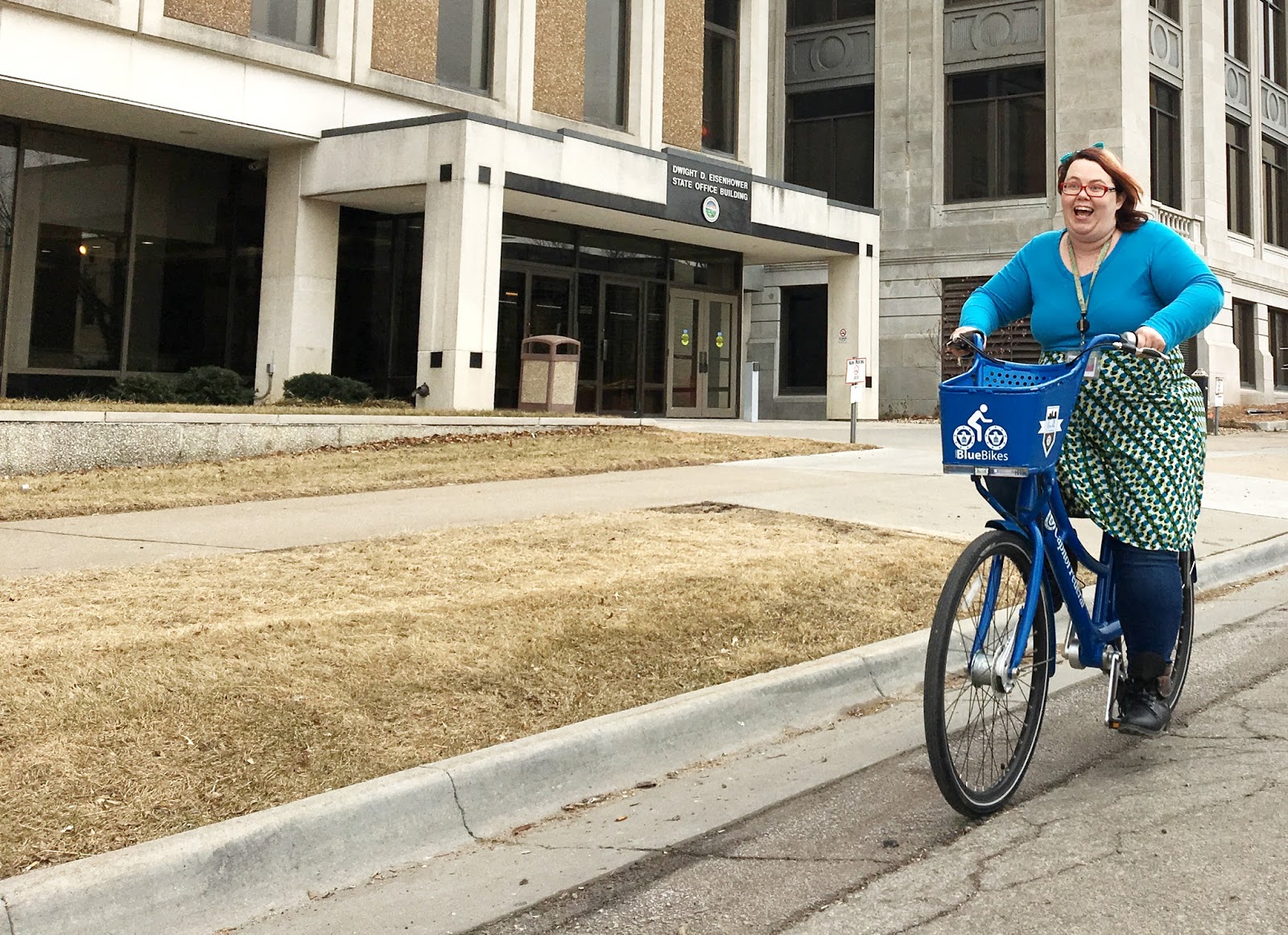
Mallory Goeke, a Communications Specialist for KDOT,
demonstrates how to check out a Metro Bike.
Topeka Metro Bikes has been awarded Transportation Alternatives (TA) funds to add over 200 bicycle parking spots and five bikeshare stations in Topeka.  The new stations and parking spots combined with a corporate sponsorship that increases the number of publicly available bikes in the program will make the city’s bike share program the largest among comparably sized metropolitan areas. 

“Walking and bicycling are important modes of travel for people of all ages and abilities throughout our state,” said Matthew Messina, bike and pedestrian coordinator for KDOT.  “By addressing these transportation needs, we help improve the quality of life for our communities by providing healthy and affordable forms of transportation that connect people to places of work, worship, education, public transit and recreation.”

Karl Fundenberger, Metro Bike director at the Topeka Metropolitan Transit Authority, said the funds will be used to help address the first mile-last mile gap for transit riders and provide infrastructure for a rapidly growing bike share program.

“Bike Share is thriving in Topeka,” Fundenberger said. “Biking provides additional mobility options, reduces traffic congestion and adds money to the local economy.”

The Transportation Alternatives (TA) Program provides funding for projects and programs defined as transportation alternatives that advance non-motorized transportation facilities.  Those federal dollars come directly to KDOT to be used specifically to assist in developing accessible transportation for those who can’t or choose not to use motorized transportation.

Mallory Goeke, a KDOT Communications Specialist, takes a spin on a Metro Bike. Topeka Metro Bikes was recently awarded a KDOT Transportation Alternatives grant to help expand biking as a transportation option in Topeka.
Topeka Metro Bikes has been working on helping biking grow as a transportation alternative in Topeka, starting in 2015 with 100 bikes available to rent and growing to 300 in 2018. 
“It’s going to get easier and easier to be able to choose to ride a bike in Topeka,” Fundenberger said.  “When more people choose alternative transportation, traffic flows smoother and more parking spaces are available.”

Both Messina and Fundenberger said addressing the equitability of transportation options is an important way to improve both the culture and the economy of the local area.
“By addressing the last mile barrier, the program helps contribute to the growth of our state by helping connect people to the rest of the city,” Messina said.

Fundenberger said the TA grant will be used in part to help fill in bikeshare gaps in eastern Topeka.  TA grant money will also be used to retrofit bus stops with racks to lock bikes and will add bike share stations as well as public bike racks in high-use areas. 

For more information on riding with Topeka Metro Bikes or to learn more about biking in Topeka, visit www.topekametrobikes.org or contact Karl Fundenberger at 785-730-8615.

Wednesday, November 29, 2017

Cranksgiving collects food for those in need

Earlier this month more than 20 bicyclists gathered to participate in Topeka's Cranksgiving event. 
Courtesy photo: Bike Topeka

The majority of holiday books, songs and movies have one message: It is better to give than to receive. Donating food to those in need is a great way to spread goodwill to others, especially during the holiday season.

That is just what happened recently in Kansas’ capital city. Last week in Topeka, more than 20 bicyclists of all ages took to the streets to spread holiday cheer. The cyclists collected more than 500 pounds of food during the city’s 5th Annual Cranksgiving.

More than 500 pounds of food was gathered during the
Cranksgiving event. Co
urtesy photo: Bike Topeka
 
Karl Fundenberger, an Cranksgiving event organizer for Topeka, said that the event is designed to be a Thanksgiving food drive powered by bicycles.

“It happens in communities all over the U.S.,” Fundenberger said. “All food was donated to the pantry at the Center for Safety and Empowerment at the YWCA of Northeast Kansas.”

Fundenberger said that the event is a perfect combination of recreation and transportation.

“It requires navigational skills, cargo-carrying skills, and quick thinking – and it shows riders how capable they are on just two wheels,”
Fundenberger said. “It also demonstrates to the community how effective bikes can be for transport of people and cargo and how important it is to provide bicycle facilities as a part of the transportation network.”

Andy Fry, another event organizer, said that Cranksgiving has another reason for existing.

“For participants, Cranksgiving also helps identify challenges in a population’s ability to find food in a human-powered perimeter and food desserts or a lack of food distribution points or resources in a community,” Fry said.

Fundenberger said that riders had 90 minutes to collect food items from eight different categories. To visit more stores, participants were only allowed to pick up two items per location. If they hoped to complete the list and win, they would need to visit four different stores.

A group ride and shopping trip, dubbed, “The Haul” took place simultaneously to the Cranksgiving event. The group rode together to local grocery stores and to some nearby donors’ homes to pick up more items.

“Some of the riders and teams in the competition were sponsored by friends and family, and The Haul ride was totally sponsored by donors,” Fundenberger said.  “Beyond cash sponsorship for groceries, prize sponsorships came from PT’s Coffee, Jerry’s Bike Shop, Capp’s Bike Shop, Kaw Valley Bicycle Club, Hazel Hill Chocolate, and others.”

Want to get involved next year? Contact any of the host organizations or send an inquiry to info@biketopeka.com or like the Bike Topeka page on Facebook.

For more information on how you can participate in Cranksgiving in your community, check out www.cranksgiving.com  


Monday, January 23, 2017

Is it a car or a bike? The answer is both

Move over, Fred Flinstone, moving your car with just your feet is so prehistoric. Why not use pedals instead?

As more and more people are trying to find alternative fuel and ways to get around, an interesting type of vehicle is starting to emerge onto our streets: The car and bike hybrid.

These vehicles come in a variety of shapes and designs. Some are fueled by the sun to run small motors to continue running when pedaling isn’t an option. A few models have batteries that can be recharged in a matter of hours. Early prototypes of other start up companies claim their version of a car/bike hybrid can also run on plants.

At their core however, these vehicles truly run on pedal power and could change how we get around in the near future. And for those who live in countries where vehicles aren’t accessible, this type of transportation could really make difference. Most of these vehicles are covered and protect the driver from the elements.

Check out these videos of some of these hybrids in action:


Do you see these vehicles taking off? Tell us what you think!  

Monday, September 12, 2016

Creative campaign encourages pedestrian/bike health, safety


Over the summer, Lawrence-Douglas Health Department  adopted a new and creative ad campaign to encourage healthy exercise and safety. Jenalea Myers, an employee at the LDC Health Department, describes the development of this ad campaign.

"Earlier this year, Community Health staff  at the Health Department came across the Travel with Care campaign, which is an initiative of People for Bikes," Myers said.

The Travel with Care campaign helped the LDC Health Department outline how the ads would look and they gave them suggestions on who should be featured and the messages the ads should send.


Myers said The Travel with Care campaign in Lawrence also coincides with the city's Be Active Safe Routes initiative.

"We decided it would be a great campaign to adopt locally because of the work being done around our Be Active Safe Routes initiative. We liked that the campaign not only encouraged pedestrian-bicycle safety but that it also highlighted everyday people who are cyclists, making it relatable and hopefully increasing the number of local residents cycling."


Pre-production of this campaign began earlier this spring with a local search for bikers to photograph. From there it only took two months for the ads to begin running in a variety of media.

"In April, we selected the local residents to be featured and hired a photographer to capture images of them with their bikes," Myers said. "From there, we created the ads based on template provided by People for Bikes. We began doing advertising in June, which has included print ads in the Lawrence Journal-World, Lawrence Magazine and Lawrence Kids Magazine and digital ads on the Journal-World’s website. We’re now in the process of placing ads on the University of Kansas buses. We also had posters printed that have been distributed around Lawrence in highly visible public places.


According to Myers, The Travel with Care Campaign has proven to be a success.

"The feedback has been great so far!" Myers said. "We’ve heard from many people who have seen the ads either in the newspaper, in a public place or on our social media pages. It’s been so great that we’ve considered doing an additional photo shoot in the near future to include some more cyclists!"


For more information about People with Bikes click here.
Want to learn more about what the City of Lawrence is doing to encourage safe bike routes? 
Click here