Showing posts with label Maintenance. Show all posts

Wednesday, September 11, 2019

5 insights into “big dance” of KDOT road-striping crew

A work truck, far left, passes the KDOT paint crew convoy near Pratt.
By Tim Potter,
Public Affairs Manager
South Central Kansas 
Kansas highways are striped with paint: yellow lines to guide motorists and to aid in preventing collisions, white lines to mark the road’s edge.

It takes skill and coordinated teamwork to put those lines down safely and neatly, with reflective paint that drivers can see in different conditions. As one Kansas Department of Transportation paint crew supervisor says of the work, “It’s a big dance.”

Here’s a look at how and why those lines get methodically painted, from a recent ride in the Pratt area with the KDOT District Five road-striping crew based in Hutchinson:


This KDOT paint crew truck has an attenuator on the back. The attenuator is a safety device designed to absorb impact. It’s like a gigantic rear bumper.


Insight No. 1:  Safety is a priority partly because the paint truck leading the slow-moving convoy of three crew trucks rolls only at about 8 mph when spraying the paint.

To help prevent faster-moving motorists from colliding with each other or with the KDOT trucks, the District Five crew positions three trucks so they work in concert and help shield one another.

A truck in the rear, driven by Christy DeSantis, Equipment Operator Trainee, carries a rear-facing digital display alerting traffic to the paint crew ahead. The rear truck also bears an impact-absorbing assembly called an attenuator. It’s essentially a gigantic rear bumper.

A few years ago, a semi going a highway speed crashed into an attenuator on a KDOT truck on U.S. 50 near Kinsley. The attenuator absorbed so much impact that everyone escaped serious injury, said Chris Craig, District Five Paint Crew Supervisor.
A second, middle truck also carries a rear-facing alert message and another attenuator. “I’ve had close calls where the truck’s almost been hit” from behind, said Allen Palmatier Sr., Equipment Operator Senior and driver of the middle truck.

The two rear trucks help protect the paint crew in the third, lead truck. All three trucks have flashing lights so other motorists can see them.

The idea is to allow vehicles to safely pass the paint convoy. The KDOT drivers keep enough distance between their trucks to allow a passing vehicle to pull in if needed -- but not so much distance as to encourage a line of cars to pull in between the trucks. Sometimes, the KDOT convoy pulls over if traffic becomes too congested.

Through radio headsets, the drivers of the three trucks alert each other to passing and approaching vehicles, whose drivers sometimes illegally pass on both sides, in no-passing zones and on right shoulders.


A sample of the reflective glass beads that are embedded in road stripe paint so traffic lines can be seen by motorists in different conditions.


Insight No. 2.: To be seen by motorists at night or in bad weather, the painted lines are designed to reflect back to motorists. So when the yellow or white paint gets sprayed down, it is embedded with tiny glass beads that are also applied by the truck. The beads give the paint its reflective quality, so it is visible at night and in bad weather.

Onboard-bead containers carry up to 36,000 pounds of beads.
The crew checks to make sure it’s sending out the right concentration of beads.

Palmatier periodically stops and gets out to measure the newly sprayed lines to make sure they are the correct width.

In one previous close call, while outside one of the trucks near Larned, Palmatier said, he had to leap into a ditch to escape. A semi going too fast stopped just inches from the back of his truck’s attenuator.


Insight No. 3: The striping work takes skill and coordination.
Chris Blume, one of the painters, sits in a glass-encased booth on the back of the paint truck. They call the booth “the doghouse.” From a chair on the right side, he peers down and from the side – on the white-line side -- and uses a steering wheel and other visual aids to put new paint and beads down over existing faded lines. The paint shoots and beads drop from carriages extending from both sides of the truck. It takes a practiced skill to be able start and stop the paint at the right instant, in the right configuration: double lines, single lines, curving lines, lines with gaps in between.

Using both hands, Blume flips switches on a control board to operate different paint guns. A black hose from a paint tank in front of the “doghouse” pulses with hydraulic pressure.

By headset, Blume communicates with Craig, the crew supervisor, known by the crew as “Corky.” Craig has been on a paint crew for 17 years. He monitors a screen to make sure he is driving the paint truck on a course to put the paint down right in line.

From the driver’s seat, Craig keeps Blume informed of the configuration of upcoming lines, so Blume will know how and when to apply the paint. Before the paint shoots out, “dusters” mounted on the truck blow away debris so the new paint will adhere. The new paint is noticeably brighter and more reflective.
The communication and coordination required is why Craig calls the work “the big dance.”


Insight No. 4: Sometimes, motorists mess up the fresh paint, and that can create more work for KDOT.

Normally, it takes about 10 minutes for the paint to dry enough for it not to be tracked by cars rolling over it. It takes hours more for it to cure.
Motorists can avoid getting fresh paint on their cars by watching out for paint crews or by avoiding passing.

During one pass over the highway, someone on the crew blurted out over the radio, “Screwing up our paint. … Thank you, buddy!” as a passing semi tracked through fresh paint.

“If they tear it up too much, we go back and redo it,” Craig said. Sometimes, KDOT will have to shut down a lane to grind off the mess. It’s not just about cleaning things up. Tires passing over fresh paint can remove the beads, and they have to be reapplied.


KDOT’s Allen Palmatier Sr. periodically checks to make sure the new painted lines are the correct width.


Insight No. 5: The painting goes on for months and sometimes at night, from around late April often into November and December. The paint can’t be applied if it’s wet, too cold or too windy.

Because of heavy traffic volume on certain highways in Newton or Wichita, the crew works at night. They use lights to illuminate their work.

“It’s like a Christmas tree at night,” Craig said.

Thursday, June 20, 2019

Mowing 101: How KDOT maintains Kansas roadways


KDOT maintains more than 150,000 acres of highway right of way across the state through mowing, weeding and land maintenance. 

Did you know that KDOT maintains more than 150,000 acres of highway right of way?
 As a result that means there is a lot of grass to mow, land to maintain and weeds to control.  Each year KDOT spends approximately $6.7 million on mowing efforts. There are a few situations that KDOT takes into consideration before mowing will take place:

Crews will mow at specific times during the year, but it will also be done as necessary for safety reasons. KDOT’s largest priority are visibility areas in and around intersections, signs and inside of curves.

As seen in recent weeks, mowing after periods of heavy, prolonged rain can make it difficult on equipment and can cause ruts in the land adjacent to highways. Mowing in these conditions can also damage equipment, which can take even longer to repair and get the area mowed. KDOT crews will mow areas when it is safe to do so.

KDOT's priorities are visibility areas in and around intersections, signs and inside of curves.


As summer continues, maintenance crews work hard to keep Kansas moving, please give them room to work.

In order to save time and give our crews more opportunities to fix roads and maintain areas that have a larger impact on traffic, KDOT may mow less frequently in underdeveloped areas. Mowing on steep slopes can be dangerous, and KDOT also limits the amount of times those areas are mowed as well.

There are many benefits for KDOT’s mowing policy and the amount of time and funds saved gives crews more time and resources to maintain highways and bridges. Farmers and adjacent landowners can harvest hay from the roadsides at no cost.  
In addition to all these situations,

As summer continues, KDOT maintenance crews are working hard to keep Kansas moving. Please give them room to do their job, whether its filling potholes, picking up litter or mowing the right of way.

You can find more information about KDOT’s mowing policies and permit information on our webpage:

Tuesday, June 4, 2019

Heavy rains, flooding impacts KDOT construction

May was one of the wettest months Kansas has seen in recent years. Some parts of the state saw more than 20 inches of rain — more than four times the average amount for some areas. 

Greg Schieber, KDOT Bureau Chief of Construction and Materials said that KDOT is currently working through the impact of severe weather on the 2019 construction season.

"Not only has the severe weather impacted the physical work that can be completed on a project, it is also impacting materials supply for projects including aggregate supply and binder supply," Shieber said.   "We are working with contractors now on prioritizing the projects that can be completed this construction season. KDOT also has initiated discussions on the potential of changing late start dates and delaying some projects until the 2020 construction season."


Estimated rainfall for the month of May. Source: NOAA 

Shieber said in some situations, the floodwaters are still too high to assess damages, putting construction projects farther behind. As reported last week, the Lewis and Clark Viaduct is one of those projects. 

Location at Kaw Point, where the Kansas River meets the Missouri River near the Lewis and Clark Viaduct. The Kansas river has pushed the flow of the Missouri river to the north.  

All this additional rainfall only exasperated several rivers that were already full because of heavy snow melt from states farther north. Highways in parts of the state have closed at times due to water covering the surface and that’s not the only problem. This much water has led to delays in maintenance repairs and construction projects across the state.

Joe Palic, KDOT Area Engineer in Marion, is dealing with delays on some construction projects. 

High waters caused K-177 to close between Strong City and Cottonwood Falls last month

“The flooding hasn’t been the issue, it’s been the heavy rains that have saturated the job sites and made it tough to work,” Palic said. 


Ashley Tammen, Public Affairs Manager for north central Kansas, also said that for each day of heavy rain means another day lost in highway work as crews work to clean up debris from flooding.

KDOT crews help clear water on K-140 in Saline County last month.


Ron Hall, District Engineer for southwest Kansas, said that weather can have an impact on construction season. “Some projects may take longer to complete, the planned start date for some projects may be delayed,” Hall said. “Schedules and tasks change due the impact of weather events.” 

Delays can also happen because KDOT crews and contractors must spend more time and resources cleaning up debris and tacked on mud on the roadways. 

After the flood waters recede debris can be left behind and KDOT crews work to clear the roads. 

“Pavement can sustain damage from floodwater,” Tom Hein, Public Affairs Manager for south central Kansas said. “Before a highway is reopened, it is checked for damage.” 

Hein also said that while there have been delays on smaller projects, for larger projects it is less of a problem. “It slows down work, but they’ll eventually catch up.”

Damage to K-7 in northeast Kansas from flooding earlier this spring. 


The heavy rains and flooding have also had an impact on normal maintenance activities across the state, like mowing the right of ways. 

Jeff Romine, Area Superintendent for Wamego, said that there are a couple of reasons why crews can’t mow when the ground is saturated.

Heavy rains help grass grow quickly, unfortunately, all the water received has caused the ground to become saturated, which can make mowing efforts difficult. 

“It is harder on the equipment when it is wet due to the equipment falling through muddy area,” Romine said.  “It also causes the mower to pull harder with the mower getting mud stuck between tires and frame of the machine. Mowing when wet leaves large ruts in the ground and then the grass dies, creating more work because we need to haul dirt in and do some landscaping.” 

Romine also added that if KDOT mowing equipment is damaged, it puts crews even farther behind.

Kansas is expected to receive even more rain this week. Please be patient as KDOT crews work when it is safe to do so. Please be aware of flooding risks and check Kandrive.org regularly for road conditions. Remember if you come across a flooded roadway — turn around, don’t drown. 


Wednesday, March 6, 2019

Concrete stitching helps preserve the driving surface

By Priscilla Peterson,
Public Affairs Manager, Southeast Kansas 

KDOT maintenance crews from Independence and Altoona recently took advantage of some mild winter days to perform a preservation activity called concrete stitching on sections of U.S. 400 in Montgomery County. 

The process is used to pin cracks in the driving pavement back together, preventing elevation and separation issues in concrete slabs.


To stitch the pavement, first a crew member measures the crack and paints locations that will be drilled at an angle to the crack. The painted spots are then drilled and cleaned.

Steel pins are placed alongside each drilled location, and epoxy is applied to each hole before the rebar pin is inserted.


Each pin is placed at a 35-degree angle to the crack and hammered into the hole.
Pin securely placed, more epoxy is applied and the hole is smoothed over.


The stitched section is now ready for crack sealing, as shown in a previously stitched and sealed location next to the work zone. And now, on to the next section! 

Tuesday, December 5, 2017

#KDOTTUESDAYS: New chemical storage building in Concordia

The new chemical storage building in Concordia features two bay doors on either side. 

Pictured above is the new chemical storage building at the Concordia Subarea office.

This isn’t the first chemical storage building in the State, but it is the largest and the first to have two bays with doors on either side.  This design came from the minds of James Roudybush, District Two Maintenance Engineer and Robert Fuller, Staff Engineer in the Bureau of Maintenance.  Most subareas around the State have a salt dome and one smaller chemical storage building.


When operational, this design will allow trucks to load from either side eliminating the need to scrape out old salt, sand, and other supplies from the back.  It will also allow different materials to be stored in the same bay.

Wednesday, August 30, 2017

Work Zone Wednesday: A closer look at maintenance efforts across the state

There are many unsung heroes that work along the side of the roads and behind the scenes to help maintain the highways. In today’s Work Zone Wednesday, we will look at a few ways KDOT maintenance crews work to keep Kansas moving.

Mowing
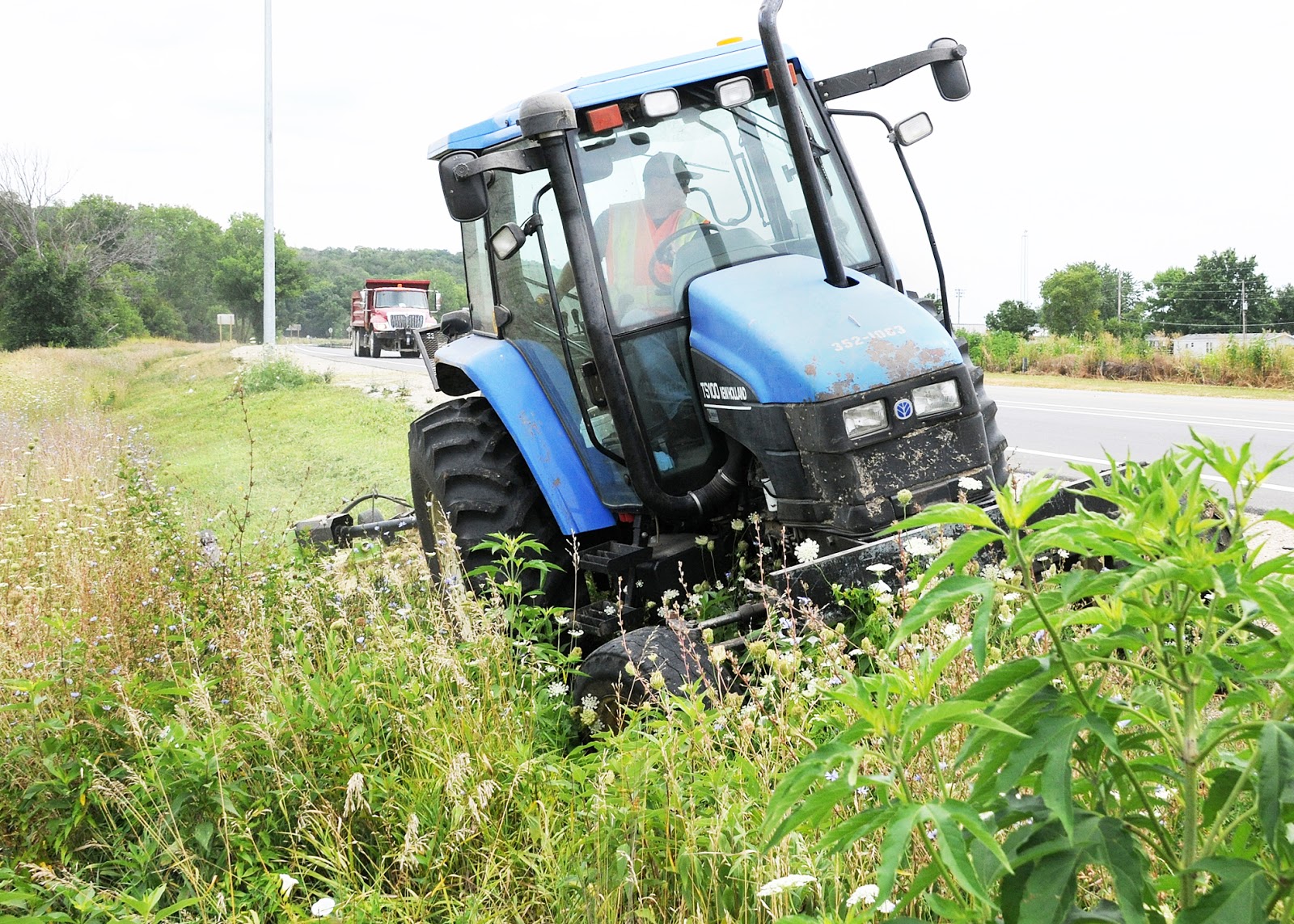
Troy Whitworth, KDOT’s Assistant to the Director of Operations, said one of the ways KDOT maintains the highways is by mowing any excessively tall grass and weedy areas around intersections, curve ramps and entrances. Mowing these areas helps to improve sight distance.  He said KDOT crews usually operate medium duty farm type tractors with brush hog mowers that have 10 feet or 15 feet mower decks.

Burke Richter, a KDOT Equipment Operatorr, mows grass along U.S 156 east of Garden City. 

Some grasses and plants that grow alongside Kansas highways are visually appealing and serve as natural habitat for wildlife. Because of this, KDOT has partnered with the Kansas Audubon Society to develop a mowing policy that accomplishes roadside management that is both beautiful and functional along our roadways.
David Shaw, a KDOT Equipment Operator, mows grass along the U.S. 50 bypass near Dodge City.

Painting
KDOT maintenance truck lays down fresh painted
lines along the highway
Whitworth said that painting lines on our highways provides traffic guidance and are important to let drivers know where they are while driving on the roadway.

“Painting pavement lines provides defined lanes for the traveling public to drive in,” Whitworth said. “By using the painted lines, you will know if you are driving on two-lane roadway with head-to-head traffic or a multi-lane highway where the traffic is all traveling the same direction. Without the pavement lines, you may not have a frame of reference for the roadway at times of low light, night time or during inclement weather.”

KDOT’s paint is embedded with reflective glass beads that cause light refraction, which makes the lines glow when headlights shine on them at night. The longevity of the reflective lines can vary and sometimes maintenance crews are dispatched to repaint the lines, especially after a bad winter. Snow plows can damage the pavement markings by scraping off the reflective beads while clearing the roadways.

Signing

KDOT Maintenance crews update a speed limit sign in this photo from 2011.

Whitworth said that there are three types of signs along the roadway: Regulatory, warning and guide signs. Regulatory signs alert drivers of the laws and regulations that are enforceable. Warning signs guide the driver when it comes to making important decisions on how to operate the vehicle. Guide signs provide the driver with navigational information.

KDOT signs are typically made of aluminum metal sheets and are cut or stamped out of the shape that is required for a specific sign, such as an octagonal stop sign.
KDOT crews install signs along state highways.

“The adhesive material that is applied to the aluminum shape may have a reflective quality to it and is pressed into the aluminum shape,” Whitworth said. “Typically, the sign shape has holes that are cut during the stamping process, which allows workers to mount the sign.”

There are times when a sign may need to be repaired or replaced.

“If the sign face is worn, faded or the reflective sheeting is damaged, we may need to replace the sign if it no longer serves its purpose,” Whitworth said.

KDOT maintenance workers face several challenges while working along the highways.
“Traffic and traffic control are some of the challenges of working on the roadway,” Whitworth said. “Traffic speeds and inattentive drivers can really cause issues during any work that is being done on or near the roadway. Our employees are also out in extreme conditions throughout the various seasons.”

Remember to slow down in work zones and always be aware of your surroundings. Never use your cell phone while driving and look out for highway workers.