Showing posts with label KHP. Show all posts

Tuesday, April 21, 2026

A challenge that could have cost him his life

Technical Trooper Phillip Metzen
I’m Technical Trooper Phillip Metzen with the Kansas Highway Patrol’s Troop I. On Dec. 1, 2025, after serving the state of Kansas for 11 years, I faced a new challenge within my career that almost cost me my life.

I responded to the scene of a non-injury crash on Highway K-96 in Wichita involving three motorists. Light snow was falling at the time, causing slick road conditions. I positioned my patrol car on the inside lane of the highway with my emergency lights activated to provide protection for the disabled vehicles involved in the crash. As I was relaying my location to dispatch, prior to exiting my vehicle, my patrol car was suddenly struck from behind.

I responded to the crash to help others, but within just nine seconds of stopping, I was the one who needed help.

The impact pushed my patrol car nearly 100 feet forward, despite it being in park. During the collision, my head struck the driver’s side visor and a mounted camera. I was then thrown back into the driver’s seat, which broke backwards, causing me to strike the pillar between the driver’s side doors.

The crash investigation revealed that the vehicle which struck my patrol car had failed to slow down and began sliding out of control several hundred feet back. The vehicle crossed three lanes of traffic before colliding with my patrol car.

As a result of the crash, I sustained multiple injuries, including a torn rotator cuff and labrum tear in my shoulder, which will affect me for the rest of my life. I am also still experiencing symptoms from the concussion I suffered and have ongoing medical appointments to aid recovery.

Working in law enforcement is dangerous, and I know the risks I face every day on the job. This was not the first time I’ve been struck by a motorist on the roadway; it was the third time since I began my career in 2015. If this crash had occurred just a few seconds later, I would have been outside of my patrol car, and I might not be here today to tell my story.

That is why I urge every driver to slow down when they see emergency lights ahead. It doesn’t matter if those lights belong to a police vehicle, a KDOT vehicle, an ambulance, a fire truck or a tow truck.

Life moves fast. Slow down so it doesn’t end too soon.


Monday, October 3, 2022

Three seconds and Move Over Law

Lt. Tanner Blakesley's car was struck at full highway speed, which was propelled into
another vehicle that struck Lt. Blakesley and seriously injured him. 

Lt. Tanner Blakesley

By Lt. Tanner Blakesley, K28

I was a road trooper in the Topeka area for two years when I woke up in a ditch. The driver of the vehicle we had stopped was standing over me, asking me if I was okay. I realized I had been hit by my patrol car after a passing vehicle struck the rear of my car at full highway speed. Since that day, I have become a strong enforcer of the "Move Over Law."

That January was the first day I was training a new trooper. We had stopped a vehicle on I-470 in Topeka, and it became necessary to have the occupants exit their vehicle. I exited the patrol vehicle to help the new trooper with this task. I approached the driver's side of the vehicle, got the driver out of his car, searched him, and escorted him into the ditch.

During this time, several cars had not moved over. I diverted my attention from traffic and towards the new trooper while he had the passenger exit the vehicle. The next thing I remember is waking up in the ditch. I did not know what had happened. I was able to put the parts of my broken memory together after seeing the video from my patrol car cameras and talking to individuals at the scene. There’s nothing like seeing video of yourself launched off your vehicle's windshield into the air.

Three seconds after walking between the stopped vehicle and my patrol car, another vehicle hit the rear of my patrol car. The impact of my patrol car being hit propelled it into the vehicle I had stopped. Unfortunately, I was hit by the corner of the patrol car and thrown into the ditch. Three seconds later and my life, along with the driver of the stopped vehicle, could have been very different. Most likely, we both would have died that day because of a careless driver not moving over for emergency workers on the side of the road.

After waking up, I didn’t know just how bad I had been hurt. The new trooper checked on me first and told me not to move. I could see the new trooper was taking control of the crash scene. Luckily, he had managed to dive over the guard rail and escape serious injury.

Even though I knew I was hurt, I had adrenaline pumping through my body and got myself up and went up the ditch to help. I quickly realized my injuries were serious; I had to sit down and wait for more help. It would be four months before I returned to work, but I know I was lucky to be alive and lucky to be able to even go back to work.

Vehicles must Move Over or Slow Down for emergency vehicles and work crews not just because it is what the law requires, but because when a vehicle does not, it doesn't allow time for those in the way to react and try to get out of harm’s way. It's easy to become complacent when every day you see many cars not moving over.

Three seconds on one cold January day could have ended differently for several people because of one individual's carelessness and disregard of the Move Over Law. 


Lt. Tanner Blakesley is with the Kansas Highway Patrol


Wednesday, August 14, 2019

Kansas Law Enforcement warns: Don’t drink and drive


Impaired drivers to be tested during “No Refusal Weekend”


Topeka, KS - As the summer season concludes over the next few weeks, Kansas law enforcement will be doing all they can to keep the roads safe from impaired drivers. Beginning on Aug. 14 and through the Labor Day weekend, more than 150 law enforcement agencies from across the state will join forces in a concentrated effort detecting and removing the impaired driver.

This year’s campaign includes a No Refusal Weekend, Aug. 16 – 17, when all suspected impaired drivers who refuse breath testing may be subject to blood testing for alcohol and/or drugs. This No Refusal Weekend, law enforcement officials may work in coordination with prosecutors to obtain blood draw warrants for drivers who refuse breath and/or drug testing. No Refusal programs help ensure that prosecutors obtain the scientific evidence needed to effectively prosecute cases involving impaired driving.

“My hope is there are no impaired driving crashes or fatalities in the state of Kansas,” said Kansas Highway Patrol Superintendent Herman Jones.  “Make the right decision, don’t get behind the wheel impaired. The impaired driver makes the choice to endanger themselves and everyone else on the road.”

According to the National Safety Council, 40 percent of car fatalities occur in the summer months. The Labor Day holiday brings increased traffic and unfortunately, a higher-than-normal number of deaths related to impaired drivers on the road. On average, impaired drivers cause about one-third of all traffic fatalities in Kansas. Across Kansas, impaired drivers injure or kill more than 2,200 people each year in car crashes.

“We want everyone’s summer to end on a high note and not in a senseless death that is 100 percent preventable,” said Chris Bortz, Kansas Department of Transportation Traffic Safety Program Manager. “Law enforcement will be vigilant in their efforts to keep everyone safe, but everyone has a personal responsibility in this effort; not just law enforcement.”

The 22-day enforcement campaign will be supported with statewide education and on-the-street vigilance by law enforcement.  This year’s campaign reinforces that no excuse is a good excuse for driving impaired. Designate before you celebrate, use a ride sharing service or get a ride from a sober friend are just a few ways to get home safely.

Impaired drivers can face jail time, suspension of their driving privileges, fines and other costs of up to $10,000. In addition, the offender will be required to install and pay monthly services fees on an ignition interlock. Beyond the financial and legal penalties, impaired drivers face the risk of losing their own lives or taking someone else’s.

Tuesday, July 2, 2019

Be prepared for Independence Day and summer travel


Summer travel is heating up across the country and many people will celebrate this holiday weekend by hitting the road and traveling to - and through - the Sunflower State. The Kansas Turnpike Authority and Kansas Highway Patrol and The Kansas Department of Transportation are partnering to remind motorists to travel safely during Independence Day, and throughout the rest of the summer.

From July 3 through July 5, KHP personnel will be working in support of the Combined Accident Reduction Effort (C.A.R.E.) enforcement, along with personnel from other states. C.A.R.E. focuses on occupant protection, impaired driving laws, and other crash-causing traffic violations. C.A.R.E.’s goal is increased safety and ease of travel on our nation’s roadways.

Being prepared for any summer travel is a big factor in keeping your trip running smoothly,” said Steve Hewitt, Kansas Turnpike Authority CEO. “For our travelers on the Turnpike, if you find yourself needing roadside assistance, our State Farm Safety Assist program is available in our busy corridors to help get you back up and running.”

Before travelers pack their cars, they can check their route for potential delays or construction with the help of KanDrive, www.kandrive.org. KanDrive includes camera images and interactive maps as well as links to rest areas and travel and tourism sites.

Smartphone users can access the site by going to www.kandrive.org and bookmarking it to your home screen so it’s ready when you need it. If users would prefer to use the text-based mobile website, it can be found at 511mm.ksdot.org.

Much of the same information can be accessed by calling 5-1-1 in Kansas or 1- 866-511-KDOT (5368) in the U.S. Before hitting the road, drivers and their passengers need to buckle up.

“Drivers need to set a good example by wearing their seat belts,” said Julie Lorenz, Kansas Secretary of Transportation.

Studies in Kansas show that if the driver is belted, about 95 percent of all other passengers in the vehicle are properly restrained.  If the driver is NOT belted, it’s only 25 percent of the other passengers.

“Seat belts save lives every day,” Lorenz said. "It is easy to do and could save your life.”

The agencies wish all of those traveling during the upcoming holiday, safe travels. If you are in need of help on a Kansas highway, you can call KHP for assistance at *47 (*HP) or *KTA (*582) for the Kansas Turnpike.

As you enjoy your summer travels and celebrate Independence Day, the agencies offer some tips to help you and your family have a blast:

  • It’s hot out there so make sure your vehicle is in proper working order for the heat of summer - check fluids, tires, the air conditioning and cooling system.
  • When you leave, start off with a full tank of gas and a fully charged phone.
  • Plan your route of travel and check www.kandrive.org for construction, and other issues with your travel plans. The site also has links to other states’ travel information. Also give a family member your travel plans. 
  • As you travel, remember to Move Over for first responders and highway maintenance crews. If you are unable to Move Over, then Slow Down.
  • In case of a break down, keep emergency supplies in your car, including bottles of water, a phone charger, and non-perishable food items.
  • Ensure everyone in your vehicle is using their seat belt and/or an appropriately-fitted child safety seat.
  • Arrange for a designated driver ahead of time if you’ll be consuming alcohol. Do not drink and drive.
  • If you’re hosting a party, have non-alcoholic drink alternatives available for designated drivers. 


Monday, May 20, 2019

Click It. Or Ticket. Law enforcement on the lookout for unrestrained drivers, passengers


TOPEKA, Kan. — Law enforcement agencies across Kansas will be taking a no-excuses approach to saving lives around this Memorial Day weekend. Tickets will be issued to unbuckled occupants as a harsh reminder of the importance of seat belt use at all times.

More than 50 percent of traffic fatalities in Kansas in 2017 were unrestrained. Many of these individuals could have survived the car crash if they had only worn their seat belt. That’s why law enforcement across the state is stepping up enforcement with the Click It. Or Ticket. campaign that runs May 20 through June 2.

“The Click it. Or ticket. campaign isn’t about issuing citations, it’s about saving lives,” said Technical Trooper Ben Gardner, of the Kansas Highway Patrol “Too many people die in motor vehicle crashes who could have survived if they had only buckled up.”

It is prohibited to drive or ride as a passenger in a motor vehicle without wearing a seat belt for a good reason. In 2017, 53 percent of the 316 deaths from automobile crashes in Kansas were not buckled. Pick-up truck drivers, young adults and males are among some of the worst offenders and most at-risk.

“Frustratingly, there are still people out there who do not take that extra second to buckle up,” said Chris Bortz, KDOT Traffic Safety Program Manager. “Any adult not wearing their seat belt could be issued a $30 traffic citation. Make a better decision and buckle up, every trip, every time.”

In 2018, the Kansas observed seat belt usage was 84 percent, below the national average of 90 percent, according to the National Highway Traffic Safety Administration.  Education coupled with enforcement can raise this rate and ultimately save lives.


Wednesday, April 17, 2019

It takes a brave person to do what they do: Move over for highway workers, law enforcement and emergency responders


By Ashley Tammen, 
North Central Kansas Public Affairs Manager

Earlier this week I had the privilege of going on a ride-along with Trooper Ben Gardner from the Kansas Highway Patrol. I was able to witness what highway workers, law enforcement and emergency personnel face every day while performing their job duties along the highways. I will say without hesitation - it takes a brave person to do what they do.

KHP Trooper Ben Gardner stops a motorist along
the side of the road. 
During our ride-along, Trooper Ben pulled over one motorist for speeding, but when he did, he stood only a few feet away from traveling vehicles. I witnessed a large tractor trailer fly by his left side on the Interstate as he was talking to the motorist through the driver’s side window. The semi must have been traveling at least 70 miles per hour and it did not slow down.

I could tell by Trooper Ben’s reaction that he has experienced this several times and was used to vehicles not moving over. When I told Trooper Ben that I couldn’t believe how close the semi was to him he just shrugged and said, “Yeah, I know.” He then got back in his patrol vehicle, buckled up and went on with his day.

Watching the semi skim by him was a scary feeling for me to watch. I can’t even begin to imagine what our troopers are feeling when they feel the momentum of a vehicle right next to them.

Last week was National Work Zone Awareness Week and numerous transportation-related agencies worked together to help raise awareness of the need for safety for those working along the highways. It was a focused time to promote work zone safety, but it needs to be a priority for motorists all year long. I saw firsthand what all the people who work along the highways see all too frequently – lives are on the line in work zones.

I stress and urge motorists to move over when they see a trooper or anyone on the side of the road. If you can’t get over right away, be patient and slow down so you can get over safely. Do your part while driving to keep our troopers safe because they work to keep us safe.


Tuesday, February 26, 2019

Seat belt enforcement now underway near area high schools


In 2018, nearly half of all Kansas teens who died in traffic crashes were not wearing a seat belt, that reflects a similar statistic of nearly 50 percent of all traffic deaths in Kansas were unbuckled. 

That's one of the many reasons why the Kansas Highway Patrol, area law enforcement agencies and agencies in both Missouri and Oklahoma will participate in the annual “High Visibility Seat Belt Enforcement Campaign” near area high schools. The enforcement campaign began yesterday and it will run through March 8. 

According to the National Highway Traffic Safety Administration, (NHTSA) seat belts have been proven to be one of the best ways to keep drivers and passengers safe in the case of a crash. 

This initiative is coupled with the Seat Belts Are for Everyone (SAFE) program in Kansas’ high schools. SAFE is a locally sustained program, administered by the students of the high school they attend.  The focus is on reducing deaths and injuries on Kansas roadways. Currently in Kansas, 168 high schools from 70 counties participate in the SAFE program. www.ktsro.org/safe


“Troopers will be working with local law enforcement partners in an aggressive education and enforcement campaign focused on the importance of seat belt usage,” said Colonel Mark Bruce, Superintendent of the KHP. “Seat belts have been proven to save lives and prevent injuries, and our goal is to make sure all young adults buckle up in all seating positions.” 

Everyone is reminded to buckle up. Every trip. Every time. 

Thursday, November 29, 2018

Car seat installation class could help save lives


By Lisa Knoll, Public Affairs Manager for southwest Kansas

Child passenger safety technician students use
their training to properly install car seats.  
According to Safe Kids Worldwide, more than 2,600 children under the age of 13 are involved in a car crash daily.  That’s one child every 33 seconds.  While most families put kids in car seats, the latest research from the National Highway Traffic Safety Administration (NHTSA) shows 59 percent of car seats are not installed correctly.  As the District Six Public Affairs Manager for KDOT, I am all too familiar with the statistics.  In addition, I live in a county with a child safety belt usage rate of 81 percent, which is well below the state’s average of 90 percent. 

Remembering the confusion and frustration I felt installing and adjusting my daughter’s car seat, I enrolled in a three-day CPS technician certification class to make a difference in the lives of children and families in southwest Kansas.

My class included professionals from health care, EMS, police departments, KDOT and private individuals.  Our instructors were career law enforcement officers with more than 30 years of experience installing car seats and certifying technicians.  We all had one thing in common — a desire to make our communities safer for the children and families we serve.     
The first two-and-a-half days were intense — we discussed injury prevention, crash dynamics and seat belt systems. We also learned about car seats and studied car seat and vehicle manuals.  Our class completed several practice scenarios given a child’s age, height, weight and special needs.  We picked out the correct car seat and installed it in a vehicle multiple times. The class was also given five different car seat installations, we identified what was incorrect about each installation. 

Child passenger safety technician students use 
their training to properly install car seats.  
By lunch on the third day, we were ready for the final test. We hosted a car seat check lane at the Kansas Highway Patrol parking lot in Garden City.  Our instructors warned us that car seat installation was a bit of puzzle, and you never knew what to expect.  They were right.  Three cars, three seats and three children were part of the challenge, and each of them had unique scenarios.   

The first installation was basic and straight forward.  A mother-to-be arrived with an infant seat still in the box.  She was going to be induced that night, so the check lane came at the perfect time for her.  Two of my classmates showed her how to correctly install the seat and check the installation for future reference.

The second car’s occupants were an older gentleman and a preschool-age child who was in a forward-facing booster seat.  Three of our classmates greeted them and noticed right away that the seat was not correctly installed.  My classmates attached and tightened the top rear tether of the car seat, which reduces the risk of head injury in a crash.  They explained this to the caregiver so that he could correctly install the seat in the future.   
Inside the third car was a mom and an infant.  The rear-facing seat was already installed in the mother’s car, she just wanted us to check it.  My classmates noticed the level on the seat’s reading was off, which meant the seat was not positioned correctly.  They removed the seat and tried to install it again, but the seat belt didn’t lock in place like it was supposed to. 

Child passenger technician student reads
a car's manual to better understand how to
properly install a car seat for that vehicle. 
On closer inspection, they found that both seat belts in the back seat were faulty and would not lock the seat in place, which could put the infant in danger if there was a crash.  The only option was to install the seat using the vehicle’s LATCH system in the center back seat.  With the seat installed in the correct position according to the seat’s level, they realized the seat was in an almost upright position which was not safe for the infant.  When it was determined the level must not be working, the instructors were called over. After it was decided that the level was indeed faulty, another seat was provided and my classmates helped the mother correctly install.

It was a dizzying three days filled with information, demonstrations and practice.  In the end, thanks to our instructors, we have 10 newly certified Child Passenger Safety Technicians in southwest Kansas ready to assist parents.

If you are interested in learning more about child passenger safety or becoming a certified technician, visit https://www.ktsro.org/child-passenger-safety.

Wednesday, May 9, 2018

Teens from across the state gather to learn about traffic safety


The Kansas Teen Transportation Safety Conference started out with a  video greeting from Trooper Ben Gardner and surprise guest, American actor Eric Stonestreet. Together, they welcomed a group of more than 200 high school students who attended the first day of the event in Topeka. The students are leaders of traffic safety programs at their schools.

Laykn Leigh, a sophomore from Ellsworth High School, said that the first day of the conference was very interesting.
"The conference was really eye-opening," Leigh said. "We plan on bringing a lot of information back to our school."
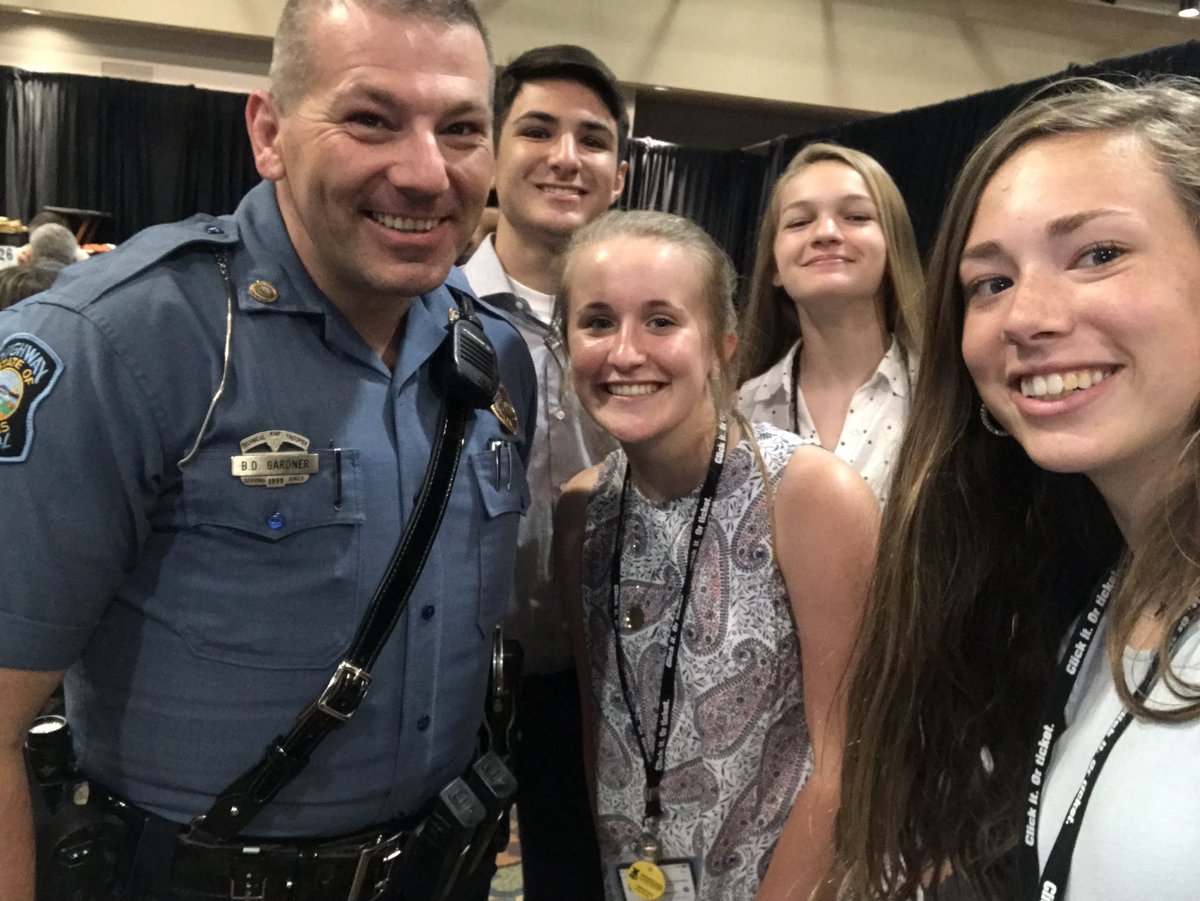
Students from Ellsworth High School snap a selfie with Trooper Ben Gardner. They were a few of the many students who attended the Teen Traffic Safety Conference in Topeka. (Courtesy photo)

The conference, which is sponsored by the Kansas Department of Transportation and AAA, is designed to share timely topics of interest to the transportation community. It is bringing students together to collaborate, develop their leadership and strengthen their communications and teamwork skills. Once they return home, they will then have the opportunity to educate their peers and communities about the importance of improving traffic safety behaviors.

Students from Goodland High traveled across the state to attend the first Kansas Teen Transportation Safety Conference. 
While at the event, traffic safety professionals and Kansas safety advocates will continue to have the opportunity to share with the students during interactive sessions. Scholarship opportunities from Stonestreet are being awarded during the conference. The event ends this afternoon. 


Monday, April 23, 2018

KDOT rides along with the Kansas Highway Patrol

KDOT took a ride with Master Trooper Neil Stanley on April 20 to teach others
about the importance of driving sober and to learn what its like to be a trooper. 
There is a popular saying that encourages others to walk a mile in someone else’s shoes, so you can understand what their world is like.  Last Friday, we decided to trade in shoes for a Kansas Highway Patrol vehicle when we got a chance to experience a day in the life of a Kansas Highway Patrol Trooper with Master Trooper Neil Stanley. 

Our goal was to ride along at the beginning of the drugged driving enforcement and tweet about our experiences as they happened. One of the biggest messages that Stanley hopes people will understand is impaired driving isn’t just limited to alcohol. He said if there is any substance being used that can impair your driving, it is something that could result in an arrest and have a license revoked.

While on the ride, Stanley explained how KHP officers rely on both their observation skills and radar technology to determine how fast drivers are going.  While a few of the stops were to enforce the speed limit, there were several instances where Stanley was able help stranded and lost drivers.

As we rode along, it was obvious that there is still a lot of work to be done when it comes to encouraging drivers to slow down and move over when emergency vehicles and highway crews are on the side of the road.
Graphic of a KHP vehicle crash last year.  Give them room

During a stop where Stanley was assisting a person towing a boat, vehicles whizzed by at high speeds. Stanley said he wants the public to understand that when you are going that fast you have less time to react if something unexpected happens. He gave an example of a highway worker who trips into the road. If someone is going faster than the speed limit, people can get hurt.  

While we didn’t encounter any drugged driving during our short ride, we had the opportunity to see and feel what it is like sitting in the front seat of a patrol vehicle. The life of law enforcement officers, emergency responders or highway workers can be challenging. They need to be ready for the unexpected at any moment.

The next time you are out on the road and you see a Highway Patrol Trooper don’t overreact, just drive normally, slow down and give them room to work. And if you ever get the chance, be sure to thank them for what they do. Just like highway workers, their job can be dangerous and at the end of the day they also want to see their loved ones.
KDOT and the KHP will ride together again next month, stay tuned on our twitter page: www.twitter.com/KDOTHQ


Tuesday, July 11, 2017

Emergencies happen: How to stay safe on the side of the road


During these busy summer months, you may encounter a stranded motorist on the side on the road or experience a disabled vehicle yourself. Blown tires and engine troubles are a fact of life while traveling. If you find yourself in either of these situations, the Kansas Highway Patrol has some tips to keep you safe.

If you experience a road side emergency and need to pull over do the following:

• Park your vehicle as far off the busy roadway as possible.

• Turn on your four-way emergency flashers (hazard lights).

• Stay in your vehicle until help arrives, especially at night or in inclement weather.

• If someone stops, crack your window and ask them to phone the police for assistance.

• If you must leave your vehicle along the highway, notify the police, sheriff or KHP of its location and the circumstances.

Remember, one of the best ways to prevent a roadside emergency is to maintain up-to-date maintenance on your vehicle.

What to do if you see someone who has a disabled car on the side of the road.

According to KHP, your personal safety is of utmost importance. If you see a stranded motorist on the roadside, do not stop your vehicle.

Instead, it is recommended that you call the KHP, or if you are traveling on the Kansas Turnpike, the Kansas Turnpike Authority and explain to them where you saw the stranded motorist. Here are the numbers below:

*47 to reach the Kansas Highway Patrol
*KTA (582) while on the Kansas Turnpike

If you don’t have a phone, proceed to the next gas station or rest area to reach the numbers above.

Remember:
If the vehicle’s emergency flashers are on, give them room. Slow down or move over if you can to avoid injuring the motorist or crashing into their stalled vehicle.

Visit the KHP’s Motor Assist Program to learn more about staying safe in a roadside emergency.

Want to know if your travel plans will be impacted by a crash or highway construction? Visit Kandrive.org for Kansas Highway Conditions.

Share your roadside emergency stories with us in the comments. How did you stay safe?


Thursday, January 26, 2017

Give them room: Roadside crashes are preventable

The lights are flashing and the sirens are wailing. Whether it’s an emergency vehicle, law enforcement car or a KDOT employee, your response should always be the same. Move over and give them room.

Earlier this week, two crashes involving Kansas Highway Patrol vehicles and officers occurred on two different days and in two different areas.  Both incidents required temporary road closures for clean-up and investigations.

“Anytime one of these events occurs it hits home pretty hard,” Stephen La Row, a KHP Technical Trooper, said. “It’s an eye opening experience for everyone involved and for anyone that works on the side of the road for that matter.”

La Row said that while these crashes are not an uncommon occurrence, they can be prevented.

“What (motorists) should be doing is paying attention to the task at hand,” La Row said.
“And that should be driving.  We can minimize our distractions such as cell phones and other electronic devices that are needless when driving a car.” 

Steve Baalman, a KDOT Area Four Engineer in Topeka, said that because of our connected society and the need for some people to use their cell phones at all times has made it noticeably scarier in work zones.

“We too often see folks with their faces buried in their cell phones,” Baalman said. “Obviously with the texting, it’s very spooky for us and it’s very unsafe.”

Both KHP and KDOT have experienced tragedy when workers were killed when working along the highways.

“The last trooper killed in the line of duty was doing a roadside inspection,” La Row said.

 “We are looking out for all our roadside workers. We all want to do our jobs and we want to do them safely. We want to be able to go home.”


“My goal is that all of the employees who work with me and work for me go home at the end of the day.” Baalman said. “I did lose one of my employees last year on U.S.  24. And although it wasn’t  work-related, it still hurt. It wasn’t the first time. I lost one of our EO Specialists on an accident on K-10. And both incidents were caused by inattentive cross over accidents. It hurts.  Every time I drive over certain sections of K-10, I remember that one of my guys lost his life there and so did his wife and baby daughter; on Father’s Day no less.”

Baalman said that despite the risks, working along the highways is worth it.

“The work keeps us coming back,” Baalman said. “I presume most folks are like me. We like the work, the service and the sense of accomplishment.  It makes it worthwhile for those folks who are driving it every day.”

Kansas enacted the Move Over Law in 2006.

“The fines are very steep as well they should be,” La Row said. “The law states that you have to move over and if traffic doesn’t allow you to, then the minimum you should do is slow down. That just keeps all our roadside workers safe.”

Thursday, August 18, 2016

Drinking and driving? Not a good choice

Janell Blaufuss is often reminded of other people’s choices.

It was her father’s choice to go jogging early in the morning before heading to work. It was a driver’s choice to drink and drive. The two choices came together when a drunk driver hit and killed John Blaufuss in December 2005.  

“No Christmas has ever been the same,” Blaufuss said. “We were such a big, happy family who loved to get together. No one had more fun than my father. There are so many places that he is missing.”

Blaufuss spoke at a press event today announcing, “You drink. You drive. You lose.” enforcement campaign at Exploration Place in Wichita. Beginning today, through Monday, Sept. 5, drivers can expect an increase of law enforcement efforts looking for impaired drivers.

A display car, designed to warn against driving under the influence is parked at the Exploration Place in Wichita during a press event announcing the law enforcement campaign, “You Drink. You Drive. You Lose.” 

The Wichita Police Department is one of 150 law enforcement agencies that have partnered with the Kansas Department of Transportation to crack down on impaired drivers.

“Drunk driving in Kansas is one of the deadliest and most often committed crimes,” said Deputy Chief Gavin Seiler of the Wichita Police. “Law enforcement is highly-trained to identify impaired drivers and we will be out in full force to stop them. The safety of Kansans is our primary concern.”

Last year in Kansas, there were 2,291 alcohol-related crashes, with 75 fatalities and 1,300 injuries.


“Driving under the influence is more common than we care to admit,” Kansas DUI Impact Center Executive Director Andrie Krahl said. “It affects everyone on the road. It’s important to plan ahead for a safe ride home. Our judgement is not accurate when we are impaired and negatively impacts our ability to make decisions.”

Friday, January 31, 2014

Five for Friday with Lt. Josh Kellerman


Talking SAFE DRIVING, RECORD-LOW FATALITIES, DRIVER BEHAVIOR

 
Today’s Five- for- Friday feature is with Lt. Josh Kellerman of the Kansas Highway Patrol. Lt. Kellerman has been with the Patrol since 2003 and currently serves as Public Information Officer.  An all-time low for fatalities on Kansas roads was reached in 2013 so we thought that was a good reason to talk about driver behavior with an expert.
  
1. What do you think is the single-most significant factor contributing to the drop in fatalities in 2013?
I believe the strict enforcement efforts from our statewide law enforcement agencies and the continued dedication to traffic safety by KDOT has played a huge contributing factor in the drop in fatalities. Through programs such as Click It or Ticket, law enforcement is provided that extra ability to be more present on our great Kansas roadways, arguably the best in the entire nation.

2. Will we ever get to zero fatalities? 
Through enhancements in vehicle safety, strict enforcement of highway laws by our LEO’s, and the continued traffic safety efforts of KDOT, I will always believe that is a possibility.  I know the Kansas Highway Patrol and all law enforcement agencies will continue to work in partnership with KDOT to make this a reality.


3. How does working a fatal crash affect you as a first responder?
Effects of a fatal crash can be found immediately as you begin to piece together your investigation.  In many cases, these effects will stay with you your entire career.  While at a fatality scene, there is so much information to gather as well as protocols to follow to complete a thorough investigation.  While doing all of this, you must also comprehend the loss of life and the absolute respect the deceased and their family deserve.  You could speak with any trooper and he will tell you the hardest part of our job is notifying a family of a death.  We obviously receive training on notifications, but no training prepares you for the pure emotion of that notification.
 
4. How do you know when someone is driving distractedly?
These days there are so many different distractions that are present.  Whether it be the GPS, radio, telephone, eating, or drinking, they are present in all our daily lives.  In many cases, vehicles weave within their lane of traffic and many times leave the lane of traffic entirely.  Often times, drivers are so distracted they do not even see us beside or behind them even when our emergency equipment is activated. 

5. What’s the craziest excuse you’ve heard from someone trying to get out of a ticket? 
I stopped a young lady early in my career for driving 75 mph in a 45 mph zone.  Upon identifying myself, she stated that she was heading to the hospital to see her mother.  While speaking with her I could smell an extremely strong odor of alcohol coming from her.  She was subsequently arrested for driving under the influence of alcohol.  Her blood alcohol content was more than three times the legal limit.  She later advised that her mother was not in the hospital and that she thought I would just let her go if she cried and told me that story.  

Five for Friday is an ongoing series featuring notable transportation figures.  If there is someone you would like to see featured, please recommend him or her in the comment box below.